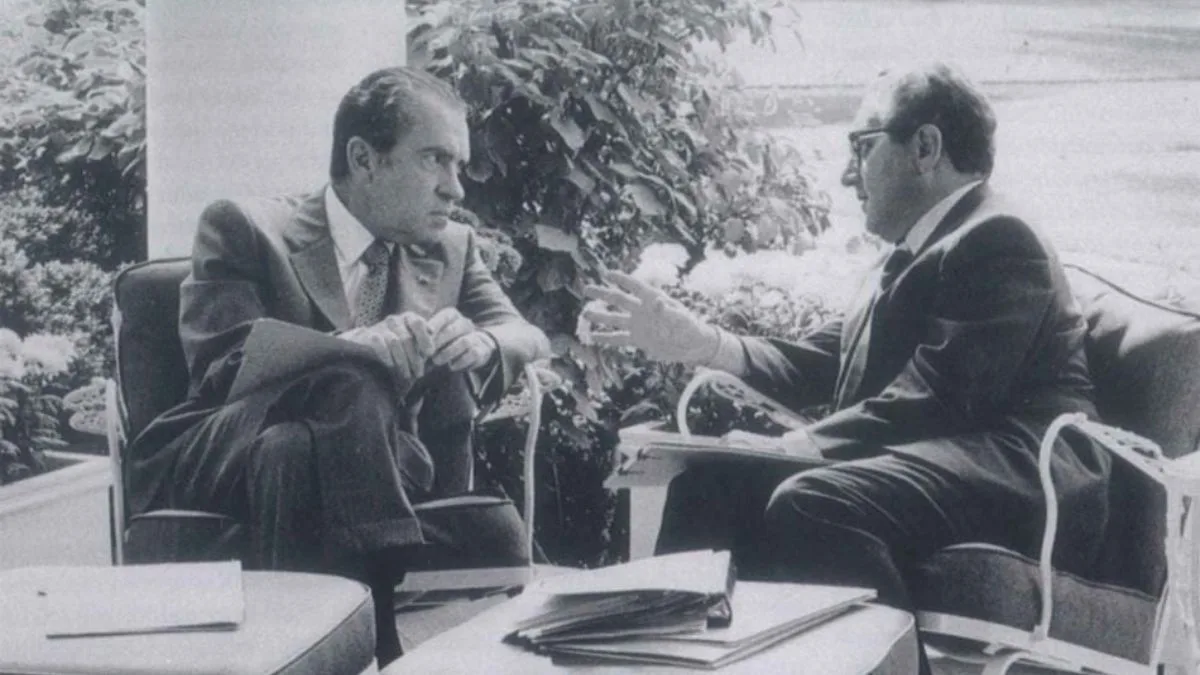
On this day, 54 years ago, when Indian Air Force flew across the border to attack Pakistan’s bases after a pre-emptive strike by PAF’s F-86 Sabrejets and F-104 Starfighters on India, US President Richard Nixon and his National Security Advisor Henry Kissinger were huddled over the telephone discussing the beginning of the 1971 India- Pakistan war.
As Kissinger told President Nixon that “it appears West Pakistan has attacked (India) because situation in East is collapsing”, the latter exploded and told his principal aide, “Pakistan thing makes your heart sick. For them to be done so by the Indians and after we have warned the bi**** (Indian Prime Minister Indira Gandhi) …”
Advertisement
The conversation at 10.45 am Washington time was dutifully recorded and released as part of historical documents for the period by the State Department many decades later.
Before India counter-attacked, Pakistan Air Force launched what it called Operation Chengis and bombed eleven Indian Air Force bases, including Srinagar, Amritsar and Pathankhot, but did not cause much damage as India had already moved its air assets to forward secret locations. While Pakistan troops advanced into India across the cease-fire line in Kashmir.
In response, the IAF launched a massive retaliatory raid on Pakistani airfields at Chaklala, Murid, Sargodha, Chandar, Risalewala, Rafiqui, Masroor and Shorkot.
Kissinger also told Nixon, that the US must approach the UN Security Council to stop the retaliatory war by India. “State (Department) believes and I agree that we should take it to the Security Council once actions are confirmed. If a major war (develops) without going to the Security Council it would be a confession of poverty.”
President Nixon wanted to know who would object. Kissinger “India and Soviet union … no one else.” In the event many other countries rallied to India’s cause at the United Nations and against the genocide that the Pakistan Army perpetuated in Bangladesh before it was liberated by the joint forces of India and Mukti Bahini after a punishing 14-day lightning war.
Two days before the war started, the then US Ambassador Kenneth Keating called on Indira Gandhi to deliver a message from Nixon asking India to stop mobilisation on the borders, the papers released revealed.
The Indian Prime Minister made it clear that “Pakistan had been the first to move its troops to the border and no one had asked them to withdraw.”
She made it clear that Pakistan’s dictator Gen Yahya Khanʼs problems had been self-created and “we are not in a position to make this easier for him.” She pointed out that India was being asked to allow the misdeeds of Gen Yahya to stand and “we are not going to allow that.”
When Keating observed that her position was “very firm”, the prime minister replied that it was “a little harder” than it had been before and went on to say that her patience had worn thin. She did not know how she could tell the Indian nation that it must continue to be patient and added, “I canʼt hold it.”
Keating started to comment about the recent alleged Indian military incursions, she cut him off by saying, “We canʼt afford to listen to advice which weakens us.”
In a message sent to Washington the same day, the US Ambassador made it clear, “There seems to be no give in this position and probably little bluff. There is no evidence that she is wavering from pursuit of Indiaʼs interests as she sees them.”