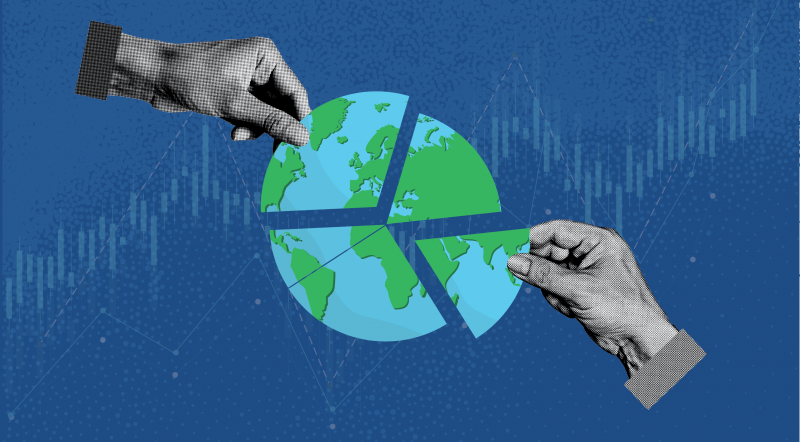
The global economy is undergoing a profound transformation driven not by traditional market forces, but by the resurgence of great-power rivalry. Over the past decade, competition between major geopolitical actors – primarily the United States, China, the European Union, and a rising constellation of middle powers – has reshaped the world’s supply chains, investment flows, energy routes, and technological standards. What was once a largely integrated, efficiency-driven global system is now fragmenting into politically shaped blocs, each seeking security, resilience, and strategic advantage.
At the heart of this shift lies the accelerating US–China rivalry. Washington has tightened export controls on advanced technologies such as semiconductors, artificial intelligence hardware, and high-performance computing, aiming to slow China’s technological rise. Beijing, in response, has doubled down on self-reliance, expanding its domestic manufacturing capacity in chips, batteries, electric vehicles, rare-earth elements, and green technologies. The result is a parallel race to build secure and politically loyal supply chains, even at the expense of higher costs. Efficiency has given way to resilience, and globalisation is being redefined through the lens of national security.
This geopolitical turn is most visible in the energy transition. As countries race to meet climate targets, control over critical minerals – lithium, copper, cobalt, nickel, and rare earths – has become a major strategic priority. China currently dominates processing capacity for many of these resources, prompting the United States, Europe, Japan, South Korea, and India to search for alternative suppliers. This has created new opportunities for resource-rich countries such as Australia, Chile, Indonesia, Kazakhstan, and several African states. It has also strengthened the strategic importance of transit countries and corridors, such as Azerbaijan’s Middle Corridor, which link production regions in Central Asia to European markets without passing through Russia or Iran.
Middle powers are increasingly shaping this new geopolitical economy. Countries like Türkiye, India, Saudi Arabia, South Korea, the United Arab Emirates, Vietnam, and Brazil are leveraging their geographies, demographic advantages, innovation ecosystems, and diplomatic flexibility to balance between the United States and China. Their goal is not to choose sides, but to maximise economic benefits while maintaining strategic autonomy. This trend marks the rise of “multi-alignment” as a dominant strategy in global politics. The world is no longer split neatly into two ideological blocs; instead, it is forming a fluid mosaic of partnerships, rivalries, and overlapping economic spheres.
Europe faces unique challenges in this environment. The continent is highly dependent on imports of energy, critical minerals, and technology components. Russia’s invasion of Ukraine exposed Europe’s vulnerability to politically risky dependencies, especially in gas supply. As a result, European policymakers have intensified efforts to diversify supply chains, strengthen green industrial production, and build new trade corridors. Initiatives such as the EU’s Global Gateway, the Critical Raw Materials Act, and the reconfiguration of trade ties with Central Asia reflect Europe’s desire to reduce exposure to both Russia and China. Yet Europe must navigate this transition carefully: cutting economic ties too quickly could damage its industries, while failing to adapt could leave it strategically exposed.
Technology adds another layer of complexity. Digital infrastructure, cloud computing, 5G/6G networks, data governance, and AI standards are emerging as new arenas of geopolitical competition. Countries are increasingly adopting national or regional frameworks that reflect their political values, security priorities, and economic interests. The result is the gradual fragmentation of the digital world into distinct regulatory zones. The US promotes open, market-driven innovation; China advances a state-supervised model with strict data sovereignty; Europe champions a rights-based regulatory approach. As these models compete, businesses must navigate a landscape in which data cannot flow freely across borders and where compliance is becoming as important as innovation.
Sanctions and economic coercion further complicate global trade. The United States and the EU frequently deploy sanctions as tools of foreign policy, targeting Russia, Iran, and other actors. China has also introduced counter-sanctions and economic pressure mechanisms. This expanding “weaponisation of interdependence” means that companies are increasingly caught in geopolitical tensions, forced to adjust operations or relocate production to politically safe jurisdictions.
Despite these challenges, the new geopolitical economy also creates opportunities. Nations that can position themselves as stable, strategically located, and economically open stand to gain. Countries along key transit corridors, such as the Middle Corridor linking Central Asia to Europe, are emerging as vital connectors in a world seeking secure alternatives. Similarly, states that invest early in green technologies, logistics infrastructure, and digital innovation can attract new industries reshaping global commerce.
Ultimately, the restructuring of global supply chains marks the beginning of a more fragmented, competitive, and strategically charged era. The new geopolitical economy will not be shaped by trade alone, but by security imperatives, political alignments, and the ability of states to adapt to a world where economic power is inseparable from geopolitical influence. Nations that recognise this shift and position themselves accordingly will define the contours of the next global order.