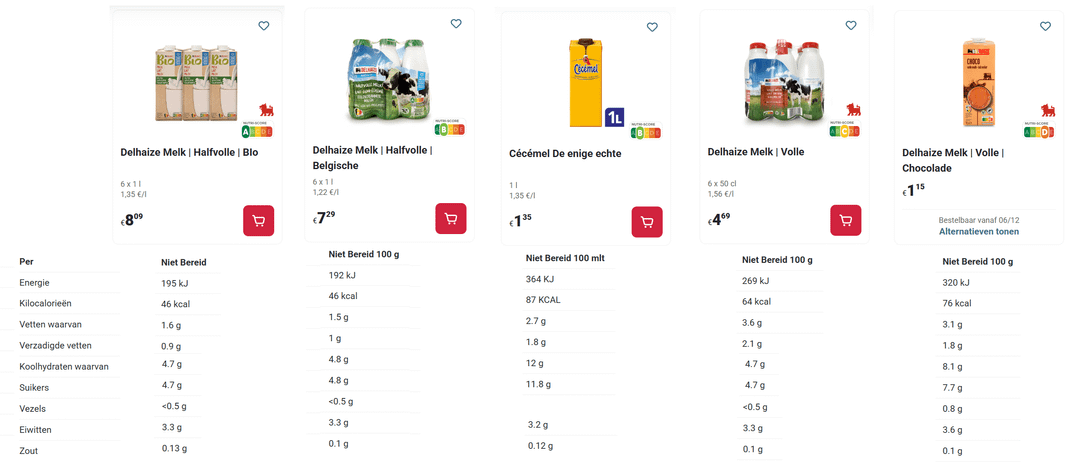
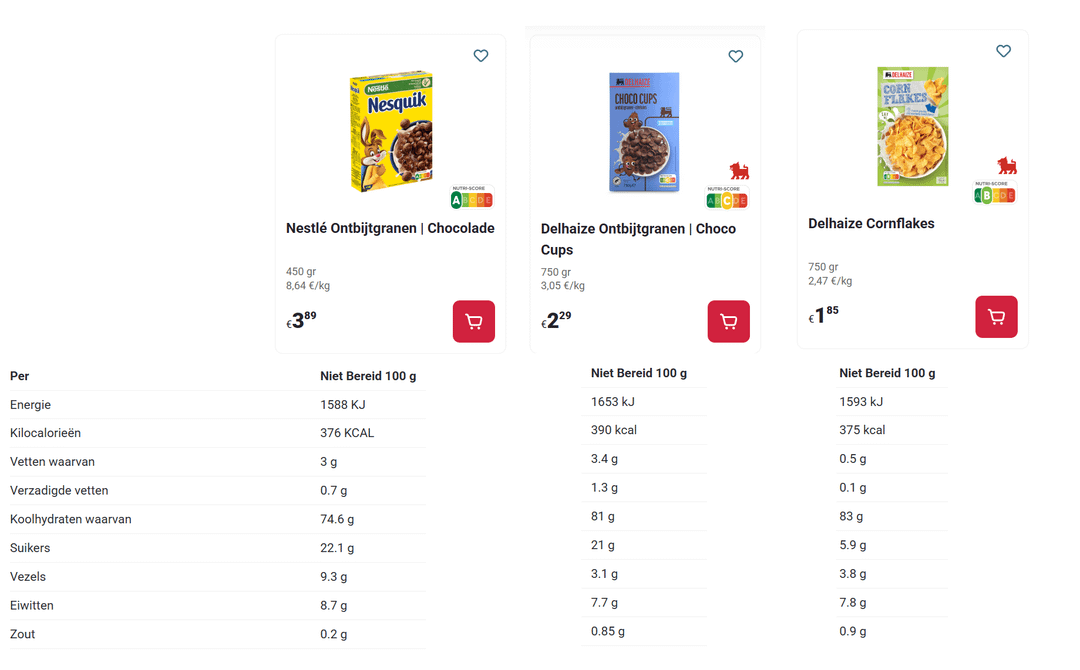
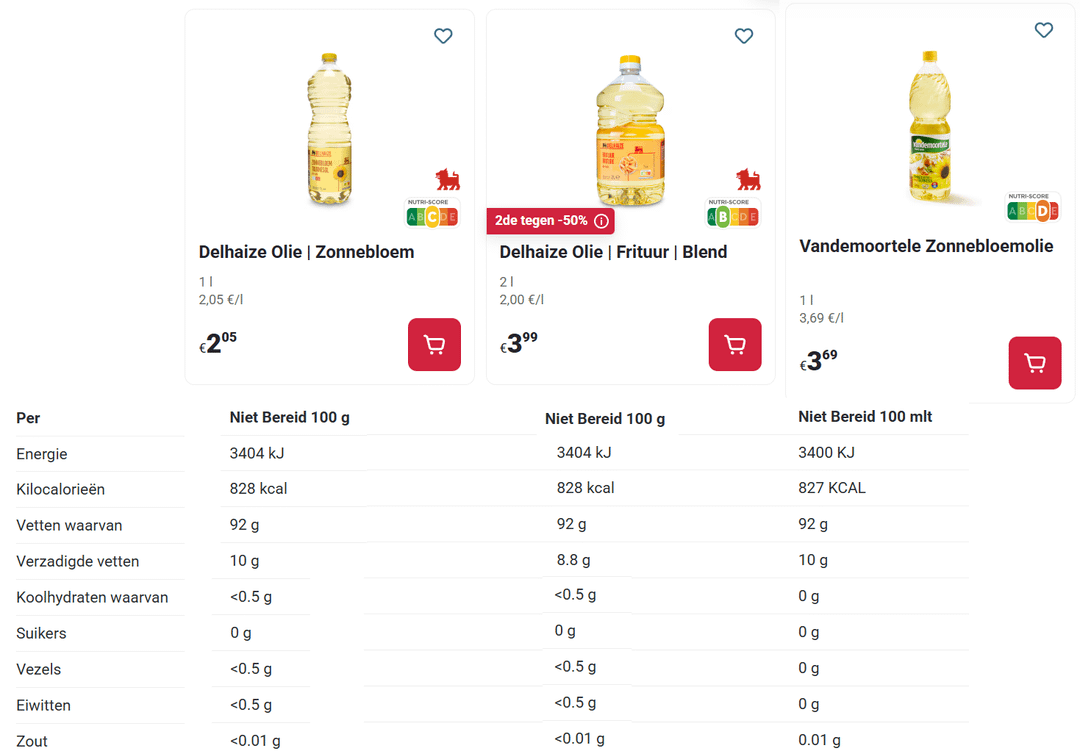
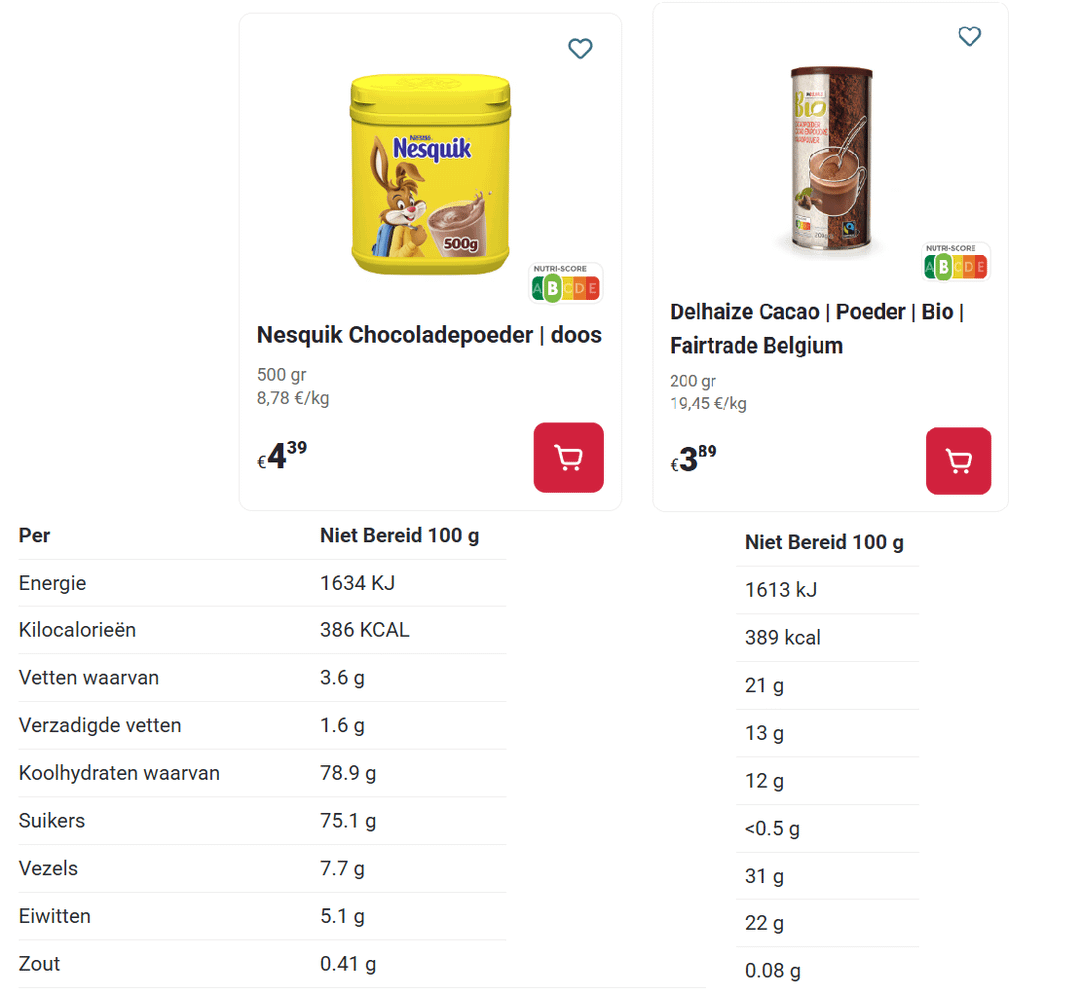
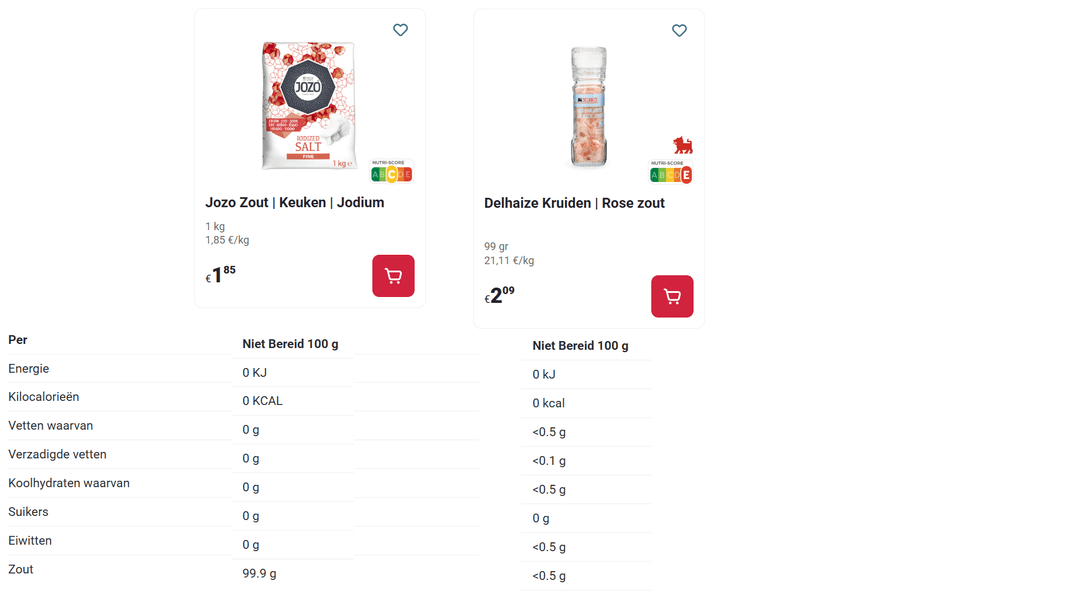
I often hear people say it is meant to compare products across the same category. That is not true, because all food is calculated the same way. Also, it is still complete nonsense as you can see here.
by 123964
I often hear people say it is meant to compare products across the same category. That is not true, because all food is calculated the same way. Also, it is still complete nonsense as you can see here.
by 123964
42 comments
at this point it must be paid off and the bio industry also pays them to “healthwash” it
The only thing I’m getting from this is: I should scam people with diet consulting, seems like a branch where bullshitting others is encouraged
ah echt? da wisten we nog nie.
wie kijkt daar ook naar? ik alleen naar de ingredienten en de suikers en vezels eigenlijk ¯\_(ツ)_/¯
I have seen two literally identical products but in different size packages have different nutriscores.
Their nutritional value was exactly the same in both, the portion sizes were exactly the same in both, but the score differed from B to C.
Completely pointless.
it IS ment to compare across the same category, but there’s only like 5 categories in total.
That being said. the nutriscore calculation was completely revised a while back, chances are some of these products are still using the old categories instead of the new, making everything extra confusing…
I’ve literally had multiple products of the same brand & packaging with different labels, because some were manufactured before the revised category and some were manufactured after.
I took these pictures in aldi last week:
https://imgur.com/a/DBu4KAS
Cecemel and aldi brand are exactly the same except cecemel has 1g/100ml more sugar and thus a little more kcal/100ml. But cecemel is B and aldi brand is E
I honestly started thinking it’s just that you pay for better nutri score
Nutri score is determined by comparison between products of the same category, which it doesn’t disclose.
So the “healthiest” microwave pizza will have a higher nutri score than the least healthy salad.
Worth at least analyzing how they got to those scores and how the system works? It’s explained here:
[https://en.wikipedia.org/wiki/Nutri-Score](https://en.wikipedia.org/wiki/Nutri-Score)
It’s important to note that, for example for the cereals, the additional fibre of the left most cereal seems to give it its higher score than the other two..
Definitely not saying the way this works is perfect but it’s interesting to at least understand what the system promotes (fibers, proteins) and wants to discourage (added sugars/fats),
Yall know nutriscores can change right? A friend of mine works in a candy factory where the same product just went from D to E (no, he’s not Willie Wonka).
Can you please explain to me why exactly you think it’s complete nonsense, based on your examples. I don’t know what I should be looking at.
I have never looked at the Nutriscore when buying something. I see it as a marketing trick with no real value.
Chocolate milk and milk aren’t the same product bro.
It’s not a tool that measure just the calories and macronutrient but also the quality of the ingredient itself.
You can have identic macronutrient but maybe one ingredient is better than another and that’s what change the note
I don’t understand what the system is supposed to tell me. Say I pick up a pack of smoked salmon and its score is D. Should I:
– look for other smoked salmon that scores better?
– eat a different fish because salmon is bad?
– eat non-smoked salmon because smoking is bad?
– eat meat instead of fish?
– eat less fish and more of something else?
It’s one of these great ideas with a terrible implementation making it completely worthless
[https://auvio.rtbf.be/media/investigation-investigation-3395373](https://auvio.rtbf.be/media/investigation-investigation-3395373)
Nutri-Score, sabotage au menu, une enquête de Tristan Godaert C’est un logo simple devenu familier dans le quotidien de nombreux Belges. Outil de santé publique destiné à guider les consommateurs vers une alimentation plus équilibrée, le Nutri-Score semble anodin. Pourtant, il est au cœur d’une véritable guerre au sein de l’Union européenne. #Investigation révèle comment l’industrie agroalimentaire – mais aussi certains États, l’Italie en tête – déploient toutes les stratégies possibles pour affaiblir, décrédibiliser et retarder la généralisation de l’utilisation du Nutri-Score. Lobbying intense, campagnes de désinformation, pressions politiques : tous les moyens sont bons pour torpiller ce logo qui, selon de nombreux scientifiques, pourrait contribuer à lutter contre des problèmes de santé publique majeurs tels que le surpoids et l’obésité.
NDLR : Cette enquête a été modifiée depuis sa première diffusion le 22 octobre. A 15 minutes 15 secondes, le calculateur de Testachats attribuait un Nutri-Score « E » au produit Actimel Kids de Danone. Alors que selon Danone et le SPF Santé publique, son Nutri-Score est un « C ». Testachats est en train d’enquêter pour déterminer la raison de cette différence et résoudre le problème.
–
Nutri-Score: Sabotage on the Menu, an investigation by Tristan Godaert. It’s a simple logo that has become familiar in the daily lives of many Belgians. A public health tool designed to guide consumers towards a more balanced diet, the Nutri-Score seems innocuous. Yet, it is at the heart of a real war within the European Union. #Investigation reveals how the agri-food industry—but also certain states, Italy in particular—are deploying every possible strategy to weaken, discredit, and delay the widespread adoption of the Nutri-Score. Intense lobbying, disinformation campaigns, political pressure: all means are being used to torpedo this logo which, according to many scientists, could help combat major public health problems such as overweight and obesity.
Editor’s Note: This investigation has been modified since its initial broadcast on October 22. At 15 minutes and 15 seconds, the Testachats calculator assigned a Nutri-Score of “E” to Danone’s Actimel Kids product. However, according to Danone and the Belgian Federal Public Service for Health, its Nutri-Score is “C”. Testachats is currently investigating to determine the reason for this discrepancy and resolve the issue.
It’s a big EU thing, but it’s not talked about much, interesting watch, there is some international reporting but it seems supressed 😀
This is from what i understand how it works, but it is so confusing that I have no idea if this is correct. But the idea I got was that if based on all available food it would get a score of 20/100, but other foods that are similar get 18 and 15 out of 100 then this 20/100 food gets a good score since it is better among the same kind. Because they assume I guess that you already know when something is really bad for you, and just wanna guide you towards which of these bad options is the least bad.
I don’t know, I’d rather have it not work that way, like if I wanna decide on breakfast I’m thinking of deciding between bread, muesli or cereal and would like to compare those, not bread and other bread and other bread. I guess you could say I should have researched this myself at home first, but they do all list ingredients so why not just say people should research what common ingredients mean at that point?
It’s based on a lot of outdated science and is largely pointless since it doesn’t take into account gender, age and lifestyle. A sedentary middle aged women has very different needs in macro and micronutrients than a physically active man in his teens or 20’s.
I feel like your examples show why nutriscore does make sense? I don’t understand how your pictures prove otherwise.
Maybe the only thing not making sense is Cecemel.
Also for Himalayan salt when I look it up it shows 98g of salt per 100g on the Delhaize website for the exact same product so I don’t know why it’s different for you.
The fairtrade cacao also seems wrong since a dry powder can’t really contain that much fat and be dry? Might be the voedingswaarde after adding to the milk.
I think the voedingswaarde tables on the website are more inaccurate and that’s where the confusion is instead of the actual nutriscore.
Edit: to add as well. The nutriscore doesn’t have 5 categories anymore. I see people posting that number a lot. The Nutriscore has changed quite drastically since 2024, and has way more categories and algorithms behind it now. It was pretty basic back in its introduction in 2021 and it’s probably perfect now but I think it’s still valuable and I used it
When you buy cheese and the nutriscore is E, you know it’s good cheese
> I often hear people say it is meant to compare products across the same category. That is not true
It is true, idk why you say it isn’t. It’s a shit system still, but you’re wrong about this.
noticed this just last week on a box of frozen garnaalkroketten. After deepfrying, the product would have fallen off the chart as an F-score
https://preview.redd.it/3p3mdy1bjz4g1.png?width=598&format=png&auto=webp&s=a34a7ea38c5b759e7438e5734df7135b3c355060
Producers & lawmakers: “here is a detailed breakdown of the nutritional values of a product in a nice column
Consumers: “Ain’t nobody got time to read that”
Producers & law makers “OK, here is traffic light system that gives a rough, so less accurate overview”
OP: “tHE nUTRiSCore iS cOMpletE nONsenSe”
OP, rather than drawing a conclusion because you don’t understand something, maybe you should have first spent some time finding out why these products end up with different scores.
Yes, there wil be weird stuff: there’s only 5 colours, products are compared to each other,… It is a a simplification, so there will be massive borderline issues.
Hundreds of food professionals have spent thousands of hours pouring over this system. Front-of-pack nutritional labelling (the group name for nutriscore) was the main topic in food for the Belgian EU Presidency last year. But for OP it’s complete nonsense because OP found a few borderline cases, or a few cases which he doesn’t understand.
The system is intended to give a consumer in the blink of an eye a rough idea of which product should be put in the basket. Is it acurate? Fuck no. If you want accurate, look at the nutritional table (while we still got it, because in wine it’s already behind a QR code).
The dairy sector has been whining for years for milk to get an “A”. But under nutriscore, only water can get an A, despite the fact that milk is a reccomended part of a healthy diet. So milk is on the low side of B (technically an A), while Cécémel is on the high side of “B”.
Breakfast cereals can go all over the place because of fibres. The nesquick has triple the amount of fibers.
I understand nutriscore raises questions, it is a complicated and contentious matter for even industry professionals. But what I hate is this celebration of ignorance, this “hurr durr look how nonsense this is because I don’t understand something”.
FOP nutritional labelling changes diets. For the same product (example Fanta), the version in countries WITH a nutriscore system will have less sugar than the version in countries without a nutriscore system. Producers WILL adapt their recipes if it helps them fall in a lower category than their competitor. Because they know nobody reads the nutrition table.
The nutriscore is based on some calculation. But there seems to be very little difference between the sunflower oils you show so I don’t understand this, either. In fact the most healthy sunflower oil is high oleic sunflower oil, because it contains much less omega 6 fatty acids. But that’s not taken into account for the nutriscore. In Colruyt they sell this oil as odourless, without even mentioning the health benefits compared to regular sunflower oil.
https://www.collectandgo.be/nl/assortiment/boni-frituurolie-geurloos-2l
Nutriscore has been abused from the beginning as well to mislead the customers.
I.e. frozen fries will get an **A score**. The reasoning is that it’s A if you eat them the way they are.
But since you most likely put them in a grease fryer, that score will be much lower in practice.
First one is “bio” yes that counts
chocolate milk is different category
full milk the last one has more calories so worse.
So this is a really bad example
Nutriscore is a system that penalises and rewards certain things more heavily than others. Like any system it can be gamed and obviously companies are going to do that.
Its also a system that is poorly explained as its important to know the categories and what ingredients weight more heavily on the score.
For example a C or D scoring food item might be perfectly healthy and nutritious aside from a relatively large salt content tanking its score. If you factor that into your other food choices and make them less salty, there is nothing wrong with eating that lower scored salty food.
I think the company that creates the nutri score is based in France.
They look at at the nutrition score of food in a certain way.
Products with fats seem to get a lower nutri score (even healthy fats like salmon).
Products with carbs and low fats seem to get a higher nutri score (baguette bias).
And so you get a weird logic where full milk gets a worse score than half full or skimmed milk, because it contains more water and less fats.
Yeah any system will have weard quirks, however, if you consistently eat A/B you will be much, much healthier.
“X is nonsense”
-Person who has no fucking clue what he is talking about.
Anyways, tons of companies haven’t fully switched to the new system and now everyone is kinda confused.
Come back in a year or two when they are fully switched.
De suikerlobby heeft dat goed geregeld.
I work in public health and I met Serge Hercberg multiple times. I don’t disagree with you at all but you need to understand how hard he’s struggling to get ANY kind of work done. The lobbies against him are more or less all powerful. That’s the “best he could manage”, in a way. It’s terrifying and saddening.
His own book develops that a little (I’m not trying to plug, just give you some context). It’s called “mange et tais-toi”.
Hope a few of you read this. Welp.
There is a huge push to cancel the nutriscore (simplification they say) because it goes against the interest of the big agrofood multibillion industry which is to sell more sugar and make us all addicted to junk food. The rest is greenwashing. And Brussels is where all the lobbies are.
The real explanation is that we are in a transition period. Chocolate milk should actually be labeled D, but Cecemel obviously has no incentive to do so at this point, so they will continue to use B until the end of 2025. This makes their product appear healthier. From 2026 onwards, their packaging will have to be labeled D.
Relevant:
[https://www.youtube.com/watch?v=Q1E642g4cF4](https://www.youtube.com/watch?v=Q1E642g4cF4)
I just keep buying what my family members like and convince myself the colors and letters are versiering. I pride myself on my abilities in English, but I can’t remember the English word for that last one. Fuck it.
You don’t really need to do any in depth analysis here! You just see chocomilk with 11+ gr of sugars per 100ml, scoring B and you know already that this is a farce 😉
Is there anyone who actually has ever trusted this score? I always knew from the get go it was bs. You can’t label food in scores. There are too many variables to label a food as healthy or not. And for some individuals some foods can be healthy while for others it can be dangerous.
This is just a system that promotes big brands under the guise of “health”.
The ontbijtgranen one is pretty accurate though? Delhaize has more carbs, saturated fats, salt and fewer fibers and protein than the Nesquick option.
A stands for lots profit E stands for less profit ……
I might be wrong but nutriscores are designated for separate categories and that might be the case here. The cecemel might be a b compared to other chocolate milk, not being compared to plain milk. Just as nutriscore A chips are still worse than nutriscore B milk for instance. Nutriscore is just for comparison within the same category. That being said, I agree that the system isn’t always that accurate.
It’s simple. You just ignore it and learn to eat healthy without this stupid nonsense label. Eat vegetables, cook your meat properly (aka do not fry) drink water and no sodas, etc.
We all know what we have to do. If you eat a small piece of cheese once a week it’s not score D or whatever. It’s healthy. If you eat every day half a kilo of cheese it is not.
So the nutri score means nothing if you don’t combine it with proper cooking, proper quantities and exercise
Regarding the first one: clear bullshit. The cecemel should be the worst for all the added sugar. But they basically invent their own score as they control the process. I’d throw skimmed in A, semi skimmed in B and whole milk in C. Delhaize chocolate milk in D and cecemel in E. To bad there’s no F.
Second is same bullshit. They control the process so they don’t compare to the real competitor. They only only one there that could actually get an A should be something like oatmeal without any added sugar. All 3 should be C or worse. And I’m having serious doubt on the Nestlé high fibre claims. Did they mix sawdust in?
Oil is sus, how did Delhaize get lower saturated fat? Different measuring system?
Then again a clear example of how good companies like Nestlé tell lies with the Nesquik. Putting a B on flavoured sugar. Are they comparing with actual pure sugar for this score? Delhaize is also not worthy a B with that saturated fat bomb.
Salt is just meh, how can you even rate salt?
Comments are closed.