The Dayton Peace Agreement, signed in Paris on December 14, 1995, ended the bloody Bosnian War, in which over 100,000 people died and which saw one of the worst crimes since World War II with the genocide in Srebrenica.
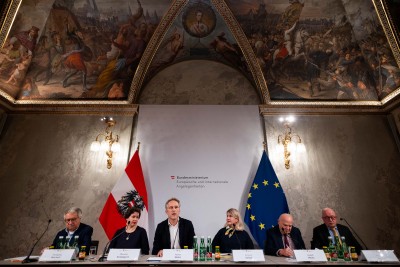
To mark the 30th anniversary in 2025, the Austrian Foreign Ministry hosted a high-level panel discussion on December 2 in cooperation with the International Institute for Peace, the Austrian Institute for International Affairs, and the University of Graz. Experts from the fields of diplomacy and academia discussed the experiences and future of the agreement.
Dayton: A fragile foundation
The agreement concluded in 1995 continues to govern the complex political system in Bosnia and Herzegovina (BiH) to this day. It divided the country into the Croat-Bosniak Federation of Bosnia and Herzegovina and the Serbian Republika Srpska, and stipulated the equal distribution of important offices among the three major ethnic groups. It also created the office of High Representative (OHR), which represents the international community and monitors the peace process.
Austria has been emphasizing its central role in the region for decades. Foreign Minister Beate Meinl-Reisinger emphasized: “Austria has long been making an essential contribution to the development and stability of Bosnia and Herzegovina – politically, economically, diplomatically, but also militarily.”
This commitment is also reflected in the composition of the OHR: Wolfgang Petritsch and Valentin Inzko, both Austrians, have already served as High Representatives. This office is currently held by German politician Christian Schmidt.
EU future as a security anchor
Austria also supports BiH militarily: initially in the NATO-led IFOR and, since 2004, in the EU-led Operation EUFOR Althea, which Austria commanded for many years and will take over again in 2027.
Despite the end of the violent conflict, the challenges remain immense, particularly due to ethnically motivated divisions and blockades. The Foreign Minister emphasized the need for EU accession: “Austria will continue to contribute to the stability and security of Bosnia and Herzegovina and support it on its path to the European Union, which will further strengthen the country’s prospects for lasting peace.”
Bosnia and Herzegovina has officially had EU candidate status since December 2022, and in March 2024, the EU member states decided to open accession negotiations. However, the minister stressed: “Bosnia and Herzegovina’s future lies in the EU, but it now needs determination and genuine reform steps.” In return, she said, the EU must offer “a clear, credible, and strategic accession perspective that builds trust and enables progress.”
The importance of this stability beyond the region was also emphasized by the U.S. Ambassador Fisher, who also attended the event at the State Department, said that the United States deeply valued its partnership with Austria in this joint endeavor. “We recognize together that stability in the Western Balkans is not just a regional priority—it is a cornerstone of European security and a shared transatlantic interest.”