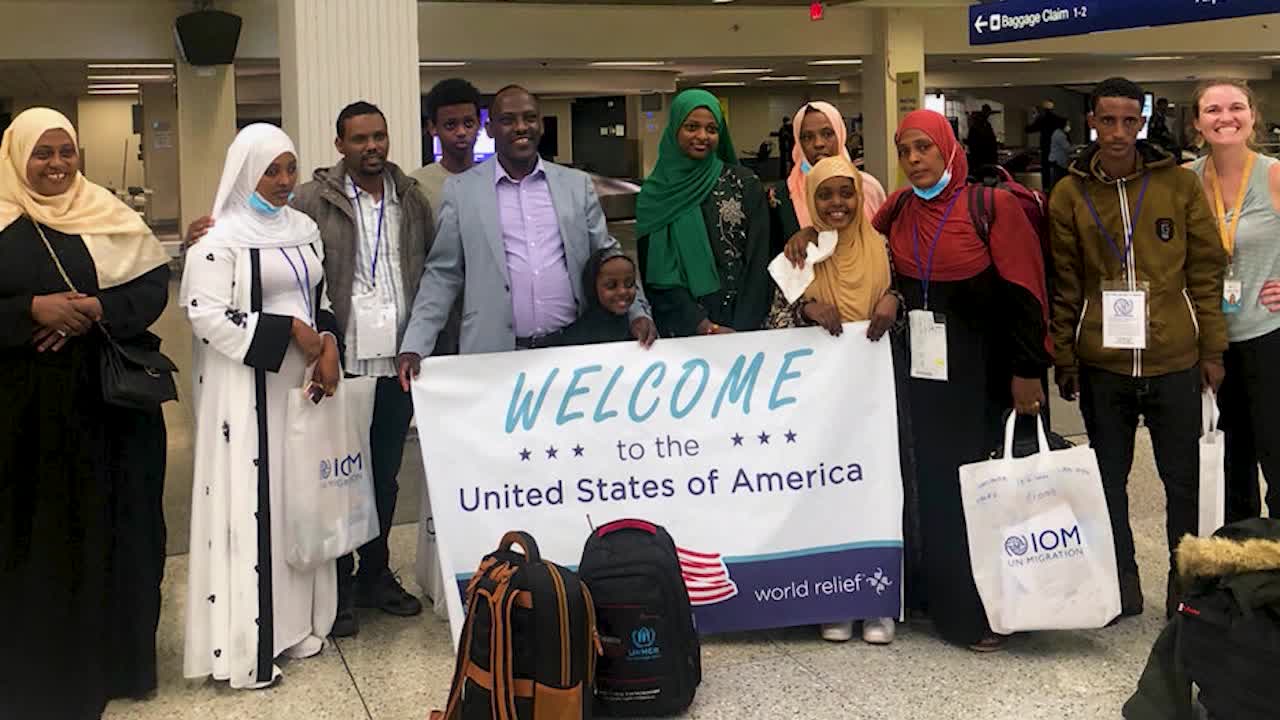
The Trump Administration is pausing pending immigration applications from 19 countries, including Somalia, as immigration enforcement activity increases in the Twin Cities.
RELATED: ICE starts operations in Minnesota targeting Somali immigrants, ABC source confirms
ABC News reports U.S. Citizenship and Immigration Services (USCIS) shared a memo Tuesday that anyone from a country on the administration’s new travel ban list would have asylum, green card, or other benefit applications paused.
“I think this is a really devastating blow to the legal immigration system to people who have been going through the process,” said Julia Decker, policy director for Immigrant Law Center of Minnesota.
Refugees can apply for a green card after they’ve been in the United States for one year, according to USCIS.
“Once people arrive in the United States with that refugee status, there is additional processes through which people have to go through in order to apply for lawful permanent resident status, which is also known as a green card,” said Decker.
She explained the green card process is the only path to naturalization, and applicants spend months or years in the process. It is also costly with attorney and application fees.
“Somalis have been coming to Minnesota for almost 40 years,” said Jane Graupman, executive director of International Institute of Minnesota. “The vast majority, over 90% of Somalis in Minnesota, came to Minnesota as refugees, and that’s because they’ve had a protracted war in Somalia.”
According to Graupman, the process to enter the U.S. as a refugee can take upwards of 20 years in some cases. It starts with a vetting process overseas, while the individual is still in a refugee camp.
“Refugee status is really hard to get,” she said. “People go through years of screenings, they have FBI checks, Homeland Security checks, they have health screenings both abroad and here. It takes years for those screenings to clear before people can arrive.”
There are other paths for immigrants to obtain legal status.
As 5 EYEWITNESS NEWS reported last week, President Trump directed the Department of Homeland Security to reconsider temporary protected status (TPS) for Somalia, affecting about 700 Somali nationals living in the U.S.
Census data estimates a range, but on the high end, it’s estimated that 108,000 Somali residents live in Minnesota — roughly 1.9% of the state’s population — so fewer than 1% of those 108,000 residents have TPS. That means the vast majority are legal citizens, and over half were born in the U.S., according to the U.S. Census Bureau.
“Most people don’t want to leave their homes, they don’t have a choice, they are fearing for their lives and they actually have to prove that is the case,” said Graupman, of the TPS process.
Some Somalis may also be seeking asylum.
“A person who is seeking asylum is already going to be here in the United States when they apply for that asylum,” said Decker. “It’s possible they could be undocumented. It’s also possible they could’ve entered the U.S. on some kind of visa, so maybe they entered the United States on a student visa, or a work visa, or a visitor visa. It’s also possible they presented themselves at the border after traveling.”
According to the state demographer, there are an estimated 5,800 Somalis in Minnesota who are not citizens. That includes people with visas, refugees, and undocumented individuals.
Jaylani Hussein, executive director of CAIR-MN, estimated there may be a couple hundred undocumented Somali migrants in the state.
“It’s a number we don’t know, but it’s very insignificant compared to what we see in other communities,” he said during a press conference Wednesday. “I think less than a thousand for sure.”
According to Decker, the process of receiving an asylum status can take time.
“They have to meet the same legal standard as someone who is a refugee,” she said. “People may not currently have documents but they may be applying for something but they haven’t actually been granted anything yet. We need to consider that process can take a long time.”
For Related Stories: Callan Gray Immigrants Immigration Somali Community