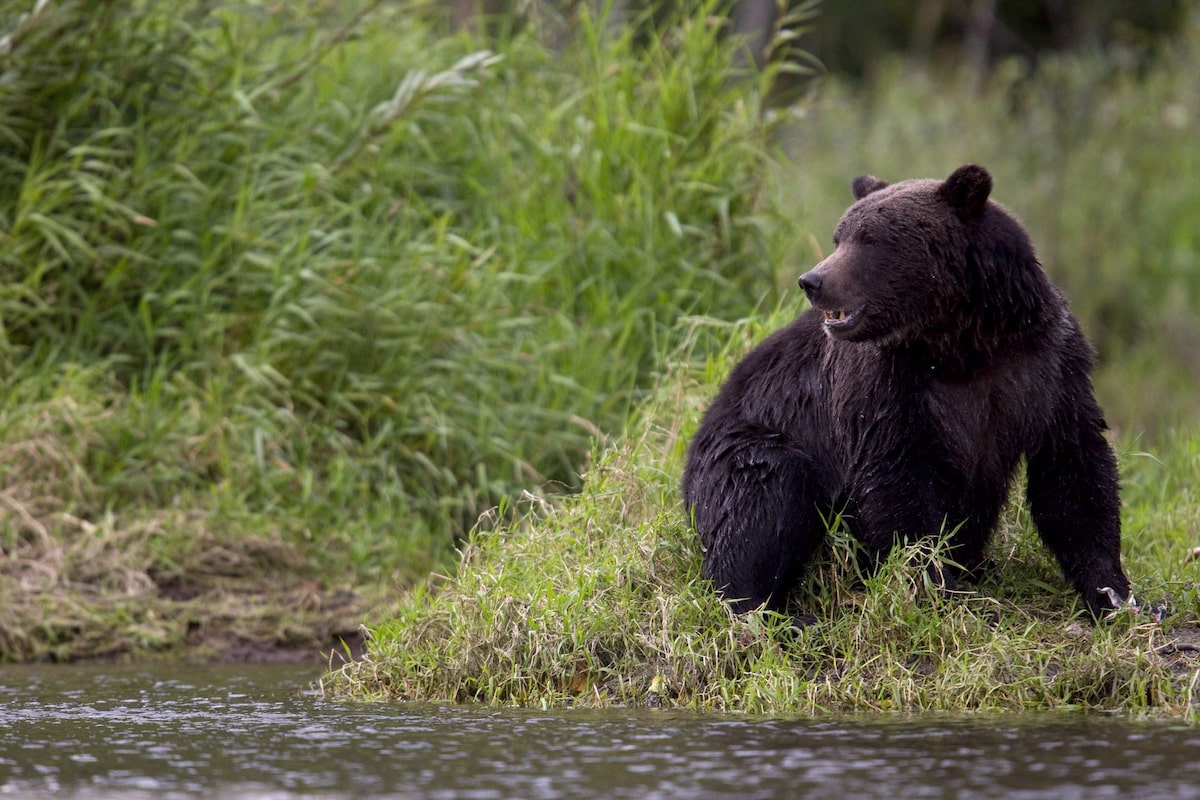
A grizzly bear fishes along a river in Tweedsmuir Provincial Park near Bella Coola, B.C., in 2010.Jonathan Hayward/The Canadian Press
Chris Darimont is a conservation scientist at the University of Victoria and a science director for the Raincoast Conservation Foundation. Paul Paquet is a conservation scientist at the University of Victoria and a science director for the Raincoast Conservation Foundation.
The B.C. Wildlife Federation is shooting from the hip again.
Within 24 hours of a tragic bear attack involving children, the hunting lobby group was advocating for a return of the grizzly bear trophy hunt.
Jesse Zeman, the group’s executive director, claimed that without hunting, “grizzlies and humans will increasingly occupy the same spaces with inevitable consequences.”
This argument is simple and seductive, but ultimately silly, because it grossly disregards the evidence.
Let’s start with the most basic facts. Attacks are extraordinarily rare. Grizzlies rank low among animals in British Columbia that cause harm, well below ungulates, domestic dogs and stinging insects. Although grizzly incidents have increased over the decades, serious injuries or death among people averaged about one per year from 1960 to 2014.
Each year, however, dozens of grizzlies are killed during conflict with humans or destroyed afterward, often after being lured toward food sources that people have not secured, such as fruit, garbage and livestock. Those figures vary considerably year by year.
Grizzly attack shatters Indigenous community where bears hold spiritual significance
Provincial data, accumulated over several decades, allowed us to understand what factors might lead to this yearly variation in conflict between bears and humans. In a peer-reviewed paper (the only one of its kind), we looked for spatial and temporal patterns that would indicate if hunting was one such factor that had an effect on the number of conflicts between bears and humans. We found no signal related to hunting.
This finding makes sense when one understands that grizzlies involved in conflict and those killed by hunters are generally different members of the bear population.
Age data show that conflict bears are generally younger than those targeted in hunts. Spatial data show that grizzly hunting occurs in wild places, whereas much of the human-bear conflict occurs close to human settlement adjacent to high-density bear populations.
Understanding these realities makes a proposal to reinstate the hunt to protect people hopelessly illogical. It’s not a solution.
Research on other carnivores has revealed a positive association between hunting and subsequent conflict: More hunting can mean more conflict with humans, rather than less. In another paper from our lab group, we detected this pattern for cougars in some areas in B.C.
This is likely because killing older animals leaves more “teenage” animals in the population, which are more likely to engage in conflict.
Two more grizzly bears captured, will be assessed after B.C. attack on schoolchildren
If the Bella Coola attack was not related to the ban on grizzly hunting, how do we make sense of it? What are the solutions? Again, let the evidence guide us.
Our paper found a striking association between conflict and food supply. Years with diminished food supply (namely, salmon) see an increase in conflict. Why? Animal behaviour studies suggest that when animals are nutritionally or otherwise stressed, they take risks in their search for, or protection of, food.
In this way, the scenario in the Bella Coola valley this year was primed for conflict: the pink salmon numbered far fewer than last year and forest fires on the nearby plateau might have pushed bears down the valley, adding to the population of bears with less to eat.
Stressful environmental conditions hit hardest in the fall as grizzlies enter what’s called hyperphagia. This instinctual drive to eat, even at the expense of safety, takes over. This is the window when more than 80 per cent of conflicts between bears and humans occur. November is bedtime, and some bears are likely going to bed hungry.
And even at the best of times, protecting their young is always a top priority for mama bears. The attack on Bella Coola schoolchildren is believed to have included a sow and two cubs. A sow would be unable to distinguish kids from those who intend to harm her cubs. Tragically, the school group was simply in the wrong place at the wrong time.
How can tragedies like this be prevented? There are solutions. Allocating new resources to bolster salmon populations is a crucial step. So too are increased province-wide efforts in education and enforcement; we need to minimize food attractants people create that lure in bears when environmental conditions are harsh.
If the BCWF truly wanted to reduce grizzly-human conflict, they would enthusiastically support these investments. Instead, capitalizing on natural feelings of fear and retribution, they demand a return to a trophy hunt, and without any evidence of its efficacy.
Fortunately, their desire is as fringe as trophy hunting. There is no public appetite for this outdated form of hunting. And that’s why the hunt was cancelled in the first place.