By Lou Hebert | Special to The Press
Dec. 7
1894: Two men are shot and killed in a brazen robbery aboard the B&O Railroad near Bairdstown in Wood County. The victims had been traveling east from Indiana to look for work when they were accosted by the bandits.
1909: Toledo police chief Perry Knapp issues orders to arrest horse owners in the city who do not blanket their horses in the cold weather.
1913: The Toledo Housewives League announces a boycott of the purchase of fresh eggs until prices fall back to 30-cents-a-dozen.
1941: Navy ships at Pearl Harbor are bombed by Japanese forces in a sudden sneak attack, ushering in the start of World War II. Toledo and the nation react with shock and resolve. Young men rush to enlist.
1953: Oregon Township residents voice complaints in a special meeting to talk about the bad odors from the Otter Creek ditch. A lively discussion is held with public and private officials about what is being done to clean up the putrid smells that offend many people in the area. Irving Wodtke of Pickle Road says despite many promises to clean it up, it “still stinks.”
1959: More than 100 stores in Toledo display Nativity scenes as retailers make a public effort to put “Christ back in Christmas.”
1960: The U.S. census is released, and it shows Toledo as the 39th largest city in the nation with a population of 313,411, which was larger in 1960 than Miami or Tampa, Fla.; Salt Lake City, Utah; Albuquerque, N.M.; Nashville, Tenn.; and Charlotte, N.C.
Dec. 8
1842: The second Wood County Courthouse in Perrysburg is completed.
1903: Oil fever continues in the area as a new well is drilled in Oregon Township. It may produce about 100 barrels per day. Farmers and onlookers watched as the well began to fill with the black crude.
1904: Onetime Toledo grifter and swindler Cassie Chadwick, also known as Madame DeVere, goes to trial in New York for fraud in one of the most celebrated fraud cases of that era. Chadwick had been arrested and jailed in Toledo in years prior for trying to swindle wealthy businessmen.
1917: It’s announced in newspapers across the nation that Toledo is going to become the “center” of the airplane industry as industrialist John North Willys agrees to build an aircraft plant in Toledo for the war effort. Willys is to become president of Curtiss Aircraft Company, and Toledo factories are to produce airplanes at the Overland plant. The predictions never materialized as Curtiss Aircraft remained headquartered in New York, although Toledo did build many of the parts and engines.
1920: In Toledo, American Legion search parties find a German cannon given to the city as a gift from the French government. The whereabouts of the cannon today are currently unknown.
1923: Scott wins the national high school football championship, defeating Washington High School of Cedar Rapids Iowa, 24-21.
1925: Toledo experiences its first home invasion robbery when bandits break into a house at gunpoint and rob nine people of jewelry and cash, estimated to be worth about $7,000. The robbery happened at 1109 Prospect as the victims were gathered around a radio listening to jazz music. Police say the bandits were gentlemen as they returned a valuable ring to one lady who said it was her wedding ring.
1941: President Roosevelt and Congress declare war on Japan and Germany. Armed sentries begin patrolling military sites around Toledo.
1961: Toledo police officer Walter Boyle is shot to death in the line of duty while serving a warrant for a suspect, who is cornered later by police and killed.
Dec. 9
1890: Horseshoer W. B. Beach of Bowling Green says he managed to put 136 shoes on horses on Friday and did another 110 the next day. He only had one helper and dares anyone to match that.
1902: A major fire occurs at Keifer Furniture on Dorr Street. Two Toledo firemen, Thomas Smith and Richard Donnelly, are killed by falling debris.
1903: It’s reported in the Toledo News Bee that Toledo Mayor Samuel Jones, a millionaire, was traveling in the South when he ran out of cash and only had a $5,000 check in his pocket, which he didn’t want to cash. So, he went to a pawn shop and got a loan for $5. The mayor has now redeemed his watch, but he hasn’t yet redeemed his pride as his ordeal is the subject of many jokes in town.
1922: Waite wins the national high school football title.
1929: “Daddy” Charles Wormley is buried at Forest Cemetery in Toledo. He was an ex-slave and a well-known citizen of that era, considered a Toledo patriarch. He died at 77 years of age. Born in North Carolina in 1852, he was freed by the Emancipation Proclamation as a teenager. He moved to Toledo in 1903.
1932: The Toledo News Bee reports that a log cabin settlement has been built on the Maumee River Valley flats 20 miles from Toledo by destitute war veterans and their families who are living as pioneers in the cabins during the winter months.
Dec. 10
1879: Toledo area medical pioneer Horatio Conant dies at age 94.
1897: It’s revealed that Toledo now has 350 miles of streets, with 110 miles paved, mostly with stone and cedar blocks.
1909: Strong, gale-force winds on Lake Erie send three ships to the bottom of the lake. Fifty-two crewmen perish in the tragedies, including several from Toledo.
1918: Toledo Public Schools close because of the worsening flu epidemic. All children in the city are banned from gathering in any public places, including theaters, stores, churches, and schools.
1926: A suspected rabid dog bites more than a dozen people in Toledo at Oakdale Elementary school. The health department says eight of the victims, which included students, teachers, and a policeman, are to undergo a series of painful rabies shots as the dog’s remains are taken to Columbus for analysis.
1940: The Neeb Motor Company of Elmore is selling a brand-new Pontiac “Streamliner Torpedo,” a six-cylinder coupe, for $923. Whitewall tires are optional.
Dec. 11
1833: The first newspaper in Wood County, called Miami of the Lake, is published.
1897: Notorious crook Danny Robb is shot and killed at the Palace Hotel by the proprietor during an assault.
1910: The town of Elmore reports that gas pressure is too low to light the streetlamps, and they will have to be converted to electricity. A group of Elmore residents took the trolley to Genoa recently to inspect a new electric streetlight that is on exhibition.
1916: Two Toledo firemen, Albert Urie and Captain Edward Welch, are killed battling a blaze at Paddington Merchandising Warehouse at 114 St. Clair St.
1935: The village of Pemberville gets its new water tower and public water system.
1984: Popular hockey coach Ted Garvin is re-hired to coach the Toledo Goaldiggers hockey team.
Dec. 12
1907: Toledo’s police judge, James Austin, declares that “guns are the greatest evil police have to deal with” and orders a mandatory 90-day sentence for anyone caught with a concealed firearm in the city of Toledo.
1909: A tragedy occurs in Oak Harbor when two schoolteachers from the town, Nelson Davids, 19, and Mary Mylander, 21, drowned while skating on the thin ice that covered the Portage River.
1932: Toledo’s bootlegger “gang wars” take another nasty turn with the brutal slaying of August “Gusty” Annarino. The 27-year-old was “taken for a ride” and his body was dumped at South and Byrne. The killing now makes 10 unsolved gang killings in recent years. The public is becoming impatient. Meanwhile his young teenage widow, Crystal, says she is getting death threats if she talks too much.
1934: Bitter cold and heavy snows hit Toledo area. Depression-impoverished families who live in shacks in the Bay View Park area have little heat and are struggling to stay warm. More than 70 single men are also struggling to stay alive in makeshift huts in the Buckeye Street dump.
1941: Civilian defense agencies are recruiting hundreds of volunteers for security patrols. Air raid classes are well attended.
1952: Port Clinton city officials urge the governor to build a new Ohio maximum security prison at Camp Perry.
1979: The Ross Hotel building, site of the original Howard’s Bar at Court and Main in Bowling Green, is leveled by flames. It would later become the site of the Wood County Library.
Dec. 13
1864: An escape by rebel prisoners is reported from the Confederate prison camp at Johnson’s Island in Sandusky Bay.
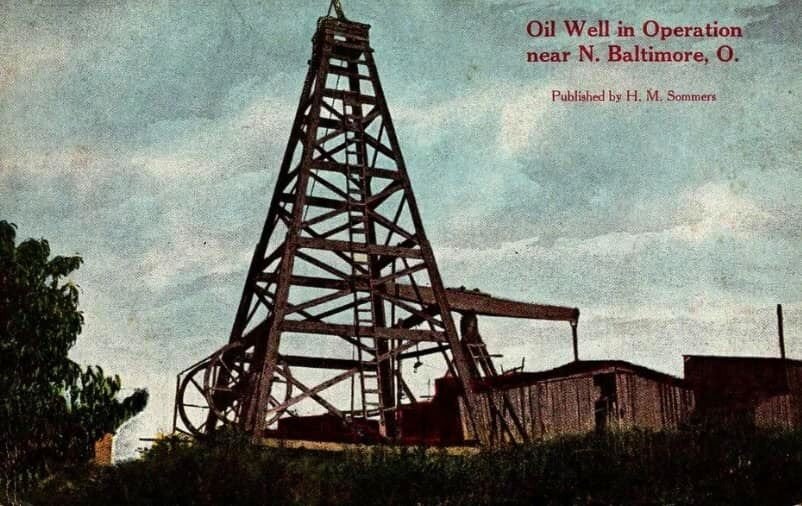
1886: Oil is discovered on the Dave Fulton farm near North Baltimore. They were about ready to give up after drilling for hours, but then a powerful jet of thick crude oil gushed 85 feet over the derrick. It was the first of what would become a major oil boom in the area, making Northwest Ohio the “oil capital” of the nation for several decades.
1909: Toledo City Council approves electric streetlights for East Toledo’s Main Street.
1919: Harry Gardiner, a “human fly,” scales the side of Milliken Hotel in Bowling Green to the delight of spectators.
1946: A deadly passenger train disaster occurs near Mansfield, Ohio where 15 people are killed, including two crew members from Toledo. The Pennsylvania Golden Triangle passenger train crashed into the wreckage of two freight trains.
1957: The village of Genoa is under pressure from the state health department to stop funneling raw sewage into Packer Creek and must show progress on the construction of a new $400,000 sewer and water treatment system.