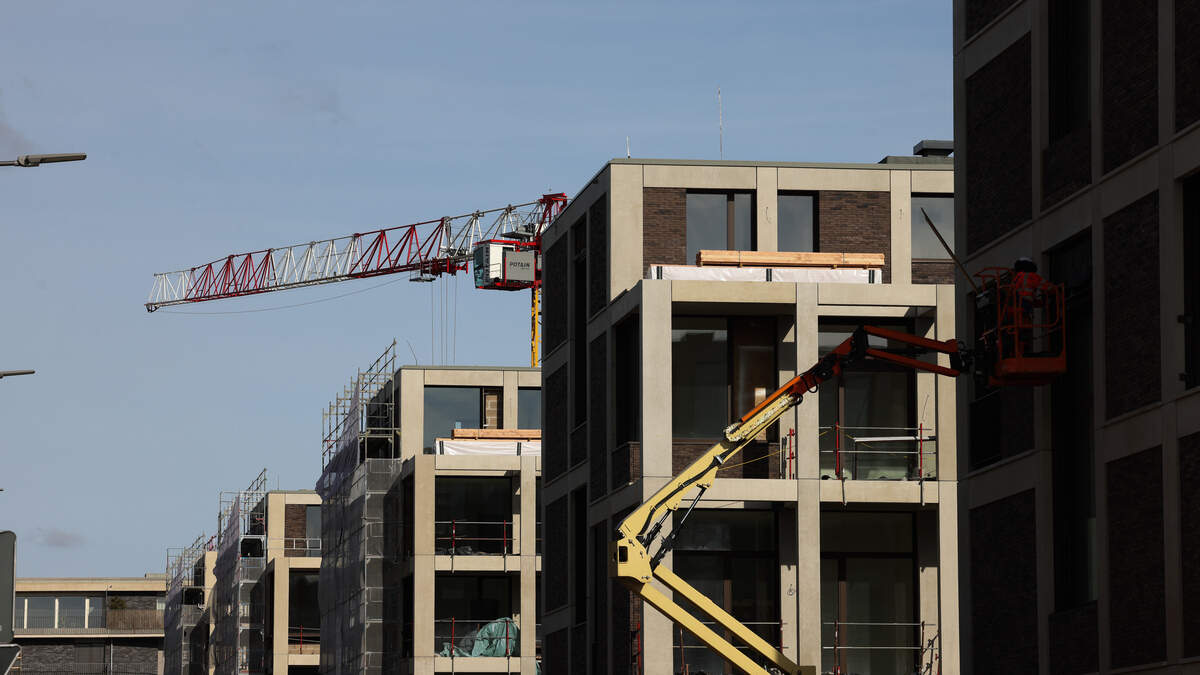
The Luxembourg construction industry is not coming out of its economic doldrums.
Mersch-based construction company Tragec, specialising in public road construction and exterior design for private and public customers, has announced it will complete its current contracts and then cease operation. Its 2024 financial year ended with a loss of €1.1 million.
Construction giant Karp-Kneip has made an offer to take on 47 its roughly 60 employees, which some have already accepted, Christophe Thiry, member of the Karp-Kneip board, confirmed.
The less-bad news
The number of construction companies filing for bankruptcy fell in the first half of the year. There were 89 insolvencies in the construction industry, 10% fewer than in the first half of 2024. 515 people lost their job as a result, some 35% fewer than in the first half of last year.
The number of insolvencies tells only part of the story, though, Thiry said, because some construction firms simply cease operations, which is not reflected in the insolvency statistics. In 2024, 700 companies were dissolved that way and deleted from the commercial register – more than ever before.
Whether through redundancies like those at Stugalux, bankruptcies like Cenaro or business closures like Tragec, activity in the construction sector has fallen sharply since 2022.
Also read:Luxembourg’s oldest workers are in construction
Worsening housing crisis
That is despite unrelenting demand for new housing. According to Statec, 6,500 homes need to be built each year by 2030, which is significantly more than what is being achieved today. It is a situation that could also be exacerbated by the fact that thousands of employees in the construction sector will retire in the coming years and need to be replaced.
If and when the construction industry does pick up again, these people will be missing. This is one of the reasons why Karp-Kneip is taking on Tragec employees: to replace the employees who will be retiring over the next few years.
The personnel situation is exacerbated by the fact that few young construction workers are joining the company and many Portuguese workers are leaving for their home country.
The situation on the market remains difficult. “It’s perhaps a little better than a year ago,” said Thiry, “but it’s still very, very difficult and it probably won’t get much better next year either.”
Order numbers are falling in the construction sector © Photo credit: Chamber of Skilled Crafts
The main reasons are not enough orders and regulations that the industry considers too stringent. “If you ask building material dealers or the landfill sites in Luxembourg, they are all 40% to 50% below the figures from before,” said Thiry.
Although interest rates have fallen again, both private clients and the state are holding back on building contracts. The ECB’s interest rate had been at 0% since 2016. It then rose for the first time in years in 2022 and reached 4.5% in 2023. Although it then dropped again in 2025 to its current level of 2.15%, the construction industry is not moving again yet.
This translates into the number of building applications remaining low. The small upturn in the second quarter was because many buyers brought forward their investments to benefit from tax advantages before they expired on 1 July 2025. According to the central bank, while Luxembourg’s financial institutions granted loans totalling €11.2 billion for residential property in 2021, the figure was only €6.1 billion in 2024 – despite higher construction costs.
More public investment needed
According to the Chamber of Skilled Crafts (CDM), the positive effects of interest rate cuts have not yet been felt in Luxembourg. It is therefore “imperative that the state continues its counter-cyclical measures to counteract the decline in the construction sector’s labour force.” The state and municipalities must invest more in infrastructure and housing construction, the CDM has said.
Private owners should also be encouraged to develop their properties more quickly. To achieve the average density of 39.7 flats per built-hectare, 164 hectares would have to be developed each year.
Building land is scarce and therefore expensive. In addition to financing and construction costs, these prices have also risen. According to a study by the Observatoire de l’habitat, although land costs fell by just under 15% in 2023 and 2024, they had previously increased by a total of 150.4% between 2010 and 2022.
Measures introduced by the government to make building in Luxembourg attractive again have not worked so far and seem half-hearted, the study said.
The problem, according to Thiry, is that politicians believe things are not so bad. “But if you look at the real figures, the reality is quite different. The construction industry has lost 5,000 people and many companies have gone out of business.”
Too little usable building land leads to high prices, slow construction and a worsening housing crisis © Photo credit: Chris Karaba
“Unfortunately, the situation in the construction industry can still be categorised as difficult,” said Paul Nathan, vice president of the CDM. “On the one hand, the construction industry is still lacking orders due to low economic growth and the struggling residential construction segment. On the other hand, there are still no clear signs of a sustainable recovery.”
The weakening economy is becoming a challenge for many companies in the sector. “At the same time, increased material and investment costs, administrative costs and the ongoing shortage of skilled labour are placing an additional burden on companies,” the chamber said.
Few new buildings
Analysis of data collected by the CDM shows that the transaction volume for new builds (VEFA) has remained at a particularly low level. A decline of 36% was recorded between the fourth quarter of 2024 and the first quarter of 2025. This trend was reflected in a total of 253 VEFA sales in the first quarter of 2025.
“Since 2022, the number of homes sold has been almost 5,850 units below the average for the years 2016 to 2020,” said the CDM. “This decline in demand in the market for new construction has a significant impact on the construction sector and is leading to a gradual deterioration in the financial health of companies and employment in the sector.”
According to Statec projections, more than 32,000 new homes will be needed in Luxembourg by 2030 to meet the expected population growth.
Housing construction capacity should be 6,500 units per year to achieve this, instead of the current 2,500. Achieving the goal would require the integration of around 7,000 additional skilled workers into the construction sector. Subtracting the roughly 5,000 employees who will retire by 2030, some 12,000 new workers for the construction sector would be needed.
(This article was published by the Luxemburger Wort. Machine translated, with editing and adaptation by Alex Stevensson.)
Also read:Make English an official language in Luxembourg, country’s business lobby urges