By Surabhi Gupta
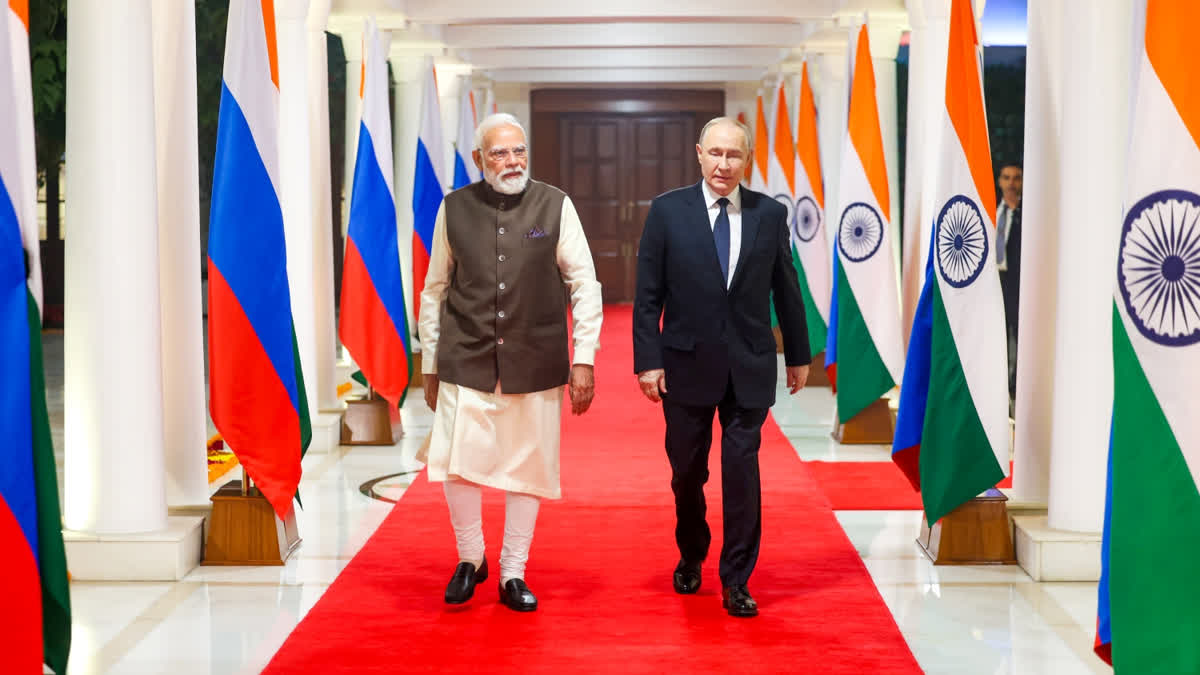
New Delhi: Russian President Vladimir Putin arrived in New Delhi on Thursday evening for a two-day state visit that has drawn intense global scrutiny. Landing at Palam Airport, he was personally received by Prime Minister Narendra Modi, who had reached earlier to welcome him before hosting a private dinner at his residence.
The visit, Putin’s first to India since the Ukraine war began in February 2022, comes at a moment of heightened geopolitical flux, sharpened U.S.-Russia tensions, and growing Western unease over India’s deepening engagement with Moscow.
Putin is in India for the 23rd India-Russia Annual Summit, accompanied by a senior delegation that will hold wide-ranging discussions on defence partnerships, energy trade, technology cooperation, financial mechanisms, and cultural exchanges. On Friday, he will receive a ceremonial welcome at Rashtrapati Bhavan, pay homage to Mahatma Gandhi at Rajghat, participate in delegation-level talks at Hyderabad House, address a business conclave organised by FICCI, and later attend a state banquet hosted by President Droupadi Murmu.
But beyond the protocol and the photo opportunities, the world is watching closely.
A Visit Loaded With Geopolitical Signals
India’s relationship with Russia has long been under Western scrutiny, but this visit comes with added layers. Western capitals see New Delhi’s steadfast engagement with Moscow, especially its refusal to halt purchases of discounted Russian crude, as a challenge to their sanctions architecture.
For the Biden administration, the EU and the UK, the India-Russia equation increasingly intersects with broader anxieties about multipolarity, supply chains, BRICS expansion and de-dollarisation dynamics.
Major General Dr Rajan Kochhar, Senior Adviser at Defence Research and Studies and MP-IDSA, captured the mood succinctly, commenting, “Western responses are likely to be calibrated, diplomatic reminders, commercial shading (tariffs, export controls), and messaging to New Delhi about the risks of transactional closeness. But outright coercion is unlikely: India remains a strategic partner for the U.S., and Washington also needs New Delhi on Indo-Pacific and supply-chain issues.”
Kochhar added that what makes the visit consequential is the possibility of concrete deliverables, and said, “If India shows even tacit support for BRICS financial measures (or agrees to deepen rupee/third-currency arrangements), it would strengthen alternatives to Western financial architecture, a potential strategic win for Russia and China, and a headache for U.S./EU policy aimed at isolating Moscow economically.”
The visit, he said, blends “symbolic signalling” with hard geopolitical stakes: “For the U.S. and EU, the concerns are real, erosion of sanctions pressure, strategic signalling, and the strengthening of alternative financial/strategic architectures. For China and BRICS, the visit is an opportunity to deepen multipolar initiatives. For India, it is the latest demonstration of strategic autonomy, but one that requires deft balancing to avoid strategic costs with Western partners.”
Former Indian diplomat, Manju Seth told ETV Bharat, “Global attention is fixed on President Putin’s India visit amid a highly complex geopolitical moment. While the U.S. and EU continue to pressure Russia to end the Ukraine war, Washington is simultaneously pushing peace mediation, even as several European countries encourage President Zelenskyy to hold firm and resist a proposed peace deal. This contradictory Western approach underscores the uncertainty surrounding the conflict.”
“At the same time, both the U.S. and EU are uneasy about India’s close ties with Russia, viewing the partnership as strategically inconvenient. What they must recognise, however, is that India and Russia share a long-standing, trusted relationship dating back to the Soviet era, one that continues despite India’s diversification of partnerships.
“Since independence, India has consistently pursued non-alignment and now strategic autonomy, enabling it to balance major-power relationships without joining any bloc. Despite periodic Western pressure to fall in line with their positions, India has largely held firm, prioritising its national interests and maintaining an independent foreign policy that remains central to its global approach.”
Two Elephants In The Room: Trump And Europe
Veteran diplomat K. P. Fabian described the geopolitical backdrop using a striking metaphor. “There are two elephants in the room when the Prime Minister and President Putin meet. Trump is the big elephant, and the EU plus the UK form the smaller elephant. The two elephants do not have a common focus,” said Fabian.
Fabian argued that while Donald Trump, now again a dominant force in U.S. politics, is primarily concerned with American defence exports, Europe’s anxieties are rooted in the ongoing Ukraine conflict, and said, “For Trump, what matters is to what extent the defence purchases from Russia go up. Trump himself wants to reopen economic relations with Russia and have it join the G7, making it G8. But if India buys more arms and equipment from Russia, Trump considers it a loss to America.
Europe’s expectations, he said, are entirely different, as according to him, “Europe, sidelined by Trump in the matter of the Ukraine war, naively expects India to put pressure on Putin to stop the war. Putin has made it clear that Russia will take the whole of Donbass militarily if needed.”
Fabian suggested that the future of India-Russia trade is also a key concern for many in the West. “Russia wants to increase trade with India. So does India want to trade more with Russia? The two countries should form companies that will take care only of their bilateral trade. Such a company will not be vulnerable to Washington’s sanctions,” he explained.
India Defied Western Pressure, And the West Is Watching
Diplomat Achal Malhotra emphasised that the intense Western attention stems from a perception that their pressure campaign on India did not succeed, saying, “The visit is taking place in the backdrop of India defying sustained pressure from the U.S. and Europe that India should distance itself from Russia, particularly stop buying crude oil from Russia. India is not willing to make any compromises with its strategic autonomy, as visibly demonstrated by India.”
This has led some Western observers to worry whether their approach may have backfired, as Malhotra explained, “They are now eager to watch the outcome of the visit and assess whether they have pushed India too far towards Russia, which in turn may even lead to the revival of the India-Russia-China trilateral.”
Malhotra also noted how BRICS dynamics amplify this global interest, and said “IRC and other members of BRICS may accelerate the campaign for finding alternatives to the West-dominated institutions of global governance, on the lines of the New Development Bank initiative by BRICS, which are now also working towards de-dollarisation of the economy.”
A world where India, Russia, China, and other emerging economies coordinate more tightly is a nightmare scenario for Western strategists. “From the West’s perspective, further polarisation bringing India, Russia, China (and even North Korea), Iran, Brazil, South Africa on one side of the spectrum could complicate world order,” said Malhotra.
But Malhotra insisted such fears are misplaced, stating, “India is likely to continue pursuing its policy of multi-engagement and multi-alignment and balancing its relations with major powers, while advocating multipolarity and multilateralism.”
Economic And BRICS Angle: A New “Prism” Of Concern
Economist Sharad Kohli argued that Washington and Brussels are viewing the visit through multiple economic and strategic lenses, especially tariffs, sanctions and BRICS developments.
“The recent proximity between India and Russia is being seen through a new prism. The reason is the ongoing tariff tussle, which the US has with India, and which the US has with China as well. The proximity of India and Russia is being seen with that angle.”
He added that NATO’s tensions with Moscow deepen the West’s concern, saying, “Most of the EU is part of NATO. And there is severe stress buildup on the borders of NATO and Russia. So that is also one angle why this visit is being looked forward to.”
Russia’s sanctions-induced isolation is another driver. “More than 15,000 sanctions have been imposed on Russia. So Russia obviously is looking for newer territories for business, and India, being the world’s most populous country, obviously offers possibilities,” he added.
Kohli also highlighted the BRICS dimension. “America doesn’t look at Russia and BRICS through a very good prism. That is another aspect which is bothering the US and the West, that BRICS friendship may end up giving birth to a new BRICS currency or become so substantial in world business that it may impact the global economy. If these nations get together, there could be a problem, and the US and the EU can become weaker.”
Defence And Strategic Autonomy At The Core
Defence expert Commodore Anil Jai Singh (Retd) said Europe’s concerns are rooted in fundamentally different perceptions of Russia, observing, “Europe sees Russia very differently from India. They see it as an aggressor they have to be wary of.”
He said Russia is seeking strong partners amid diplomatic isolation. “Russia needs India as it has very few friends of any consequence in the world besides China. The rest are mainly rogue states like North Korea and Iran. India also offers a possible route for further communication with the West,” stated Singh
But India’s motivations, according to him, also extend to managing its own strategic interests: “Another probable reason, besides the long-standing relationship, is to balance China, lest that strategic relationship starts working to India’s detriment.”
Singh underlined that the visit symbolises New Delhi’s unwavering policy: “This visit reflects India’s commitment to strategic autonomy, which means that we act in our own interest, which others should not dictate, and the world should respect that.”
Yet he warned that India must negotiate defence deals carefully. “Business growth is one aspect, but besides oil, other commodities or defence equipment, there is little that Russia can give us. From a defence perspective, we would be looking to augment our capabilities, but should insist on technology transfer and not just licensed production,” he said.
Why This Visit Matters Globally
Putin’s presence in New Delhi at this moment is symbolically powerful:
It signals that Russia retains major diplomatic partners despite Western sanctions.It tests the limits of U.S. tolerance for India’s strategic autonomy.It energises BRICS conversations on financial alternatives and de-dollarisation.It allows India to demonstrate independence amid great-power rivalry.It raises questions in Europe about India’s role in the Ukraine conflict.It highlights the shifting global order toward multipolarity.
For India, the visit reinforces the message that it will not be pressured into alignment, neither with the West nor with Russia-China. For the West, the fear is that India’s balancing act may tilt the global system away from Western dominance. For Russia, India is both a partner and a geopolitical lifeline.
The world, therefore, is watching, not just for agreements, but for signals.
A Visit Loaded With History
Putin last visited India in December 2021, months before launching the invasion of Ukraine. The two leaders have met several times since, but largely at multilateral forums. This is his first bilateral visit since the war began, giving it exceptional weight.
The coming hours, the meetings, the joint statement, the business engagements, will be analysed in capitals across Washington, Brussels, Beijing, Moscow, London and Tokyo.
India and Russia may emphasise continuity. But the world is watching for change.