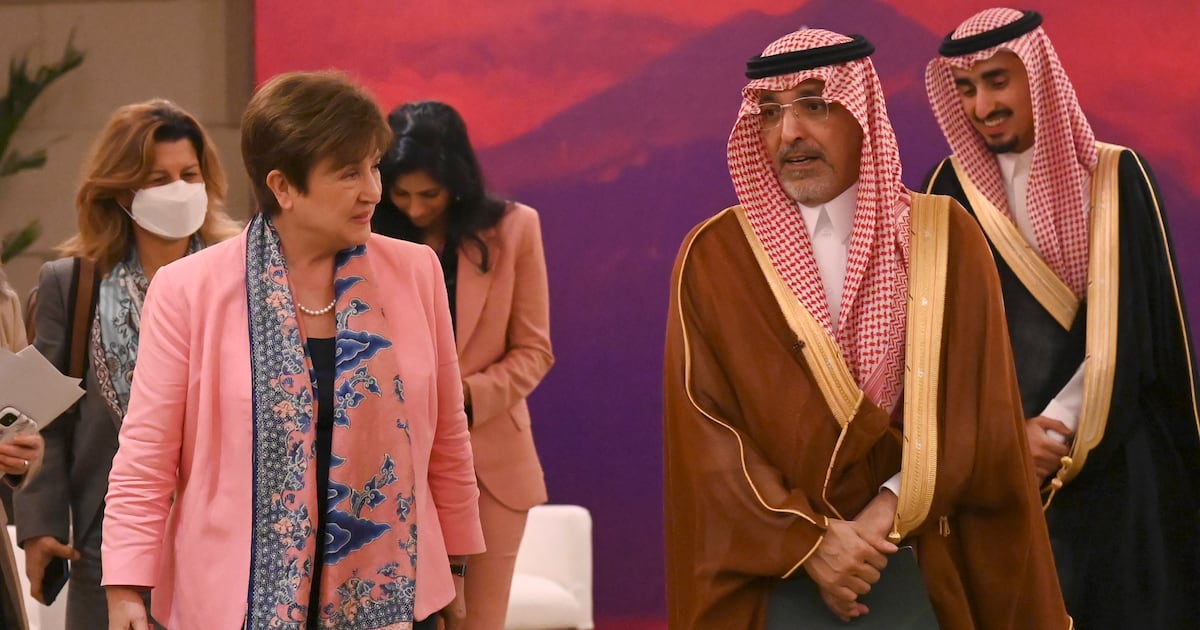
The International Monetary Fund on Thursday welcomed Saudi Arabia recalibrating its Vision 2030 spending as the kingdom seeks to narrow its fiscal deficit.

Saudi Arabia’s Ministry of Finance this week unveiled the budget for next year. In it, the ministry projects Saudi Arabia’s fiscal deficit will narrow to 165.4 billion riyals ($44 billion) in 2026 – or 3.3 per cent of its gross domestic product – from 245 billion riyals in 2025.

Public revenue is estimated at 1.147 trillion riyals. Saudi Finance Minister Mohammed Al Jadaan at the time said the deficit was “by design”, explaining the kingdom will have a deficit until 2028, media reported.

The ministry said it remains focused on enhancing spending efficiency and improving quality of essential services while also continuing to implement gigaprojects and other strategies under Vision 2030.

Mr Al Jadaan said the kingdom would be willing to scale back on some of the gigaprojects.

“If we announce something and we need to adjust it, accelerate it and make it a priority more than others, or defer or cancel it, we will without blinking,” he said.

A representative for the IMF said it welcomes “the recalibration of Saudi Arabia’s fiscal expenditures”.

“This will help ensure … a proper sequence of spending while maintaining fiscal and external sustainability,” Julie Kozack said.

She added it was also important that any fiscal policy avoid “pro-cyclicality” – meaning the kingdom’s fiscal policy plays a buffering role rather than an amplifying one. “Part of that is to avoid magnifying the impact of lower oil prices on growth,” she said.

The fund currently projects Saudi Arabia’s economy – the largest in the Arab world – to grow at a 4 per cent pace next year, driven by higher oil production and strong domestic demand linked to the kingdom’s reforms.

Saudi Arabia’s 2026 budget made no specific mention of gigaprojects like Neom, a project long at the heart of the Vision 2030. Mr Al Jadaan said any potential cancellation of the futuristic city will be up to the decision of the Public Investment Fund (PIF), which is leading Saudi Arabia’s diversification efforts, Bloomberg reported.

The PIF is expected to announced its updated investment strategy early next year. PIF governor Yasir Al Rumayyan previewed this new strategy in September, saying the new long-term strategy will be a continuation from the original that stretches into 2040.

Mr Al Rumayyan also said at the time that Saudi Arabia is seeking to secure foreign investment as PIF deploys 80 per cent of its capital domestically.

More on Turkey’s Syria offence
What drives subscription retailing?

Once the domain of newspaper home deliveries, subscription model retailing has combined with e-commerce to permeate myriad products and services.

The concept has grown tremendously around the world and is forecast to thrive further, according to UnivDatos Market Insights’ report on recent and predicted trends in the sector.

The global subscription e-commerce market was valued at $13.2 billion (Dh48.5bn) in 2018. It is forecast to touch $478.2bn in 2025, and include the entertainment, fitness, food, cosmetics, baby care and fashion sectors.

The report says subscription-based services currently constitute “a small trend within e-commerce”. The US hosts almost 70 per cent of recurring plan firms, including leaders Dollar Shave Club, Hello Fresh and Netflix. Walmart and Sephora are among longer established retailers entering the space.

UnivDatos cites younger and affluent urbanites as prime subscription targets, with women currently the largest share of end-users.

That’s expected to remain unchanged until 2025, when women will represent a $246.6bn market share, owing to increasing numbers of start-ups targeting women.

Personal care and beauty occupy the largest chunk of the worldwide subscription e-commerce market, with changing lifestyles, work schedules, customisation and convenience among the chief future drivers.

The President’s Cake

Director: Hasan Hadi

Starring: Baneen Ahmad Nayyef, Waheed Thabet Khreibat, Sajad Mohamad Qasem 

Rating: 4/5

The%20specs

%3Cp%3E%3Cstrong%3EPowertrain%3A%20%3C%2Fstrong%3ESingle%20electric%20motor%0D%3Cbr%3E%3Cstrong%3EPower%3A%20%3C%2Fstrong%3E201hp%0D%3Cbr%3E%3Cstrong%3ETorque%3A%20%3C%2Fstrong%3E310Nm%0D%3Cbr%3E%3Cstrong%3ETransmission%3A%20%3C%2Fstrong%3ESingle-speed%20auto%0D%3Cbr%3E%3Cstrong%3EBattery%3A%20%3C%2Fstrong%3E53kWh%20lithium-ion%20battery%20pack%20(GS%20base%20model)%3B%2070kWh%20battery%20pack%20(GF)%0D%3Cbr%3E%3Cstrong%3ETouring%20range%3A%20%3C%2Fstrong%3E350km%20(GS)%3B%20480km%20(GF)%0D%3Cbr%3E%3Cstrong%3EPrice%3A%20%3C%2Fstrong%3EFrom%20Dh129%2C900%20(GS)%3B%20Dh149%2C000%20(GF)%0D%3Cbr%3E%3Cstrong%3EOn%20sale%3A%3C%2Fstrong%3E%20Now%3C%2Fp%3E%0A

Benefits of first-time home buyers’ scheme

Priority access to new homes from participating developers
Discounts on sales price of off-plan units
Flexible payment plans from developers
Mortgages with better interest rates, faster approval times and reduced fees
DLD registration fee can be paid through banks or credit cards at zero interest rates