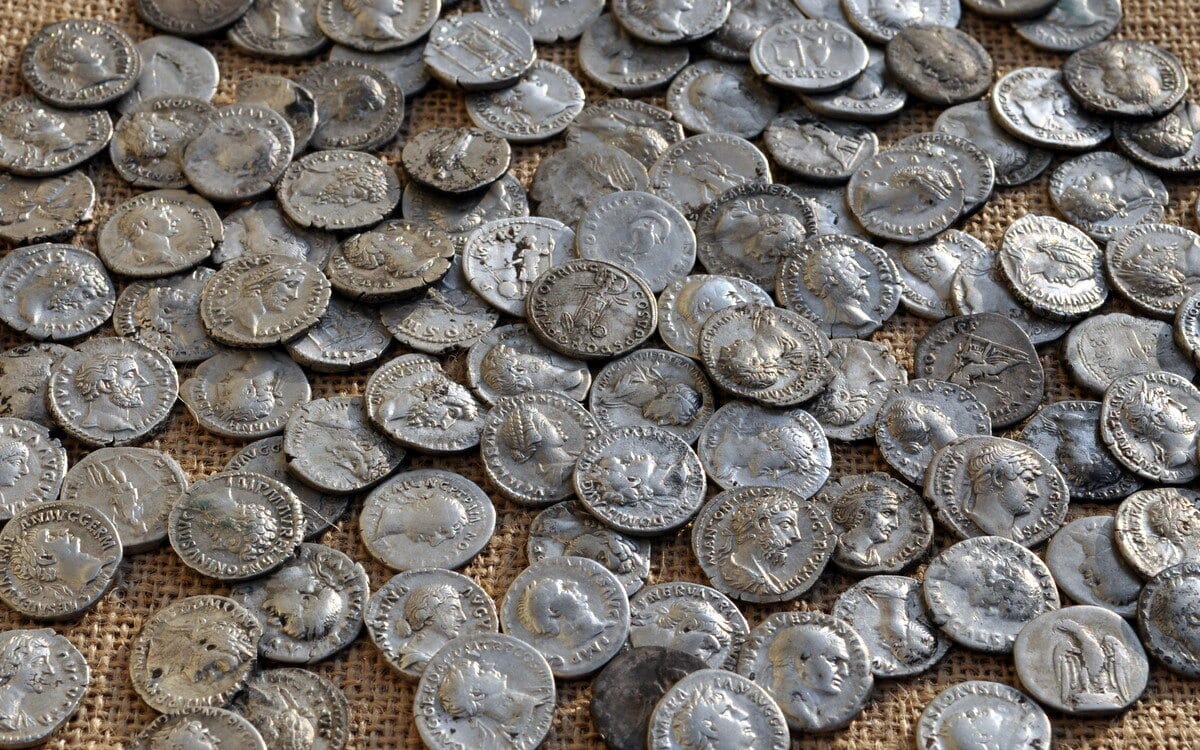
Roman silver coins hoard. Credit: Wikimedia Commons / Birmingham Museums Trust, Benedict Pond CC BY-SA 4.0
Archaeologists in Croatia have unearthed a rare medieval silver coin hoard linked to the era of the First Crusade, a discovery scholars describe as one of Europe’s most significant numismatic finds. The hoard surfaced during excavations at the Batina site in the Baranja region, a location long known for its Iron Age layers and its role along the Roman frontier.
Researchers did not anticipate uncovering medieval material at all, yet the dig revealed an extraordinary cluster of early silver coins.
Experts say coins from the First Crusade period seldom appear so far inland. The find has captured immediate attention from medieval historians and numismatists across Europe, who believe it could reshape understanding of currency movement and travel routes during the late 11th and early 12th centuries.
Archaeologists are surprised by material far outside the expected time period
Archaeological work at Batina has been underway since 2008, largely focused on ancient fortifications, Roman military structures, and prehistoric deposits. Because of these deep ancient layers, researchers were not expecting artifacts from the medieval world. Curator and archaeologist Domagoj Dujmić said the discovery came without warning. The team was examining Roman-era deposits when they encountered items that were clearly out of place.
Archaeologists in Croatia have uncovered 56 rare French silver coins linked to the First Crusade—one of Europe’s most significant medieval numismatic finds.#Croatia #silvercoins pic.twitter.com/g0zeD1096w
— Tom Marvolo Riddle (@tom_riddle2025) December 4, 2025
“We did not expect to find anything medieval here, especially not silver coins of such rarity,” Dujmić said. He added that even in France, where these coins were minted, examples are scarce due to a continent-wide shortage of silver during that era.
Coins minted in France surface far from their origins
The hoard includes 56 medieval French silver coins minted in Limoges, Toulouse, Albi, and the diocese of Le Puy. Researchers date the pieces between the late 9th and mid-13th centuries, a range that overlaps the First Crusade from 1096 to 1099. Their appearance in northern Croatia points to unexpected connections between Western Europe and the Danube basin.
Severe medieval silver shortage makes the find even rarer
The period represented by the hoard was marked by widespread silver scarcity. Declining mining output, disrupted trade routes, and political instability limited production across French mints. Many coin types from this era survive only in single examples or extremely small numbers. Several coins from Batina represent more than 10 percent of all known specimens of their type worldwide, a concentration experts call exceptional.
Potential links to the crusader and the pilgrim movement
Because the coins originate from regions involved in mobilizing crusaders, scholars believe the hoard may be connected to groups traveling toward the Holy Land. Croatia’s geographic position made it a natural corridor for crusaders or pilgrims moving through the Balkans toward Constantinople and the Levant.
The discovery provides physical evidence that Western European travelers may have passed through the area and opens the possibility of mapping lesser-known medieval routes.
Evidence raises new historical questions
The location adds to the mystery. The coins were found at a site not previously associated with medieval settlement or activity. Researchers are now asking how such valuable currency ended up in Batina—whether it was hidden intentionally, lost during travel, or stored for protection during conflict. Continued analysis may offer answers.
A national milestone now open to the public
The Ministry of Culture and Media, which has supported Batina excavations for more than 15 years, praised the discovery as proof of the long-term scientific value of archaeological research. Officials note that medieval numismatic finds of this scale are exceptionally rare in Croatia.
The hoard is now on public display at the Archaeological Museum in Osijek. Carefully conserved and presented with historical context, the First Crusade–era coins are already drawing national and international visitors and reinforcing Osijek’s growing role as a center for medieval archaeological research.