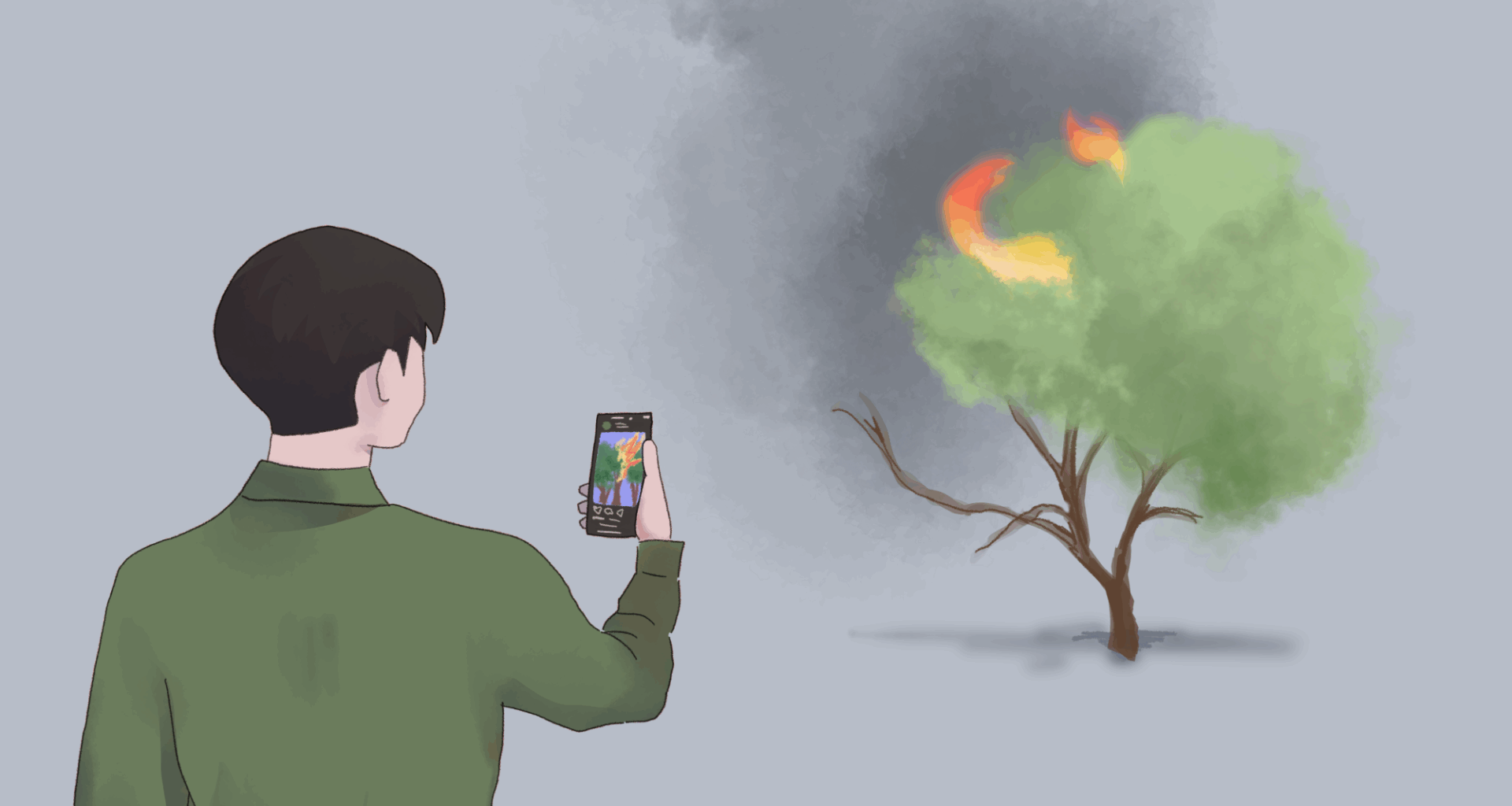
When scrolling on social media, MVHS students may come across a video on their For You pages featuring a montage of devastating scenes — fires ravaging cities, icebergs shrinking to nothing, trash consuming oceans and more. These images and video clips immediately invoke a sense of emotion, with thousands of people flocking to like, comment and repost. Yet the emotions we feel and the desire to save the helpless animals on our screens are nowhere to be found when looking at the trash that pollutes our own campus.
These social media posts, although important to evoke empathy for the situation, showcase events that occur in distant regions of the world and are beyond the viewer’s control. Students may perceive climate change to be a distant issue — their reliance on social media activism causes them to underestimate the impact that they individually have in their own community.
 Illustration | Radhika Dharmapurikar
While the intention of these videos may be to promote donations to the cause or spread awareness, viewers may not immediately gauge that they can take personal action. The large-scale, visible effects of climate change may be in distant countries that are more vulnerable to extreme weather, but the causes start locally. Many students, though expressing empathy towards climate change on a global scale, still overlook the impact of their local efforts and need to begin implementing new practices as a form of activism rather than only liking videos on social media.
For an issue like climate change to be resolved, our individual living practices need to be changed. Studies from the HOPE project show that household consumption accounts for 64% of global carbon emissions, with high emissions resulting from our mobility and transportation. A study done at the University of California, Berkeley, reveals that the average household in the San Francisco Bay Area has a typical carbon footprint of 44.3 metric tons of carbon dioxide. Affluence also has a direct relationship with carbon emissions, with wealthier households emitting five times as much carbon dioxide as poorer households, whether it be through transportation, clothing, food or housing. Silicon Valley is known for having the highest average wage of around $160,000 compared to nearby counties, only further worsening the impact of our daily routines on the climate crisis.
Climate change cannot be categorized as a distant issue if every household contributes to it. Although the extreme visible effects can be most clearly seen in other regions, such as our minds immediately gravitating to the icebergs melting in Antarctica, ignoring our own part in it would be hypocritical, something many MVHS students ultimately end up doing. Social media plays a role in this, with “climate doomism” — or the feeling that there is nothing society can do to stop climate change — becoming a rising trend. This mindset causes students to hesitate in changing their everyday habits by convincing them “this won’t do anything,” even though that individual action is exactly where the change needs to begin. Everyone must consistently provide solutions that mitigate climate change and localize and individualize the issues, rather than leaving them on a screen.
Despite many MVHS students being fully aware of the climate crisis, they often overlook the fact that meaningful action can start right here in our own community. Students tend to zoom out so far, focusing on melting ice caps, wildfires and disasters they see through social media, that they forget their own daily habits feed into the very problem they’re mourning online. With the distance of events they witness, climate change is framed as a global catastrophe, making it harder to recognize small, local choices that harm the environment, such as leaving lights on, wasting water and tossing recyclables in the trash.
Though there are still uncontrollable factors that severely impact the climate, they don’t delegitimize the actions we can individually take. For example, large data centers consume up to five million gallons per day, so decreasing one’s own consumption may feel purposeless. Broader change to pressure these institutions is necessary, but individual and household actions can reduce up to 30% of total carbon emissions in the next 30 years.
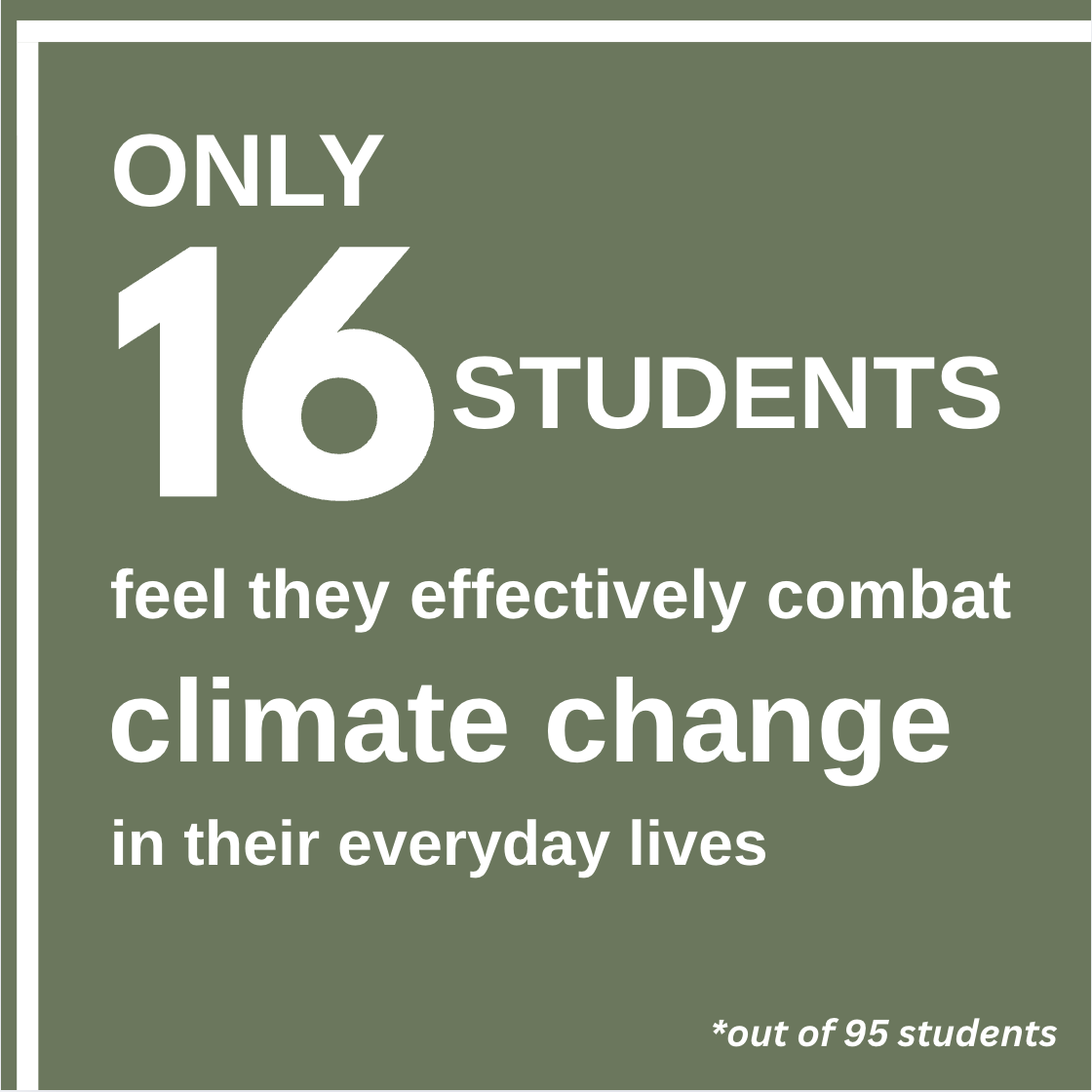
The consequences that feel “far away” aren’t actually distant. Santa Clara County has experienced intense heat waves, worsening air quality driven largely by wildfire smoke and weather whiplash in recent years, all connected to the broader climate issue. The majority of students learn about climate change through social media, yet overlook the reality that our choices have a direct impact and tangible effects, both locally and globally.
Some may argue that students aren’t intentionally being hypocritical and their inaction is simply a result of convenience and force of habit and incorporating new routines can seem unnecessary or even useless. Therefore, students default to what’s most convenient, not out of deliberate disregard, but because these habits are automatic and easier than changing familiar routines. The actions they take may feel insignificant compared to the drastic disasters they see online, making it even easier to stick with the behaviors they’ve always had. In many cases, students don’t take local action not because they’re unaware, but because they don’t genuinely care enough to change their habits, despite constantly engaging with emotional climate content on social media.
However, the fact that climate change can feel distant doesn’t make daily habits any less important. These changes aren’t demanding; they require minutes, even seconds to do, and can make a significant difference. Residential energy use accounts for approximately 20% of U.S. greenhouse gas emissions, and studies of 93 million households indicate that home energy use and daily behaviors significantly influence these emissions. Wealthier households produce 25% more emissions, primarily due to larger homes, and some affluent neighborhoods emit up to 15 times more than nearby areas. Taking minor steps such as turning off unused electronics, using less heating or cooling and washing clothes in cold water can reduce a person’s carbon footprint and reduce overall greenhouse emissions.
The reality of the climate crisis is that it’s closer than it appears on social media. Small, everyday actions, such as limiting food waste, using renewable energy and conserving water can collectively make a real difference. Beyond personal habits, students can get involved in local climate initiatives, whether that’s participating in community cleanups, supporting sustainable policies or any other climate initiatives. Santa Clara hosts several events, such as an annual coastal cleanup day, and San Francisco holds an annual climate week with several events to advocate for climate change. At MVHS, we can start by making an effort to keep our campus clean. Ultimately, we need to move beyond social media awareness and turn concern into tangible action. Climate change may feel overwhelming, but when we start locally, with conscious choices and active participation, we become part of the solution rather than passive observers.