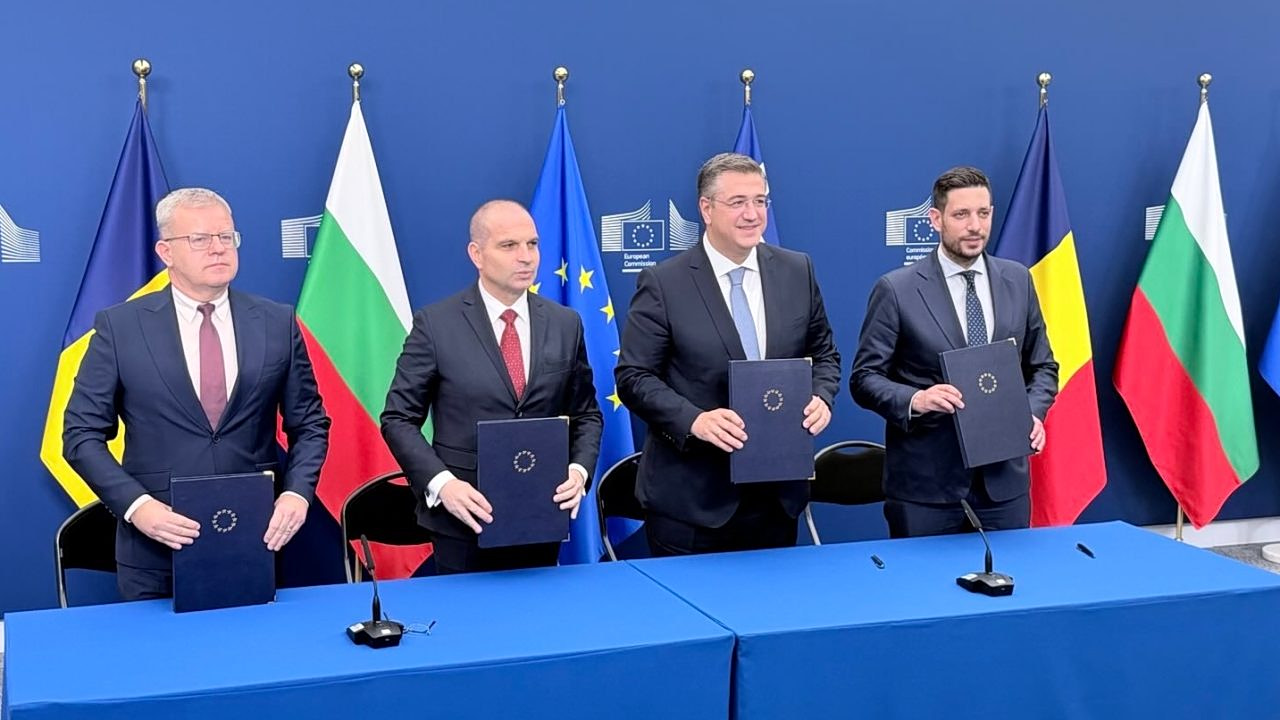
An ambitious new road and rail corridor linking Greece with Bulgaria and Romania has taken a major step toward implementation, following the signing of a trilateral Memorandum of Understanding (MoU) by the countries’ transport ministers in Brussels this week.
The final technical details and financing plan are expected to be presented in 2026.
The project, designated a top priority by European Commissioner for Sustainable Transport and Tourism Apostolos Tzitzikostas, aims to create a safe, seamless transport axis connecting Greece and Central Europe via Bulgaria and Romania. It is envisioned as a strategic vertical corridor running from Thessaloniki to Bucharest through Alexandroupolis and key Bulgarian hubs.
Greece’s Infrastructure and Transport Minister Konstantinos Kyranakis, and his counterparts in Bulgaria, Grozdan Karadjov, and Romania, Ionuț Cristian Săvoiu, signed the MoU, which outlines shared priorities and sets a timetable for coordinated action.
Regional officials say the corridor will enhance connectivity, boost trade, and reinforce the geopolitical standing of all three participating nations.
Once completed, it is expected to also strengthen Europe’s security infrastructure by linking the Aegean and Black seas, facilitating mobility, and improving the resilience of supply chains across Southeastern Europe.
Tzitzikostas hailed the agreement as a “milestone for the whole of Europe”.
“Bulgaria, Romania, and Greece are making a clear, collective choice to deepen their cooperation and strengthen the transport connections that unite them and link them to Central Europe,” he said. “The Black Sea – Aegean region is no longer a peripheral area of the EU. Two of Europe’s largest corridors meet here: the Baltic Sea-Black Sea-Aegean axis of the Trans-European Transport Network and the Rhine-Danube corridor.”
Speaking recently in Athens, Tzitzikostas also referred to the project’s potential to boost tourism flows across Europe, while stressing its importance to regional security. “The EU’s security needs are increasing, and our ability to transport forces, goods and energy across European territory is central to our future,” he said.
Work on detailed mapping of the corridor’s central, western and eastern axes will begin immediately, the Commissioner confirmed. “Within 2026, we will present a joint plan with set priorities and a comprehensive financing proposal.”