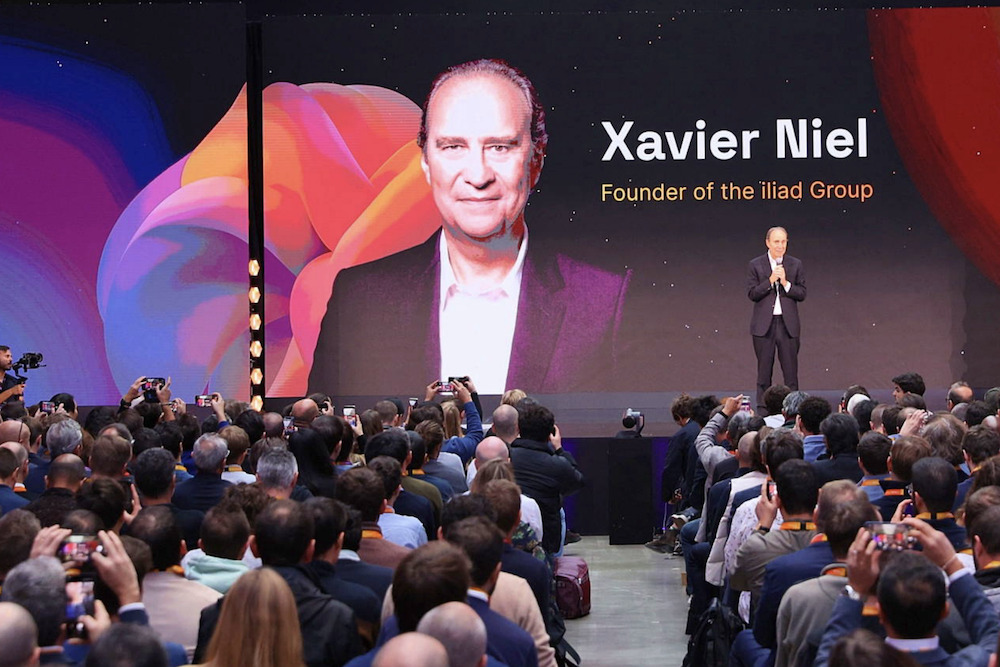
At its ai-PULSE 2025 conference, European cloud operator Scaleway announced the availability of what it claimed was the region’s first Nvidia Blackwell Ultra GPUs (B300-class), marking a significant upgrade in its AI infrastructure offering. The move underlines Scaleway’s ambition to supply advanced, sovereign AI compute to European enterprises and developers and not leave the running to the US hyperscalers.
The company said the Blackwell Ultra B300 adds a “higher performance tier” to its GPU portfolio, aiming to meet the growing demand for agentic AI and large-scale inference workloads across the continent.
At the event, Scaleway detailed an expanded AI stack including access to the model Holo 2 by H, and the full suite of models from Mistral AI – both now deployable on its cloud infrastructure. The company pointed to the ease of deployment through integration with Hugging Face, stating that with “just a few clicks” users can spin up open-source models on European infrastructure.
Among other enhancements, the update includes new ARM-based CPU offerings (in collaboration with Ampere Computing) optimised for energy-efficient, continuous inference, and early testing of next-generation CPUs from Fujitsu (MONAKA), aimed at reducing power consumption and total cost of ownership for sustained workloads.
New Availability Zones
On the expansion front, Scaleway confirmed it has added new cloud Availability Zones in Sweden and Italy, with an additional zone in Germany already committed. The company said these regional rollouts are designed to bring cloud resources closer to organisations across Europe, helping meet rising demand for local data residency, operational resilience and jurisdictional clarity.
Further diversifying its offering, Scaleway also affirmed continued growth in quantum computing capabilities. Users can now access quantum-emulation and hardware from multiple modalities: photonic quantum processing from earlier partnerships, plus new access to neutral-atom systems from French vendor Pasqal and superconducting processors from leading European vendor IQM Quantum Computers.
Scaleway said all these quantum resources are accessible through familiar open-source frameworks such as Qiskit, Pulser, Perceval and PennyLane, essentially putting “advanced quantum methods through a single provider”.
Scaleway CEO Damien Lucas described the upgrade as delivering “the most complete sovereign AI stack available in Europe today”, stressing the importance of trusted infrastructure, energy efficiency and transparent operations amid rising demand.
The announcement builds on a prior move earlier this year: in June 2025, Scaleway acquired assets from Normandy-based analytics and AI firm Saagie and struck major partnerships with France Télévisions and national public computing organisations.
Not all Nvidia
Away from the Scaleway event, Hewlett Packard Enterprise (HPE) announced plans to integrate AMD’s Helios rack-scale AI architecture into its product lineup starting in 2026. This puts it in direct competition with Nvidia’s rack-scale platforms already in service. The Helios design, built on the industry-standard Open Rack Wide form factor and integrating AMD EPYC CPUs, AMD Instinct MI455X GPUs, AMD Pensando networking and the open ROCm software stack, promises high scalability, rack-scale performance, and standards-based Ethernet connectivity.
HPE will put Helios into the hands of cloud service providers and “neoclouds” starting in 2026. The system is engineered to handle “trillion parameter” model training and large-scale inference workloads, delivering up to 2.9 exaFLOPS of FP4 performance per rack, a 260-terabyte-per-second aggregate scale-up bandwidth, and a double-wide, liquid-cooled rack implementation adhering to open-standard design principles.
The two’s approach to Ethernet effectively offers an alternative to Nvidia’s NVLink-centric approach. Helios uses an Ethernet fabric to connect GPUs and CPUs, which is in contrast to Nvidia’s NVLink approach. Nvidia would argue that relying on a single Ethernet layer could introduce latency or bandwidth constraints in real applications but these may end up being questions for 2026.