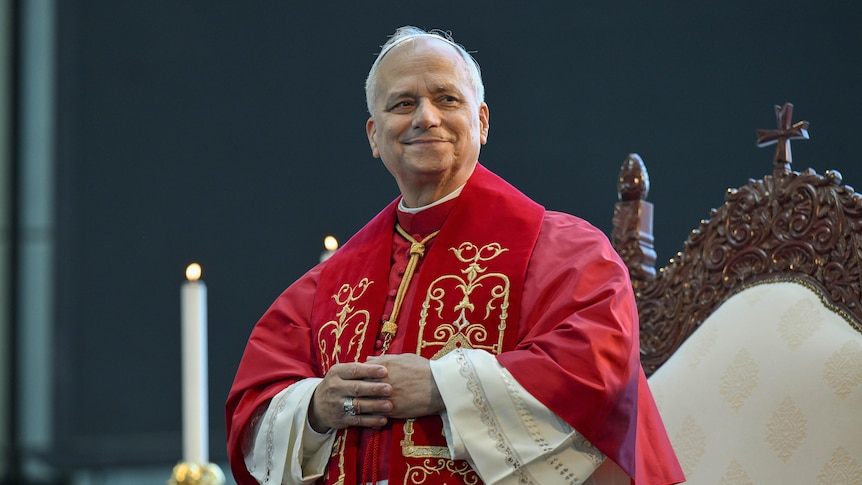
Pope Leo XIV has just concluded his first overseas pastoral visit, a successful six-day journey to Türkiye and Lebanon where he was greeted by cheering crowds and praised for his thoughtful engagement with other faith leaders. He also seems to have managed to navigate the treacherous minefield of Middle East politics with impressive diplomatic skill — a notable improvement on both Popes Francis and Benedict XVI.
Leo’s return to Rome makes a fitting moment to take stock of his first six months as Supreme Pontiff — a period that has, in some ways, been remarkable less for its dramatic pronouncements than for the sheer improbability of this first pontificate “made in the USA”.
Leo’s papacy has been delightfully surreal from the outset, and not just for those bemused Catholics who wondered, Who is this “quiet American”?
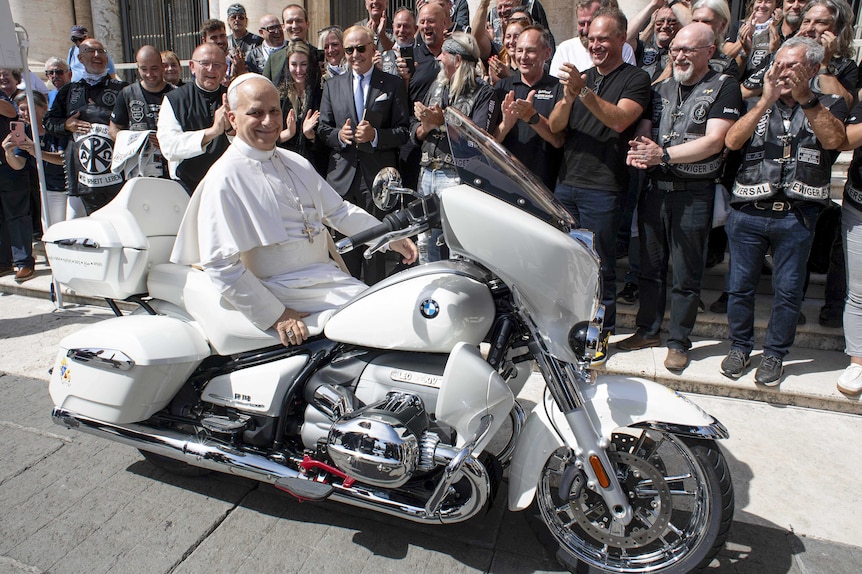
Pope Leo XIV receives a motorcycle as a gift during the General Weekly Audience at St Peter’s Square on 3 September 2025 in Vatican City, Vatican. (Photo by Francesco Sforza – Vatican Media via Vatican Pool / Getty Images)
Leo himself seems perpetually astonished by his elevation. In his first interview as pope, he described approaching church governance as “just dipping my big toe into the shallow end of the pool”. This didn’t come across as false modesty. The pope appears to be a man who is genuinely humble and who is discharging a role he never sought and probably never imagined holding.
His wide-eyed wonder is part of his charm. He looks and acts as if he is the star of a new network sitcom about a mild-mannered maths nerd from suburban Chicago who suddenly finds himself running a 2,000-year-old global institution. “The Geek Shall Inherit the Earth”, as I’m sure the writers would call it (if the studio executives didn’t reject it for being too far-fetched).
Leo is the perhaps first modern pope who seems genuinely at ease with contemporary culture. He does sports. He let himself be photographed sitting on a BMW motorcycle. He grinned ear to ear when given a box of deep-dish pizza from his hometown of Chicago.
When Leo took part in a Q&A session at the American Catholic Youth Conference last month, he sounded like he knew what he was talking about when it came to AI. No one really doubts that he can handle email and a smartphone with actual competence.
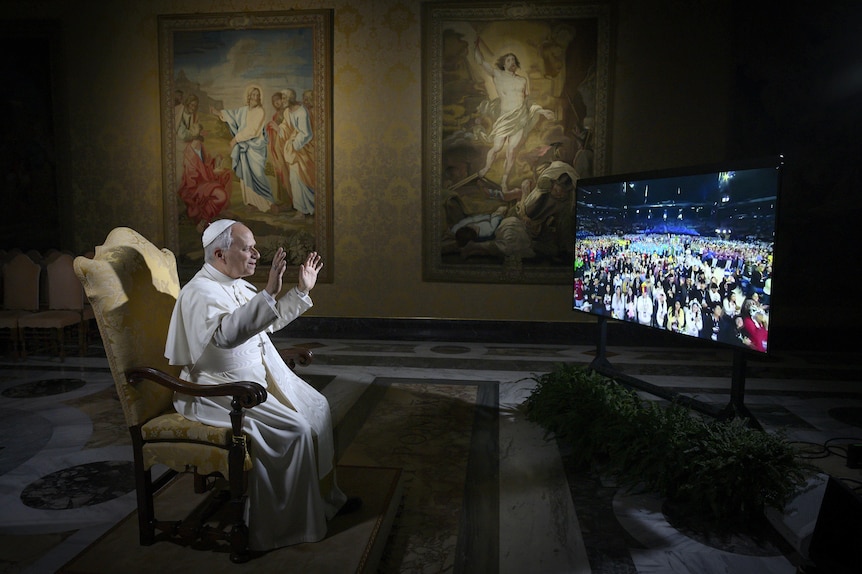
Pope Leo XIV meets, online from the Apostolic Palace, with over 15,000 teenagers gathered in Indianapolis, Indiana as they attended the National Catholic Youth Conference on 21 November 2025. (Photo by Simone Risoluti – Vatican Media via Vatican Pool / Getty Images)
The pope’s bashfulness is proving inspirational for Catholics worldwide. But his modest, self-effacing style is also shaping his approach to leadership and governance. Cautious and methodical, he is refreshingly free from the messianic certainty that can afflict those who’ve spent decades publicly exuding evangelical zeal.
The contrast between Leo and Pope Francis, a man shaped by a pre-television, pre-consumer world in the barrios of Buenos Aires, is unspoken — yet many surely see it.
Francis’s genius perhaps lay in his almost prophetic discomfort with modernity. He critiqued “throwaway culture” and resisted consumer capitalism. He warned about technology. He was nearly apocalyptic about climate change. Leo, by contrast, has the native fluency in the here and now that comes from being a child of the 1960s. He puts the “pop” in pope.
Moreover, where Francis liked to bang heads and offered to “make a mess” — many of his subordinates dreaded the regular clean-ups — Leo delivers steady work, minimal drama, and maximum approachability.
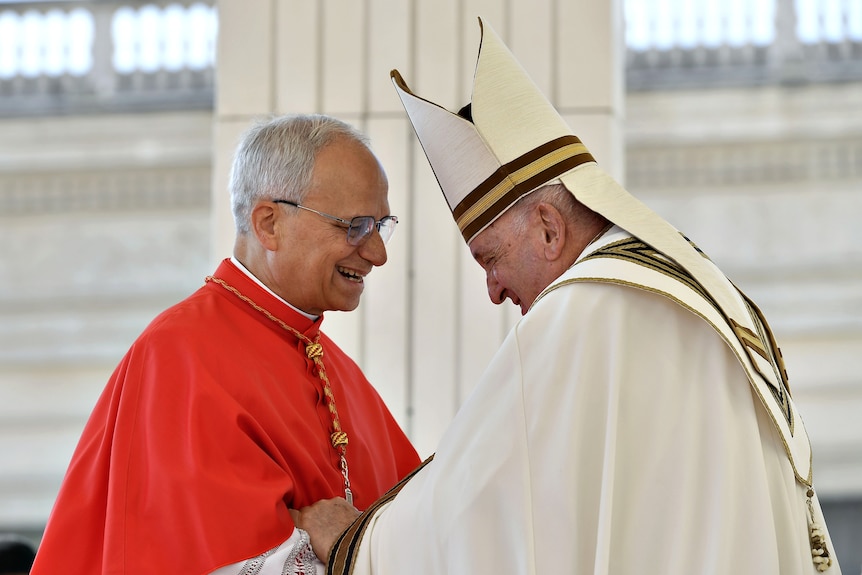
Pope Francis appoints as new cardinal US-born prelate prefect of the Dicastery for Bishops, Robert Francis Prevost, during the Ordinary Public Consistory for the Creation of new Cardinal at St Peter’s Square on 30 September 2023 in Vatican City, Vatican. (Photo by Vatican Media via Vatican Pool/Getty Images)
Right at the start of his pontificate, journalists noted how Leo appeared “looking like Benedict but speaking like Francis”. That has become a theme. Benedict’s stern theological precision — and sometimes his natty sense of style — but channelled through a less ethereal, more relatable personality.
Leo has chosen unity and reconciliation as his papal brand: In Illo uno unum (“In the One, we are one”) his episcopal motto declares. He has met with both conservative and progressive figures during his first six months. In area after area, he has attempted to walk a tightrope between their competing hopes and demands.
Nowhere has this been more evident than on the explosive issue of the Traditional Latin Mass. Francis’s 2021 restriction in Traditionis Custodes left traditionalist Catholics feeling persecuted. However, it also bewildered many moderates — why expend so much political capital on this issue? Leo has inherited expectations from both camps: conservatives want him to reverse Francis’s decree immediately; some progressives hanker after firm continuity.
Sign up for our weekly newsletter.
Leo’s response so far has been studied ambiguity. In September, he acknowledged the issue has become “so polarised that people aren’t willing to listen to one another” — in other words, he lamented how liturgy has become “political tool” rather than making a policy announcement. He promised dialogue with Latin Mass advocates but admitted, “I’m not sure where that’s going to go. It’s obviously very complicated.”
Leo’s approaches to women’s roles in the church, and to questions about LGBTQ+ inclusion, have been similar. He walks a careful line. Appointing Sister Tiziana Merletti as secretary of a major Vatican dicastery, he built on Francis’s earlier endorsement of female leadership. Yet he has firmly ruled out women’s ordination to the priesthood, citing Apostolic tradition. He has even expressed scepticism about women deacons, noting we should first understand what the diaconate itself is before discussing who should receive it:
Why would we talk about ordaining women to the diaconate if the diaconate itself is not yet properly understood and properly developed and promoted within the church? And what are the reasons for that?
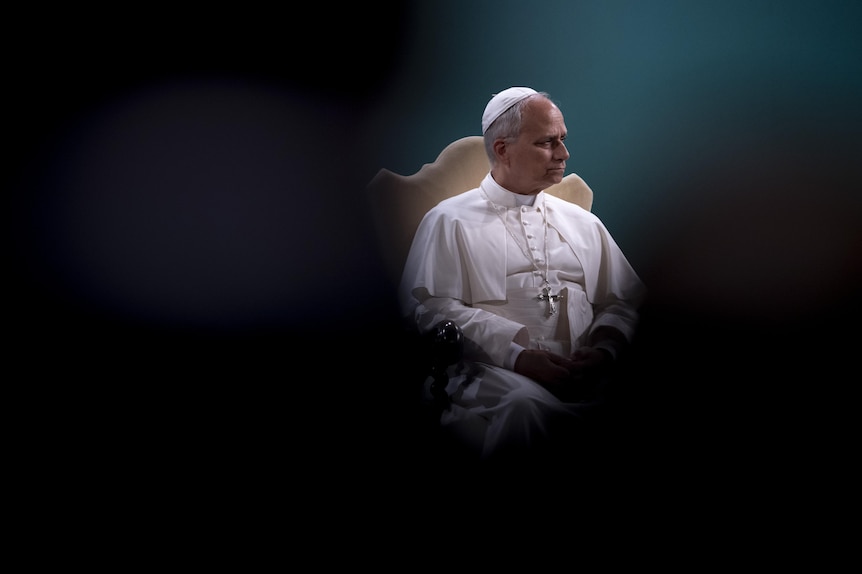
Pope Leo XIV attends the International Conference “Raising Hope for Climate Justice” as part of the Tenth Anniversary of the Encyclical Laudato Si’, at Mariapolis Center at Castel Gandolfo on 1 October 2025 in Albano Laziale, Italy. (Photo by Antonio Masiello / Getty Images)
In some ways, what’s most striking about Leo’s first six months is, therefore, what hasn’t happened. There have been no dramatic encyclicals, no controversial curial purges, few even quotable soundbites that could generate weeks of headlines.
Dilexi Te, Leo’s first Apostolic Exhortation, about our obligation to love and care for the poor, develops a text inherited from Francis. However, its very generality — vague prescriptions, no concrete actions — makes it a bit of an ecclesiastical equivalent of “motherhood” and “apple pie”.
Even Leo’s major appointments have been reassuringly safe. Filippo Iannone, an experienced canon lawyer, now heads the Dicastery for Bishops. Francis’s appointees have been retained provisionally. Leo apparently meets with existing prefects before making any changes.
An imperial papacy this is not. It bears the mark of a man who knows the institution well enough to understand that precipitous or quixotic actions create far more problems than they solve.
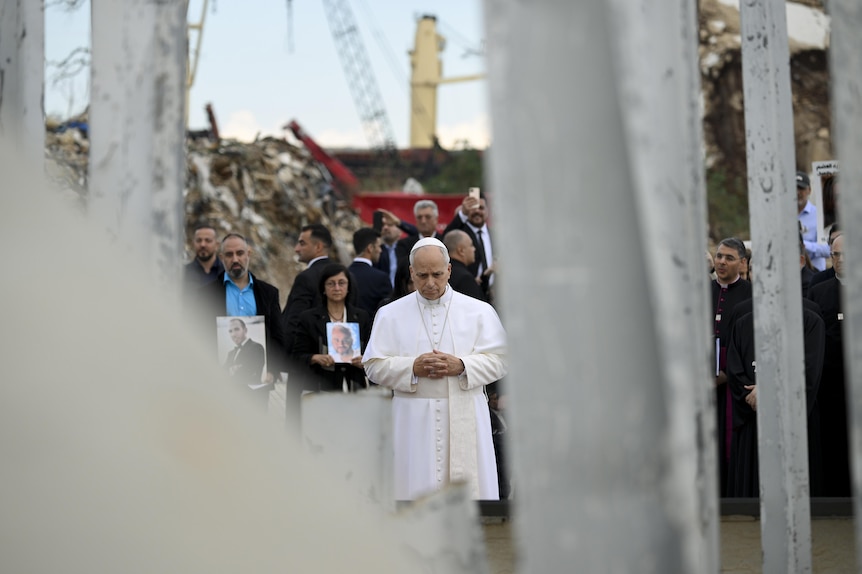
Pope Leo XIV attends a silent prayer at the site of the Beirut Port explosion on 2 December 2025 in Beirut, Lebanon. (Photo by Elisabetta Trevisan – Vatican Media via Vatican Pool / Getty Images)
Leo’s caution may have particular significance for U.S. politics. As the first American pope, Leo could have easily waded into culture-war battles or become a cudgel for partisans. Instead, ever since he came out onto the balcony of St Peter’s Basilica speaking in only Italian and Spanish, he has tried to maintain a careful distance from the more toxic culture-war conflicts being fought land of his birth.
When asked about Trump administration immigration policies, he said, “I prefer not to comment at this time about choices made, political choices within the United States”. On the other hand, he has also told American bishops they must speak more forcefully about justice for migrants, challenging them to be “stronger in their own voice”.
On China, Leo has pledged to continue Francis’s controversial engagement policy while admitting “it’s a very difficult situation”. On finances, his first motu proprio has strengthened oversight mechanisms; sensible if unglamorous. On abuse, his appointment of Iannone — who chairs a working group defining “spiritual abuse” — signals seriousness. However, his own record will doubtless face ongoing scrutiny.
The difficulty for Leo will come when he can no longer split the difference, when the calculus of papal diplomacy demands that he actually chooses sides. Warm words about loving the poor cost nothing; deciding whether the church should forego returns on investments to support its ethical positions requires taking a stand that will alienate constituencies — the same goes for other economic issues, such as whether the church should support wealth redistribution through progressive taxation.
The Israel-Gaza conflict may offer a particularly acute test case. Leo currently endorses the two-state solution, but this viewpoint is so naively safe that it’s nearly meaningless given current realities. What happens if it becomes undeniable that a two-state solution is no longer on the table — that the choices for Palestinians are, for example, between Israeli annexation, exile, or permanent limbo?
Similarly on immigration: Leo has so far maintained Francis’s almost unbounded support for migrants and his insistence that people have a right to move to improve their circumstances — yet he may, eventually, have to acknowledge trade-offs between this principle and questions of security, cultural identity and the economic capacity of receiving nations.
Can Leo honestly address the reality that societies cannot support the poor unless they themselves remain prosperous? What answer does he have to the proposition that even wealthy nations like the United States, Europe and Australia cannot absorb and materially support an unlimited number of migrants from the Global South without straining, maybe even destroying, their social fabric?
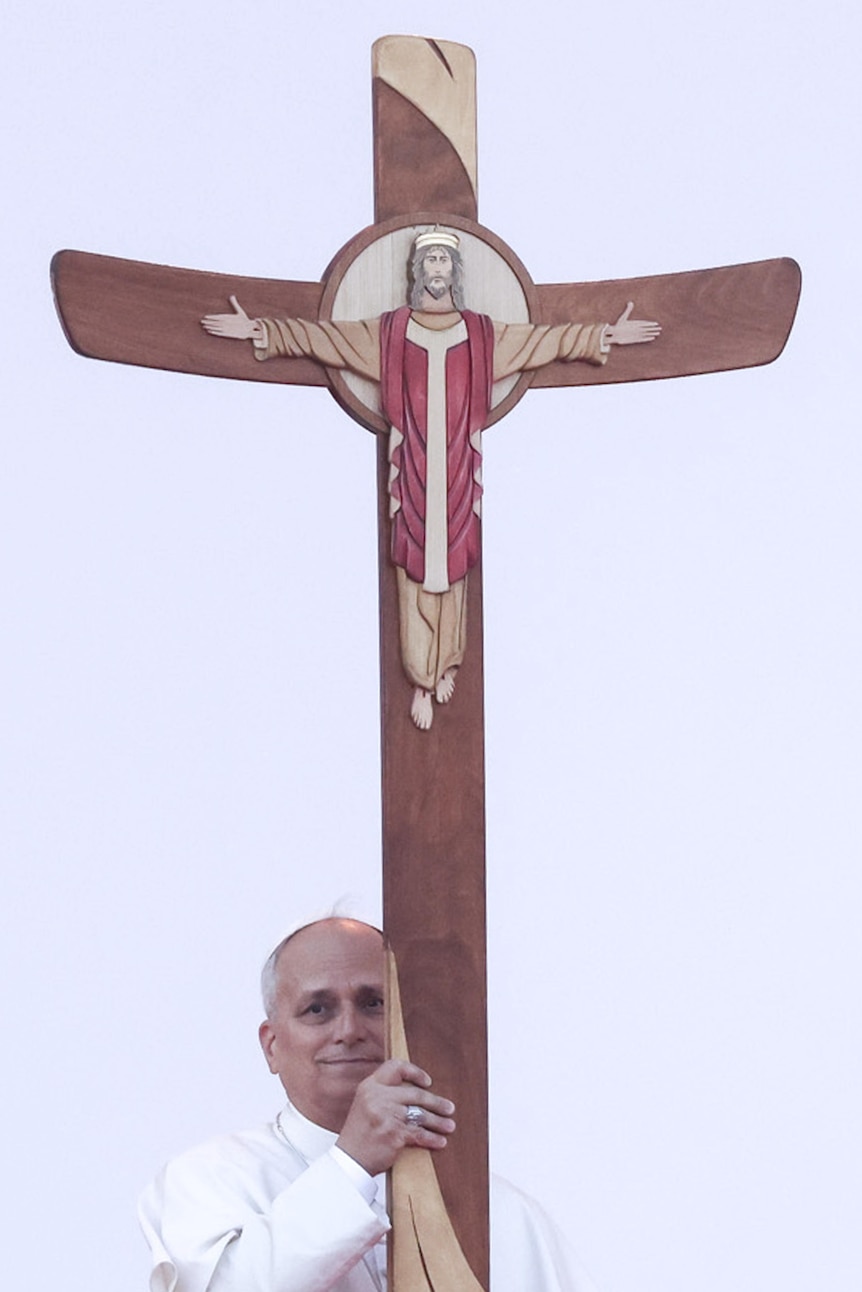
Pope Leo XIV carries the Holy Cross as he arrives in Tor Vergata to lead a special vigil prayer on the occasion of the Jubilee of Youth, on 2 August 2025 in Rome, Italy. (Photo by Alessandra Benedetti – Corbis / Corbis via Getty Images)
One of Francis’s greatest weaknesses was that he rarely seemed interested in showing that he understood his interlocutors’ arguments, in summarising them in good faith, or in rebutting them systematically and with courtesy. Leo needs to do more than this if he wants to have lasting impact.
He also needs to have a clear sense of what lies within the moral sphere and what in the political. He has the authority to pronounce in the former but not in the latter. Indeed, were he to do so it could reignite tensions, currently dormant, among Catholics.
Six months in is too early for definitive judgements on Leo. He is seventy but nevertheless still seems young. At August’s Youth Jubilee, he carried the Cross as an ordinary pilgrim and with unusual vigour. He told the crowd to “study, work, and love according to the example of Jesus”. Potentially his pontificate could go on for more than two decades.
So far Leo has governed through pastoral warmth, quiet competence and careful incrementalism. Whether that approach actually heals the Catholic Church’s deep, perennial divisions or merely postpones a necessary reckoning of them is the question that will define his papacy.
Miles Pattenden is a medieval historian and researcher at Deakin University and the University of Oxford. He is the author of Electing the Pope in Early Modern Italy, 1450-1700.