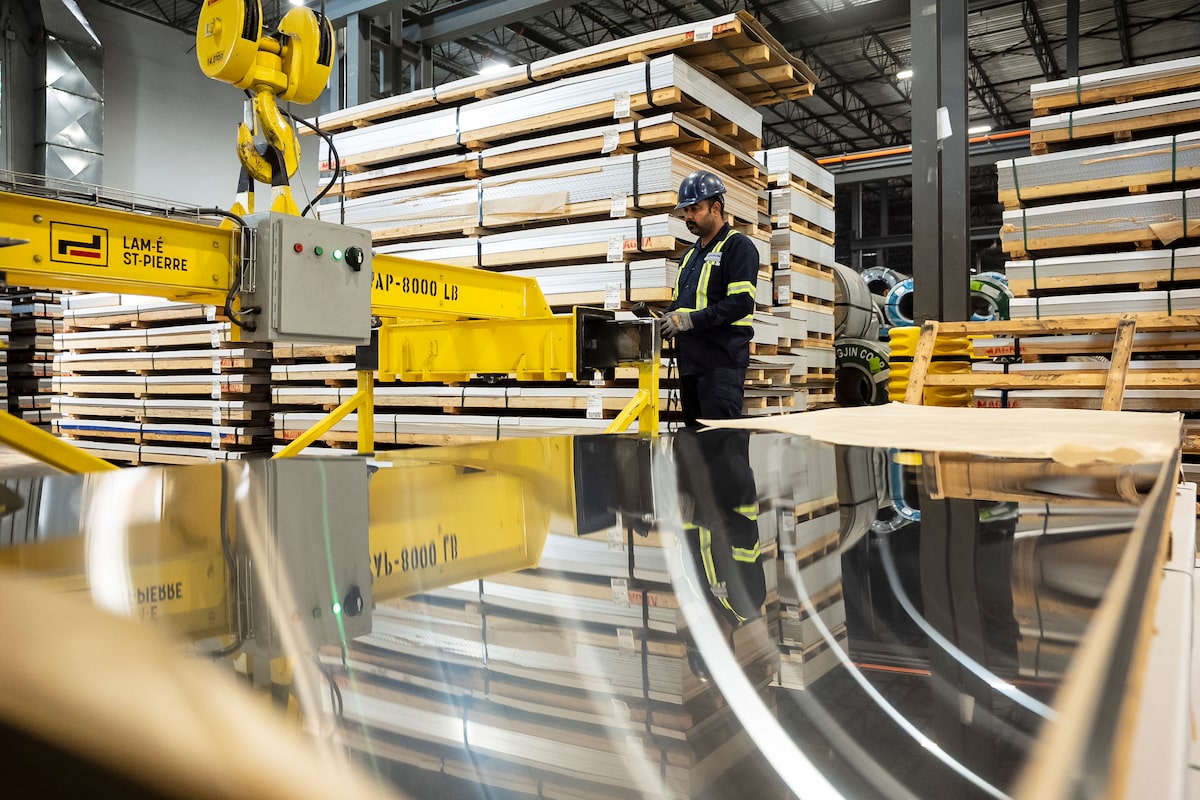
Workers load sheets of stainless steel after being pressed from coils, at Magna Stainless and Aluminum in Montreal on Sept. 18. The Trump administration has placed hefty tariffs on steel and other goods from Canada.Christopher Katsarov/The Canadian Press
The United States should scrap all national-security-based tariffs on imports from Canada and Mexico – including on aluminum, steel, cars and lumber – and move quickly to renew the three-country agreement that upholds North American free trade, the largest U.S. business group told President Donald Trump’s administration on Thursday.
But if the administration instead chooses to take a wrecking ball to continental trade, consumers in the U.S. can expect new difficulties buying the goods they need, warned a different group, an alliance of some of the world’s largest foreign corporations.
The admonishments from powerful figures in the global economy came midway through a three-day hearing held by the Office of the U.S. Trade Representative, a requisite part of its preparations for a review of the United States-Mexico-Canada Agreement that will formally begin on July 1, 2026.
Mr. Trump celebrated that agreement, a successor to the earlier North American free-trade agreement, when it was signed during his first term.
However, he and his lead negotiators have cast doubt on its future ahead of talks next year that could lead to a 16-year extension of the deal, a decision to review it annually – or a U.S. withdrawal from a tripartite pact that, in combination with NAFTA, has for decades underpinned the free movement of goods on the continent.
Trump may use USMCA withdrawal as a bargaining tactic, trade experts warn
Jamieson Greer, the U.S. Trade Representative, raised the latter possibility in comments to a Politico podcast that will be released Friday, saying “the President’s view is he only wants deals that are a good deal. The reason why we built a review period into USMCA was in case we needed to revise it, review it or exit it.”
Mr. Greer said he had also recently spoken with Mr. Trump about the possibility of splitting apart Canada and Mexico, signing separate trade agreements with each.
Mr. Greer’s willingness to discuss a possible exit from USMCA signals the U.S. has the “intention to get the best deal possible,” said Laura Dawson, executive director of Future Borders Coalition, an advocacy group.
“They are not afraid to disrupt established norms to get it. I would expect that the Canadian and Mexican negotiators are bringing a similar level of ambition to the talks as well.”
The White House has won support for its tariff agenda from some groups, including the United Auto Workers (UAW) union.
But U.S. consumers will be poorly served if the country disrupts continental free trade, warned Danny Meza, director of trade policy at the Global Business Alliance, whose corporate members include some of the world’s largest international insurers, manufacturers, miners and pharmaceutical companies.
From airlines to winemakers, U.S. businesses push Trump to preserve North American free trade
Any sudden imposition of new reporting requirements, or compliance obligations, could cause supply chain disruptions “and reduced access to essential goods,” he told the hearing Thursday.
He called USMCA “a cornerstone of North American economic integration and competitiveness,” warning that “it is critical that the agreement is not reopened or renegotiated in ways that could destabilize.”
Still, the coming review has brought a series of irritants to the fore.
U.S. Chamber of Commerce senior vice-president Neil Herrington accused Canada of failing to properly uphold free trade in dairy, health care and digital trade. Mexico, he argued, has fallen short of its obligations in agriculture, energy, government procurement and other areas.
But the U.S. imposition of tariffs on Canada and Mexico also stands “in clear violation of the USMCA’s core commitment to maintain tariff-free trade,” he said at the hearing.
The chamber, the largest business group in the U.S. – and, it says, the world – is an “unabashed” supporter of North American free trade, Mr. Herrington said, arguing that 13 million U.S. jobs depend on ties with Canada and Mexico.
Economy was on stronger footing heading into trade war, Statscan revisions show
The Trump administration, he said, should conclude USMCA negotiations quickly in order to bolster investment confidence.
He called for “restoration of the USMCA’s duty-free access,” including the removal of tariffs currently in place on Canada and Mexico under Section 232, which allows for import taxes on goods that threaten U.S. national security.
The Trump administration has used that rationale to back significant levies on imports of steel, aluminum, cars and lumber that have proved deeply disruptive to Canada, Industry Minister Mélanie Joly acknowledged Thursday.
In Canada’s steel sector, the “entire business model has been developed on servicing, supporting the U.S. automakers on the other side of the border. And that business plan doesn’t work any more with 50-per-cent tariffs,” she told a House of Commons committee.
In the U.S., however, those tariffs have been popular with some sectors. The Steel Manufacturers Association, which represents more than 70 per cent of U.S. steel capacity, told the Thursday hearing that Section 232 tariffs should remain in place, no matter what happens with USMCA.
U.S. steelmakers have accused both Canada and Mexico of becoming conduits for Chinese-made product, damaging the domestic industry.
Since Mr. Trump imposed Section 232 tariffs on those two countries, “there is a nearly one-to-one ratio between the decrease in steel imports from Canada and Mexico and the increase in American raw steel production,” Brandon Farris, the association’s vice-president of government affairs, said Thursday.
“The Section 232 program has been remarkably effective.”
He called for new measures, too, to require that “all steel and steel-intensive products be melted and poured in North America to qualify for USMCA treatment.”
But across the wide sweep of the American economy, companies and industry groups have largely argued in favour of the free flow of goods.
Thanks to USMCA, “the United States today is economically stronger, more secure, and strategically positioned to win against aggressive foreign adversaries in the future,” said Kevin Brady, co-chair of the Coalition for North American Trade.
Mr. Brady, a Texas Republican, is a former U.S. Representative who built congressional support for USMCA during Mr. Trump’s first term.
Canada and Mexico together “buy five times more made-in-America products and services than any other country in the world,” he said Thursday. The two countries combined form “America’s top customer, our top investor and our most important suppliers.”
It’s not clear how persuasive those arguments will prove to a White House intent on using tariffs to protect domestic industry.