News last week that China had published a white paper on arms control seemed promising, because it raised hopes that Beijing would provide some rationale or plan for its nuclear expansion of the past few years. Alas, it did no such thing.
China has been engaged in an unprecedented nuclear weapons build-up, almost doubling its number of nuclear warheads in a short time. There has been little indication of how far this will go, and there’s no insight in the white paper published on 27 November.
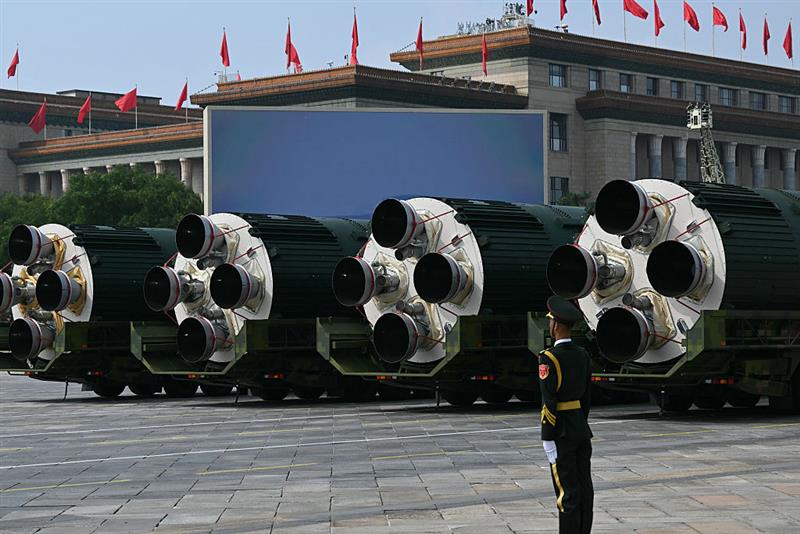
China’s nuclear expansion has been spectacular. For several decades it held around 300 warheads, with only a third being in intercontinental delivery systems. It now has around 600, according to the Bulletin of Atomic Scientists, with most of the expansion apparently in intercontinental missiles.
In September, China also unveiled a number of new nuclear missile types, including an air-launched nuclear ballistic missile. The US Department of Defense estimates that China will have well over 1,000 warheads by the end of the decade.
But there has been little indication of how many China actually plans to build. If its objective is prestige, seeking rough numerical parity with the US, it will need to build about 5,000 warheads, meaning the expansion could continue for some time. It’s problematic that the rest of the world has to guess both the reason and the end goal.
The white paper is unclear about this critical issue. Some sections suggest that China wants nuclear parity: for example, it begins by saying that the global balance of power is moving ‘towards greater equilibrium’. Does this apply to nuclear weapons? It does not clarify.
Later, the document claims that there is growing risk of a nuclear arms race, which is strange because neither the US nor Russia are engaged in nuclear expansion. A nuclear arms race could come only from China’s own nuclear build-up.
If China is seeking parity with the US, the key question is what policy changes will follow this expansion. Momentum towards a nuclear arms race could gather pace if the US–Russia New START nuclear arms reduction treaty expires in February with none of its provisions remaining in force, as the US Arms Control Association says is likely.
Does Beijing’s reference to a nuclear arms race refer to competition in technology? Here too, the indications are unclear, because the world is seeing little dramatic improvement in nuclear weapons or their delivery vehicles. The white paper touches on technology only in the context of missile defences. This is a concern. The document criticises US plans for the Golden Dome missile defence system. But President Donald Trump didn’t outline the idea for the Golden Dome until January, whereas China has been expanding its nuclear system for several years. And while the Golden Dome builds on existing US missile defence capabilities that China has long disliked, the US has made no dramatic defensive technological breakthroughs in the past decade that would prompt an expansive response from Beijing.
Moreover, even as the white paper criticises US missile defence plans, it acknowledges and defends China’s own missile defence plans in the next paragraph. China, the document says, ‘has a vast territory and must deal with a complex and volatile security environment’. This requires, among other capabilities, missile defences, though this is ‘motivated exclusively by self-defense and does not target any country or region’.
The white paper reinforces Beijing’s insistence that it will not join nuclear arms control until ‘the countries possessing the largest nuclear arsenals’—meaning the US and Russia—reduce their nuclear arsenals. ‘When conditions are ripe’, all nuclear powers, presumably including China, will join. And yet the pace of China’s nuclear expansion means that instead of the US and Russia reducing their nuclear arsenals, China may grow to match them. Whether there will be any nuclear arms control at that point remains to be seen.
The white paper also rails against AUKUS, even though any nuclear transfers under AUKUS will likely be monitored by the International Atomic Energy Agency, and AUKUS includes transfer only of nuclear-powered submarines, not nuclear weapons.
In criticising AUKUS, China ignores its own role in transferring nuclear weapons technology to Pakistan and thence to others. In the white paper it continues to shield nuclear proliferationists such as North Korea and Iran, referring to excuses such as ‘root causes’ of nuclear proliferation and criticising Western policies as being too aggressive. These are old tropes that have led to North Korea’s development of nuclear weapons and Iran’s attempts to do so.
In avoiding clarification of its nuclear expansion in the white paper, China has missed a great opportunity to set out its nuclear plans and intentions, a move that would have reassured the region and the world. Its deliberate obfuscations, its refusal even to acknowledge the unexplained, sudden and dramatic growth of its nuclear forces, will only deepen feelings of insecurity and potentially propel the world towards a new nuclear arms race that no one wants.