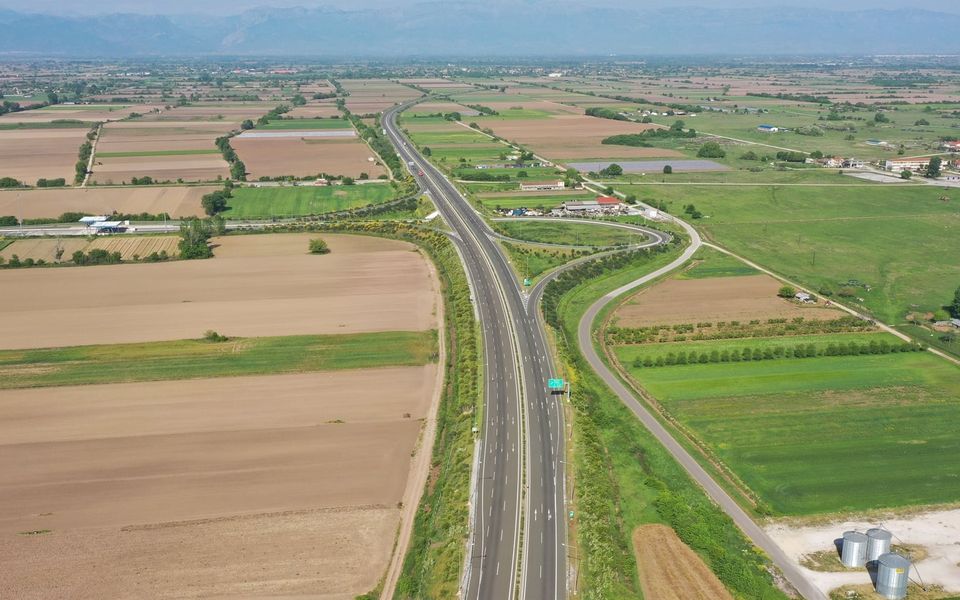
After no fewer than 16 years, the section of the E65 highway linking Lamia (in central Greece) with Kalambaka (in Thessaly) was officially launched on Tuesday in the presence of Prime Minister Kyriakos Mitsotakis. This is a 136-kilometer section of the road that the PM dubbed ‘a decades-long dream.’ The highway is not yet ready in full, but only three-quarters, as the final section linking Kalambaka with the Egnatia Odos – the highway that runs across northern Greece – which covers another 46 kilometers, will be ready in the next couple of years, according to Mitsotakis. The project has been co-funded by the European Union.
Greece, Bulgaria and Romania’s agreement on the Aegean-Black Sea Vertical Corridor, a strategic rail and road axis that will connect the three countries via Alexandroupoli, has been signed in Brussels.
The agreement was signed by European Commissioner for Sustainable Transport and Tourism Apostolos Tzitzikostas, Alternate Minister of Infrastructure and Transport Konstantinos Kyranakis, Bulgarian Deputy Prime Minister and Minister of Transport Grozdan Karadjov, and Romanian Deputy Minister of Transport Ionut-Cristian Sevoiu, marking the strengthening of cross-border cooperation and the launch of a project of high geopolitical and economic importance for the region.
“The memorandum aims to transform the geographical location into a substantial strategic advantage and to harmonize planning, timetables and financing,” Tzitzikostas said, underlining in his speech the crucial role of the Aegean-Black Sea Vertical Corridor in the European transport network.
As he said, a central role in this new framework belongs to the Thessaloniki-Alexandroupoli-Bucharest axis, which “will constitute one of the most important strategic arteries in Europe,” with critical importance for both connectivity and military mobility of the EU and NATO.