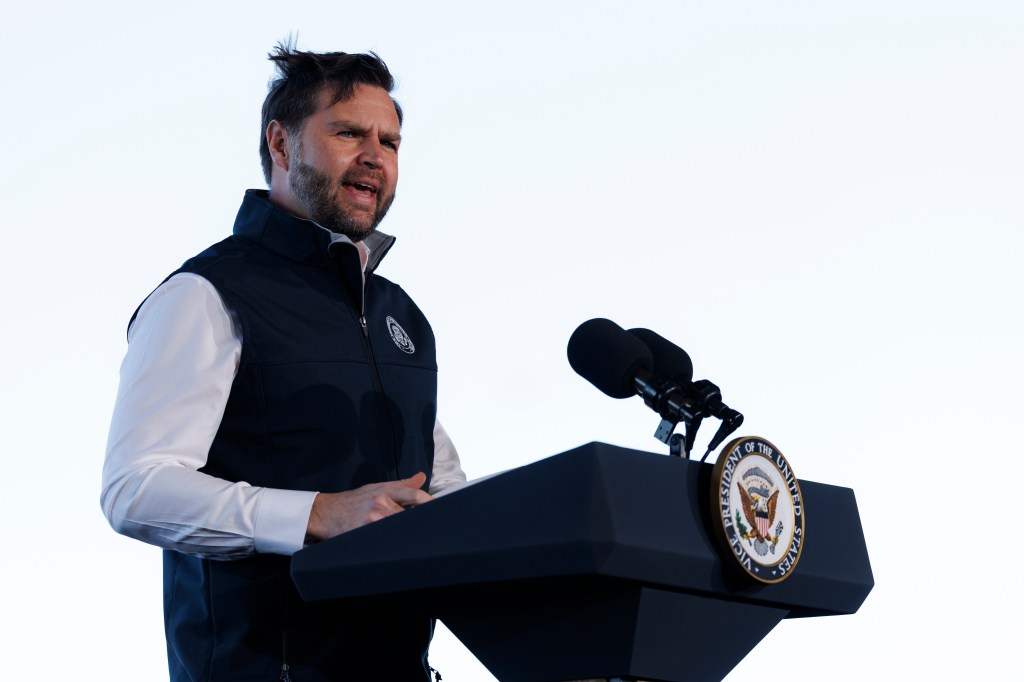
The battle for the 2028 Republican presidential nomination begins in less than 12 months. But GOP insiders gaming out the party’s future are not convinced Vice President J.D. Vance will face meaningful competition in the primary.
Vance, 41, is expected to be endorsed by President Donald Trump and key members of the president’s family, particularly Donald Trump Jr. The vice president will be boosted by the president’s political machine, as well as his own. And an ecosystem of populist media influencers, outlets and organizations—and perhaps the entirety of a MAGA political movement that has coalesced around Trump over the past decade—will flock to him. Combined with Vance’s popularity among GOP primary voters, ambitious Republicans mulling a 2028 White House bid might ultimately conclude he is impenetrable in the primary.
“Absent an act of God, Vice President Vance is the only logical path forward and will get the Republican nomination in 2028,” Republican lobbyist Douglass Mayer told The Dispatch. Mayer, who advised former New Jersey Gov. Chris Christie’s 2024 bid for the GOP nod, predicted any challenge to Vance that does arise would be “quixotic.”
But suppositions about Vance’s political strength could evaporate if the Republican Party gets mauled in the 2026 midterm elections, veteran Republican operatives emphasized in interviews this week.
The party that controls the White House typically stumbles midterm. But if Democrats win big, snagging control of the House of Representatives and the Senate while defeating GOP candidates in critical state and local races across the country, at least some of the viable Republicans interested in running for president in 2028 would reevaluate any hesitancy to take on Vance. Should a Republican wipeout dovetail with a slumping economy and hardened voter dissatisfaction with Trump, the list of prominent Republicans willing to challenge the vice president could multiply.
It shouldn’t be ruled out. While he enjoyed stable approval ratings at the start of his second presidency, Trump is now enduring severe political headwinds. His job approval numbers are down, the Democratic Party’s lead on the generic ballot gauging who voters plan to support for Congress next year is growing and even Trump supporters are getting antsy with his handling of voters’ No. 1 priority: addressing the cost of living.
“Trump in his final two years could be a whole different story than what we’ve seen so far. [If so,] MAGA World’s war for its future would erupt further into the wide open and there will be more traditional conservative Republicans who think they can capitalize,” Republican operative Jeff Burton told The Dispatch. “While J.D. Vance is certainly the frontrunner for the 2028 nomination right now, it remains to be seen if being Trump’s VP will be a blessing or a curse.”
Vance is, for now, adhering to the protocol followed by both Democrats and Republicans to wait until the day after the midterm elections to publicly acknowledge intentions to seek the White House and make overt preparations for a campaign, like hiring staff and visiting early primary states. The vice president and his team are generally declining to engage in discussions about his all but certain plans to run for president in 2028, although Vance last month did tell Fox News’ Sean Hannity: “I’ve thought about what that moment might look like after the midterm elections, sure.”
“We’re going to do everything that we can to win the midterms, and then after that, I’m going to sit down with the president of the United States and talk to him about it,” Vance added during that interview. (Unsurprisingly, both Vance’s spokesman in the West Wing and one of his senior political advisors declined to comment for this story.)
If Vance’s team was willing to engage, they might have pointed to the Rockbridge Network, a consortium of Republican donors and conservative activists. Initially, the network—co-founded by Vance and Republican mega donor Peter Thiel and now overseen by GOP operative Chris Buskirk—focused on reelecting Trump (in 2020) and empowering the “Make America Great Again” coalition of populists that sprung up around the president. In 2028, Rockbridge is sure to put its activist, financial, and political muscle behind electing Vance, who since March has been moonlighting as the Republican National Committee finance chairman. None of Vance’s potential primary opponents would begin a campaign with comparable institutional backing. And that’s before accounting for the power of Trump’s endorsement and support of his staunch allies across the party.
But that’s not the only advantage Vance wields at the starting gate, at least less than 11 months before the November 3, 2026, midterm elections and the kickoff to both parties’ presidential primaries. The vice president happens to be quite popular with Republican voters, according to private survey data that GOP pollsters shared with The Dispatch.
For instance, one Republican pollster who has tested Vance in various states with competitive primary campaigns for House seats has found that his favorable ratings tend to average around 75 percent. Just 9 percent to 12 percent of GOP primary voters in these surveys have rated the vice president unfavorably. A second Republican pollster, who tested Vance with “likely GOP primary voters” nationally in early October, found the following:
Vance had a favorable/unfavorable rating of 85 percent/10 percent, with 52 percent viewing Vance “strongly favorably.”
Vance enjoyed a “strongly favorable” rating of 78 percent among self-described “MAGA voters.”
Among GOP primary voters who said they were committed to pulling the lever for a Trump-endorsed candidate, Vance’s “strongly favorable” rating was 78 percent. Notably, this group amounted to 40 percent of the primary electorate.
“Voters feel a certain kind of way about the vice president, and until that changes, anyone who runs against him is running into an airplane propeller,” a Vance supporter told The Dispatch, requesting anonymity to discuss the vice president’s likely 2028 campaign.
Formidable Republican presidential contenders other than Vance include Texas Sen. Ted Cruz, the runner-up for the nomination in 2016; Florida Gov. Ron DeSantis, who fell short in 2024 after entering the race as a frontrunner; Secretary of State Marco Rubio, who sought the White House in 2016; and Govs. Brian Kemp of Georgia and Glenn Youngkin of Virginia, neither of whom have run before.
Republican operatives believe this group of possible candidates and other potential 2028 contenders capable of mounting a viable campaign will spend the next year-plus strategizing a White House bid with top advisers. Given the sensitivity of running against a popular sitting vice president in a primary, and concerns about eliciting a negative backlash from Trump, those conversations are likely to be quieter, and limited to a tighter circle, than usual.
Some Republican strategists expect a GOP primary with multiple strong candidates regardless of the outcome of the midterm elections and Vance’s enviable standing with the party’s electoral base. Politicians who reach a high enough level to be considered presidential material are ambitious. They tend not sideline themselves simply because the odds of winning are long (they often dismiss this sort of conventional wisdom.) Vance’s short, albeit meteoric political history, is another factor.
The vice president has three campaigns under his belt: In 2022, he won the Republican nomination for Senate in Ohio and the ensuing general election; and he was Trump’s 2024 running mate. Some Republicans eyeing the presidency might determine Vance hasn’t been tested and is more vulnerable than his high favorable ratings suggest. Some might reason that Republican voters need choices because sitting vice presidents have a terrible record of winning the White House: It’s happened only twice.
“As someone who has worked with multiple presidential candidates, I don’t think we should ever underestimate the ambition of those who think they should be president. I would anticipate that there will be some who will calculate that even if President Trump backs Vice President Vance that they can defeat him in a primary,” a Republican operative said. “There will be no shortage of consultants who will assist in that thinking.”