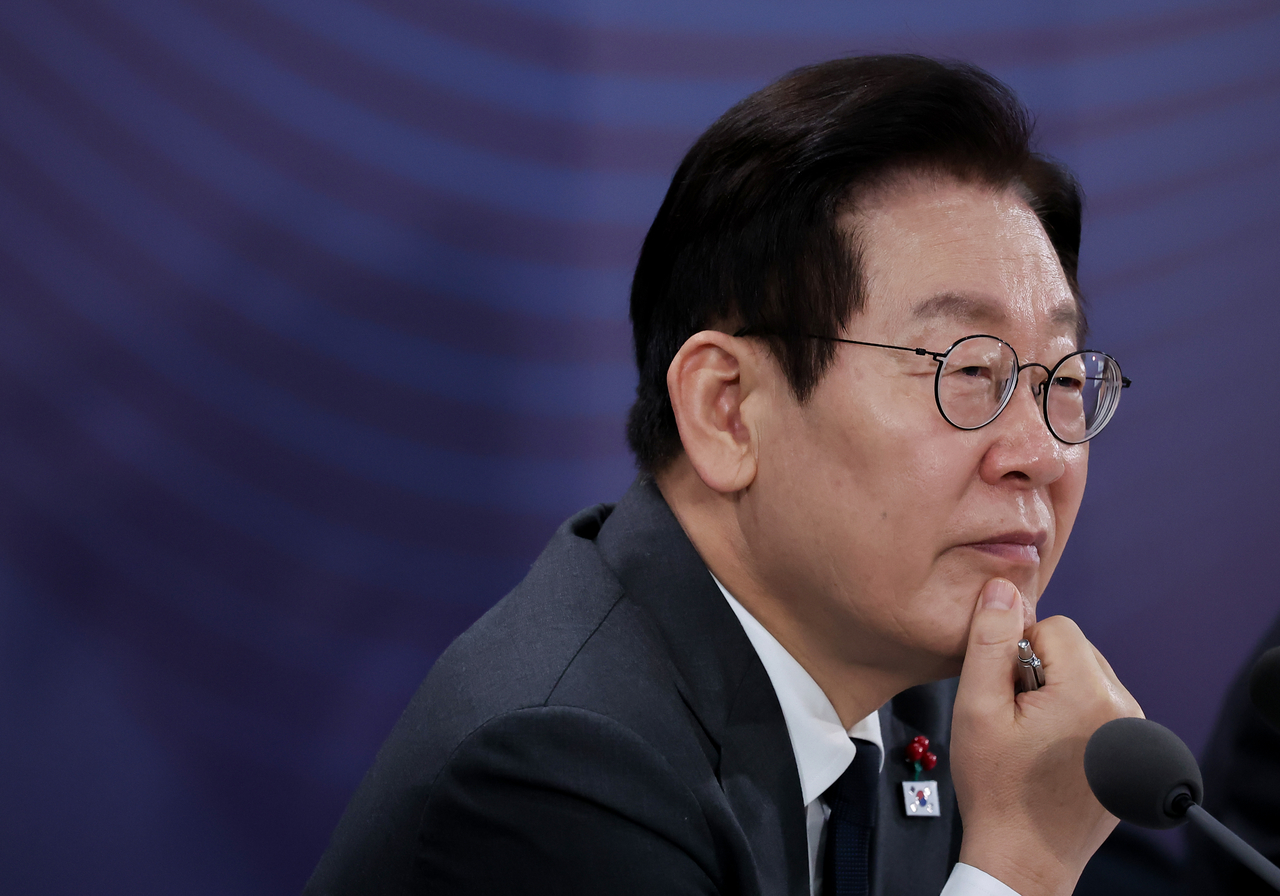
 South Korean President Lee Jae Myung listens to participants during a town hall meeting held at Korea University of Technology and Education in Cheonan, South Chungcheong Province, Friday. (Yonhap)
 President Lee Jae Myung said Friday that soaring housing prices in the Seoul metropolitan area cannot be easily resolved even if the government exhausts all available policy tools, calling the capital-region concentration a “national risk factor” that threatens South Korea’s long-term development.
Speaking at a town hall meeting at Korea University of Technology and Education in Cheonan, located 90 kilometers south of Seoul, Lee acknowledged growing public frustration over housing affordability.
“I tend to get criticized a lot because of housing prices in Seoul and the surrounding metropolitan area,” he said. “But land is inherently limited while people keep moving into the Seoul area, making it fundamentally difficult to solve.
“Even if we gather every bit of wisdom we have and mobilize all available policy capacity, it is not something that can be easily resolved.”
“Even so, I want to try to address the root causes,” he said, stressing that regional balance is no longer a matter of fairness but “a strategy for national survival.”
Lee argued that capital-region concentration, once viewed as an engine for growth, has become an impediment that “seriously undermines national development.”
Without greater regional investment and decentralization, he warned, “even maintaining the current level will be impossible.”
The president pointed to measures previously explored by past administrations — including relocating public institutions and dispersing administrative functions — and said such initiatives “must now move forward with greater speed.”
He also voiced support for megacity initiatives such as the proposed Sejong–Daejeon–South Chungcheong alliance, adding that broader integration could help local regions pool resources and strengthen competitiveness. Lee welcomed renewed discussions on integrating South Chungcheong Province and Daejeon, calling the idea “desirable,” though he acknowledged political interests remain obstacles.
Lee’s remarks come as housing market pressure persists in the capital. Apartment prices in Seoul have continued to climb for 44 consecutive weeks. According to data released Thursday by the Korea Real Estate Board, average apartment prices in Seoul rose 0.17 percent from the previous week, only slightly down from 0.18 percent rise the week before.
The Bank of Korea also noted last month that while housing price gains and transaction volumes have cooled somewhat in Seoul and nearby areas, expectations of further price increases remain elevated — particularly in districts along the Han River, where sharp recent rises have fueled speculative buying and posed early policy challenges for the new administration.
The liberal Lee administration announced a sweeping real estate package on Oct. 15 that designated all 25 districts of Seoul, as well as several surrounding cities, as specially regulated zones to curb speculative buying.
The measures imposed some of the strongest restrictions to date, including tighter mortgage limits and a requirement to obtain government approval for land and housing transactions in designated areas.
Loan-to-value ratios — used to regulate how much homebuyers can borrow in a mortgage — were sharply reduced, especially for high-priced homes. The government said the policy was aimed at cooling overheated demand rather than expanding supply. The package marked the administration’s most aggressive intervention yet to tame persistent housing price pressures in the capital region.
mkjung@heraldcorp.com