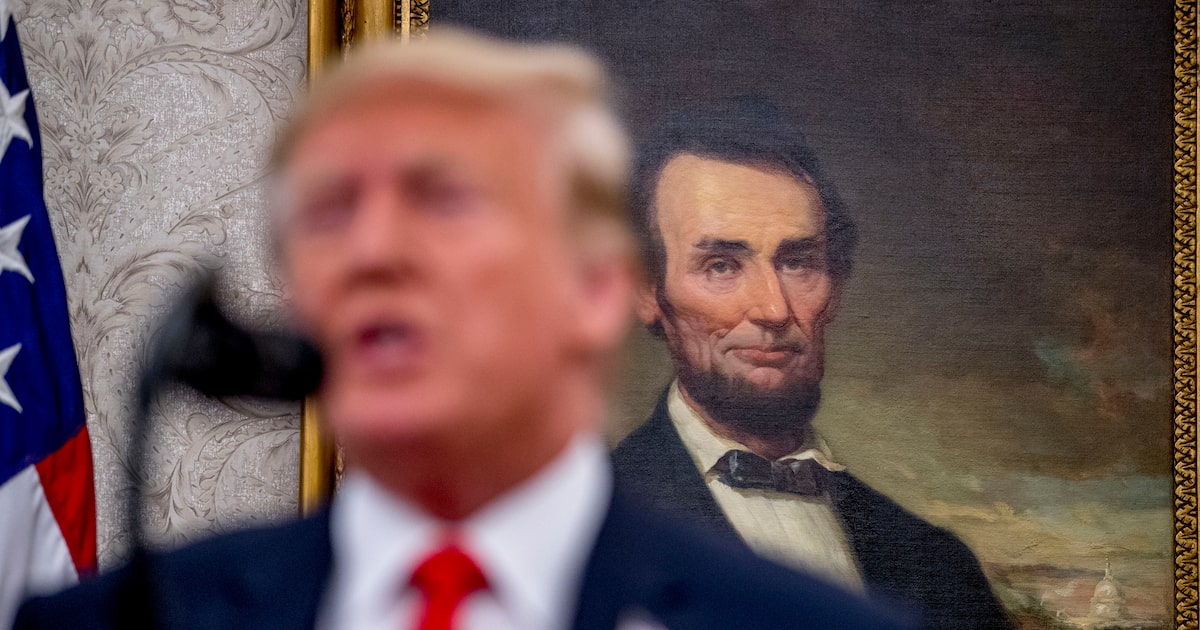
The outcry over Donald Trump’s plan to demolish part of the White House to build a gilded ballroom — opposed, polls show, by a majority of Americans — recalls another renovation controversy, this one during the Civil War.
Then as now, the nation was deeply polarized, and home improvements at 1600 Pennsylvania Ave. became a flashpoint for larger anxieties about leadership, taste and democracy.
The difference is telling. Trump has personally championed his project, reportedly down to the chandeliers. Abraham Lincoln, by contrast, wanted nothing to do with the White House refurbishing carried out by his wife, Mary Todd Lincoln. In fact, he condemned it.
Mary Lincoln, born to a wealthy Kentucky family, had a penchant for showy refinement — flounced gowns, ornamental hats and gilt-edged decor. When she moved into the executive mansion in 1861, she found it drab and worn. Visitors compared it to “a decaying Southern manor” and “an old and unsuccessful hotel.” She set out to transform it, ordering crimson curtains, a 190-piece purple porcelain dinner service, silk upholstery and a Brussels carpet priced at $2,500 — some $90,000 in today’s money.
The first lady’s taste for finery might have been harmless in peacetime, but in wartime Washington it looked like royal excess. Southern papers pounced.
“It did not take Mr. Lincoln long after his inauguration to become a despot,” raged the Charleston Mercury, accusing him of aping the “palace of the French Emperor.”
Copperhead Democrats echoed the charge, painting Lincoln as a would-be monarch while the republic bled.
Lincoln, meanwhile, was furious. When told his wife had burned through the $20,000 congressional allowance for four years’ repairs in only a few months, he exploded. “It would stink in the nostrils of the American people,” he said, “to have it said that the President had approved a bill overrunning an appropriation of $20,000 for flub dubs for this damned old house, when soldiers cannot have blankets.”
A man who had grown up in a log cabin saw no need for grandeur. His office — a modest room with a battered desk, a table for Cabinet meetings, maps on racks and a portrait of Andrew Jackson — remained plain, almost austere. One aide called it a “historic cavern.” It suited Lincoln fine.
Trump has often compared himself to Lincoln. But no two presidents could be less alike in temperament or in their vision of American democracy.
Lincoln warned early in his career that the Republic might fall not to foreign powers but to two homegrown threats: mob violence or “the rise of an Alexander, a Caesar, or a Napoleon” — a strongman who “scorns to tread in the footsteps of any predecessor.” The description fits Trump all too neatly.
Lincoln was no weakling; he suspended habeas corpus and shuttered newspapers during the war. Yet he governed with humility and restraint, never lashing out at critics or calling his opponents traitors. His Cabinet was a “team of rivals.” His most memorable phrases — the better angels of our nature, malice toward none, charity for all, government of the people, by the people, for the people — expressed his democratic faith in character as the moral foundation of power.
A man who refused new wallpaper while soldiers froze in the field would have found the idea of demolishing a piece of the White House to build a 90,000-square-foot ballroom unthinkable.
David S. Reynolds is a distinguished professor at the City University of New York and author of “Abe: Abraham Lincoln in His Times.” His new book, “Two Ships: Jamestown 1619, Plymouth 1620, and the Struggle for the Soul of America,” will be released in June.