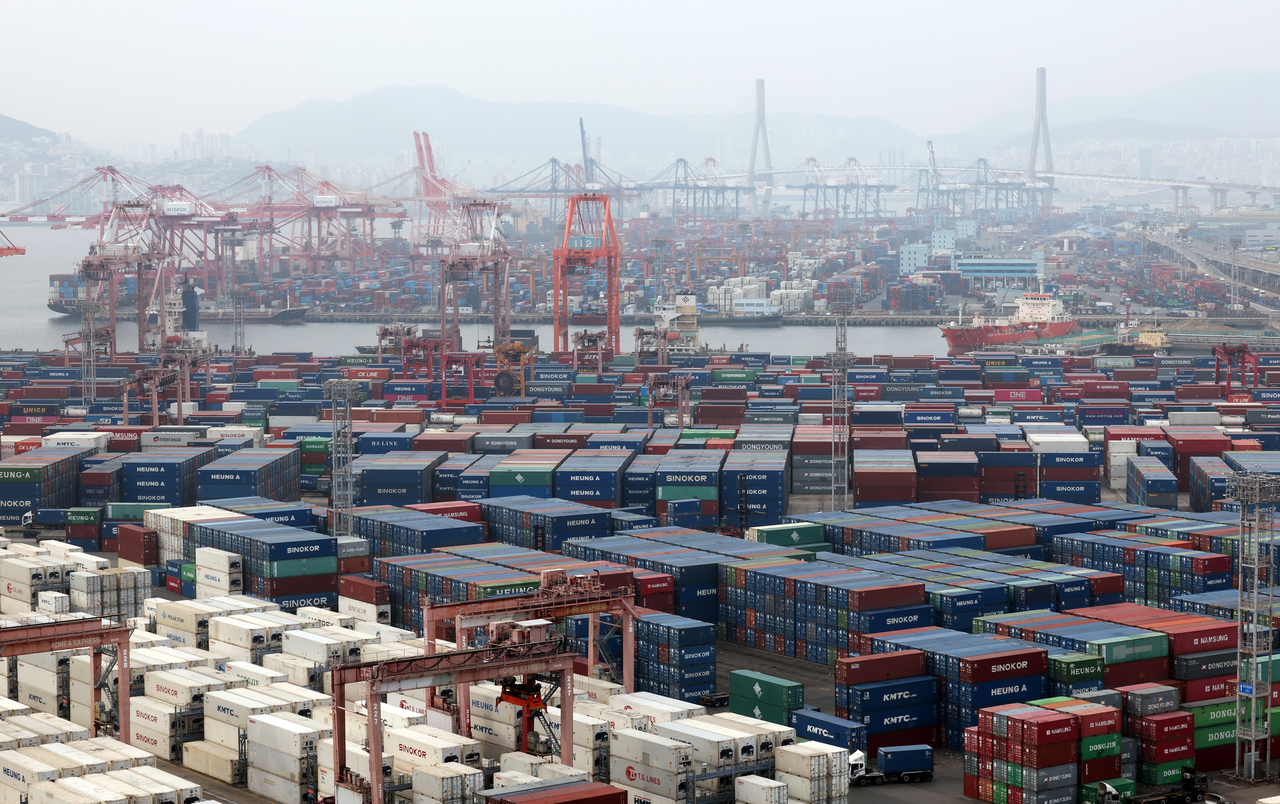
 Containers are stacked in the port city of Busan, Monday. (Yonahp)
 South Korea’s current-account surplus for the first 10 months of the year rose to an all-time high, supported by strong chip exports, despite the October monthly surplus eased from September because of fewer working days.
The country posted a $6.81 billion surplus in October, down from $13.47 billion a month earlier, according to Bank of Korea data.
South Korea has recorded a surplus every month since May 2023, marking a 30-month streak, the longest since the 84-month run that began in March 2019.
The cumulative surplus between January and October reached $89.6 billion, the highest ever for the period.
The goods account posted a $7.82 billion surplus in October, narrowing from $14.2 billion in September but extending its 31-month run of surpluses.
Exports fell 4.7 percent to $55.88 billion, a decline the BOK attributed to temporary effects from extended Chuseok holiday. On a customs basis, exports rose 3.5 percent to $59.51 billion, driven by semiconductors and ships, up 25.2 percent and 135.8 percent, respectively.
“October’s current account was largely affected by a reduced goods balance due to fewer business days during the Chuseok holiday, while the services balance saw a wider deficit as outbound travel increased over the holiday,” Song Jae-chang, director of the BOK’s financial statistics department, said at a press briefing.
By region, shipments to the US fell 16.1 percent to $8.72 billion, extending their downtrend. Exports to the European Union and China also declined, down 2 percent and 5.2 percent, respectively, to $5.19 billion and $11.5 billion.
Imports rose 5 percent to $48 billion in October.
The services account deficit widened to $3.75 billion from $3.32 billion a month earlier, driven mainly by increased overseas travel.
The primary income account, which measures the balance between Koreans’ overseas income and foreigners’ earnings in Korea, logged a $2.94 billion surplus, driven largely by overseas dividend and interest income. Dividends alone accounted for $2.29 billion
The financial account recorded a net asset increase of $6.81 billion, about half the $12.9 billion seen in September. Direct investment showed a $1.88 billion rise in Koreans’ overseas investment and a $150 million increase in foreign direct investment in Korea. Portfolio investment saw Koreans boost overseas holdings by $17.27 billion, led by equities, while foreign investment in Korean securities rose $5.2 billion, also mainly in equities.
The central bank expects the current account surplus to rebound in November.
“With the holiday effect fading in November and the trade balance already showing a substantial surplus on record chip exports, we expect the current-account surplus to rebound to more than $10 billion in November,” Song added.
By Choi Ji-won (jwc@heraldcorp.com)