A memorial for the war in Ukraine is under construction in the Hwasong district of Pyongyang. Kim Jong Un broke ground on the project on Oct. 23.
A recent review of high-resolution satellite imagery shows that over the past month a three-story structure has already gone up on the 2.6-hectare lot. Work is also moving ahead on a cemetery on the grounds that includes a statue, memorial walls, an arched entrance, and a perimeter wall.
The war memorial and cemetery are supposed to be completed early next year, and the families of soldiers who have died in the fighting will be prioritized for openings at high-rise apartments on Ryomyong Street.
North Korea hasn’t profited economically from the war. That is, North Korea has forfeited the economic boon it could well have enjoyed as one of the belligerents in Russia’s war against Ukraine.
Instead, the South Korean defense industry is profiting handsomely from demand for the weapons of war. South Korean-made armaments have a reputation for being good value for money—solid performance for a reasonable cost—leading countries in Asia and Northern and Eastern Europe to get in touch with South Korean defense firms.
In contrast, Pyongyang appears to be most concerned about using the technological advances received from Russia in exchange for its engagement and support in the Ukraine war to build up its military and prop up and reinforce the regime.
Memorial and cemetery rush toward early 2026 completion
 A memorial for the war in Ukraine and a cemetery are currently being built in the Hwasong district of Pyongyang. The families of fallen soldiers are supposed to be given priority for housing at the high-rise apartments on nearby Ryomyong Street. (WorldView-2)
Workers are hurrying to build a memorial building and a large cemetery in the Hwasong district of Pyongyang for North Korean soldiers who died in combat in the war against Ukraine. Work has been underway on the cemetery, memorial and monument since North Korean leader Kim Jong Un attended the site’s groundbreaking on Oct. 23.
In August, the North Korean government held a memorial ceremony for North Korean soldiers who have died in the war, unveiling a wall bearing portraits of 101 fallen soldiers and portraying them as heroes.
While the precise number of war dead hasn’t been disclosed, South Korean intelligence assets including the National Intelligence Service (NIS) estimate that North Korea deployed around 15,000 troops to the Ukraine war in two batches and that around 4,700 of those troops have been killed or injured. The family members of these fallen soldiers are supposed to be given precedence for openings at the high-rise apartments on Ryomyong Street.
Close to the memorial building under construction is the Kumsusan Guest House, and the Kumsusan Palace of the Sun is just across the Hapjang River.
The Kumsusan Guest House, a lodging for VIPs, was hastily built before Chinese President Xi Jinping visited Pyongyang in 2019. The Kumsusan Palace of the Sun is where the embalmed, unburied bodies of Kim Il Sung and Kim Jong Il lie inside glass cases.
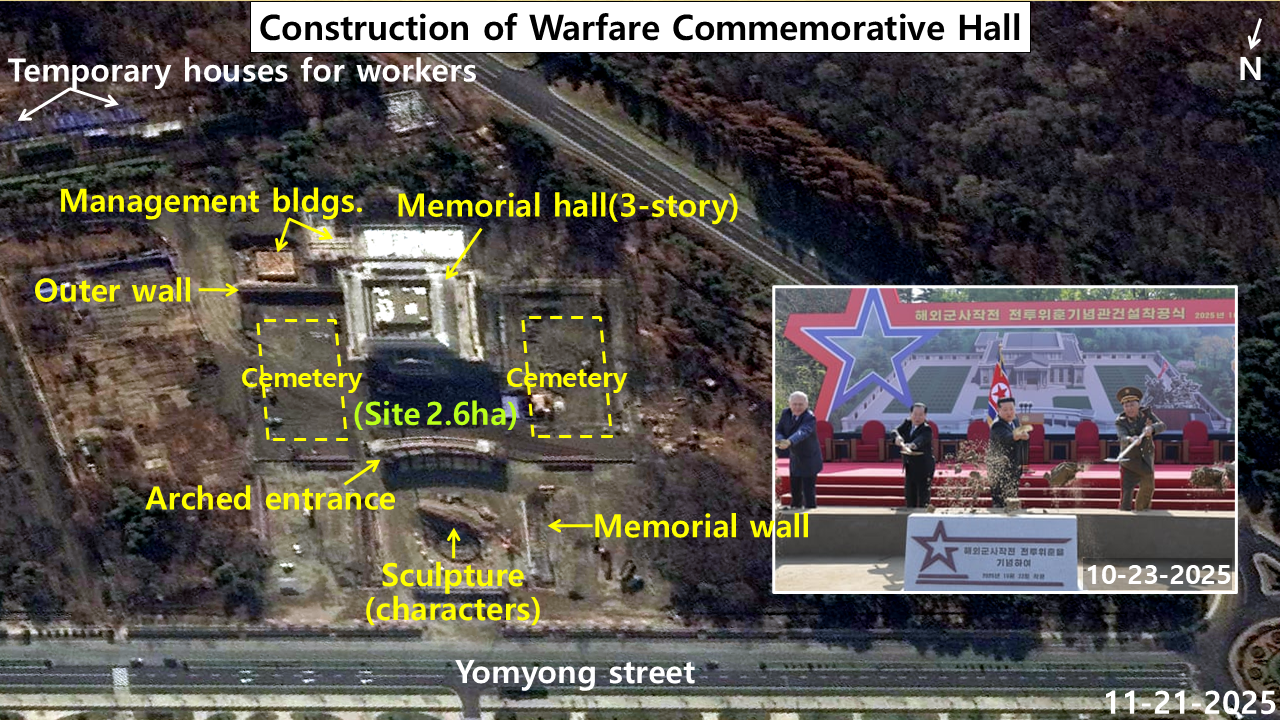 A memorial building (officially called the Memorial Building for Distinguished Service in Combat) and a cemetery are being built on a 2.6-hectare lot. Workers are rushing to complete the construction project by early next year. (WorldView-2, Korean Central Television)
Work is moving ahead on the construction of the memorial for North Korean soldiers who died on overseas assignments, a structure officially called the Memorial Building for Distinguished Services in Combat. Less than a month since the groundbreaking in October, the three-story memorial building has already gone up on the 2.6-hectare site. Construction has begun on the perimeter wall, and two cemetery sections are being prepared in rectangular lots flanking the memorial.
A bronze statue has been installed in a central plaza by the access road to the cemetery from Ryomyong Street, with memorial walls erected on either side of the statue. Passing by the statue and the walls, visitors will come to an arched entrance to the cemetery in the form of an elevated walkway. An administrative wing is being built behind the memorial building.
The memorial building and cemetery will reportedly be completed and opened around February 2026.
North Korea fails to profit economically from the war in Ukraine
The history of war shows that while bloodshed is a tragedy for the countries on which it occurs, such conflicts can be an economic boon for nearby countries and other belligerents in the form of reparations and earnings from exports of matériel.
During the Korean War, the Japanese economy boomed as manufacturers provided supplies to the United Nations peacekeeping forces, helping Japan recover from its devastating defeat in World War II and the aftermath of two atomic blasts.
The Vietnam War served a similar function for South Korea, which benefited economically from wartime economic demand and received financial rewards for the troops it sent to fight alongside the Americans and South Vietnamese.
A portion of the wages sent home by South Korean troops and workers dispatched to Vietnam formed the basis for economic development projects and the construction of critical infrastructure. The production of matériel stimulated the development of Korea’s light industry and also moved it stepwise toward the technology needed for heavy industry.
With close to 300,000 Koreans gaining combat experience during their stint in Vietnam, South Korea was furthermore able to lay the groundwork for autonomous defense capabilities, including the modernization of weapons made in Korea.
North Korea has forfeited the economic advantages it could have gained from the war in Ukraine. At the same time, South Korean weaponry is in demand around the world, with exports surging because of its reputation for high performance at an affordable price.
The South Korean defense industry has become the goose that lays the golden egg, fielding inquiries about weapons orders from India, Australia and countries in Northern Europe.
In short, it’s South Korea that’s reaping the economic rewards of the war in Ukraine. Daily NK reporting shows that North Koreans confront a hardscrabble existence aggravated by the double whammy of rising prices for rice and other goods and soaring exchange rates.
The reason North Korea has missed out on the economic benefits of war is because it’s more focused on strengthening its military capabilities and arranging transfers of new weapons technology than on collecting economic rewards, presumably because officials are most concerned about sustaining and strengthening the regime.
In short, North Korea has prioritized cooperation in the military-industrial complex, including technology for missiles and anti-aircraft systems, as part of its strategy for perpetuating the system and propping up the regime. This fixation with acquiring new weapons technology and preserving the regime shows that improving people’s economic welfare is hardly the leaders’ chief concern.