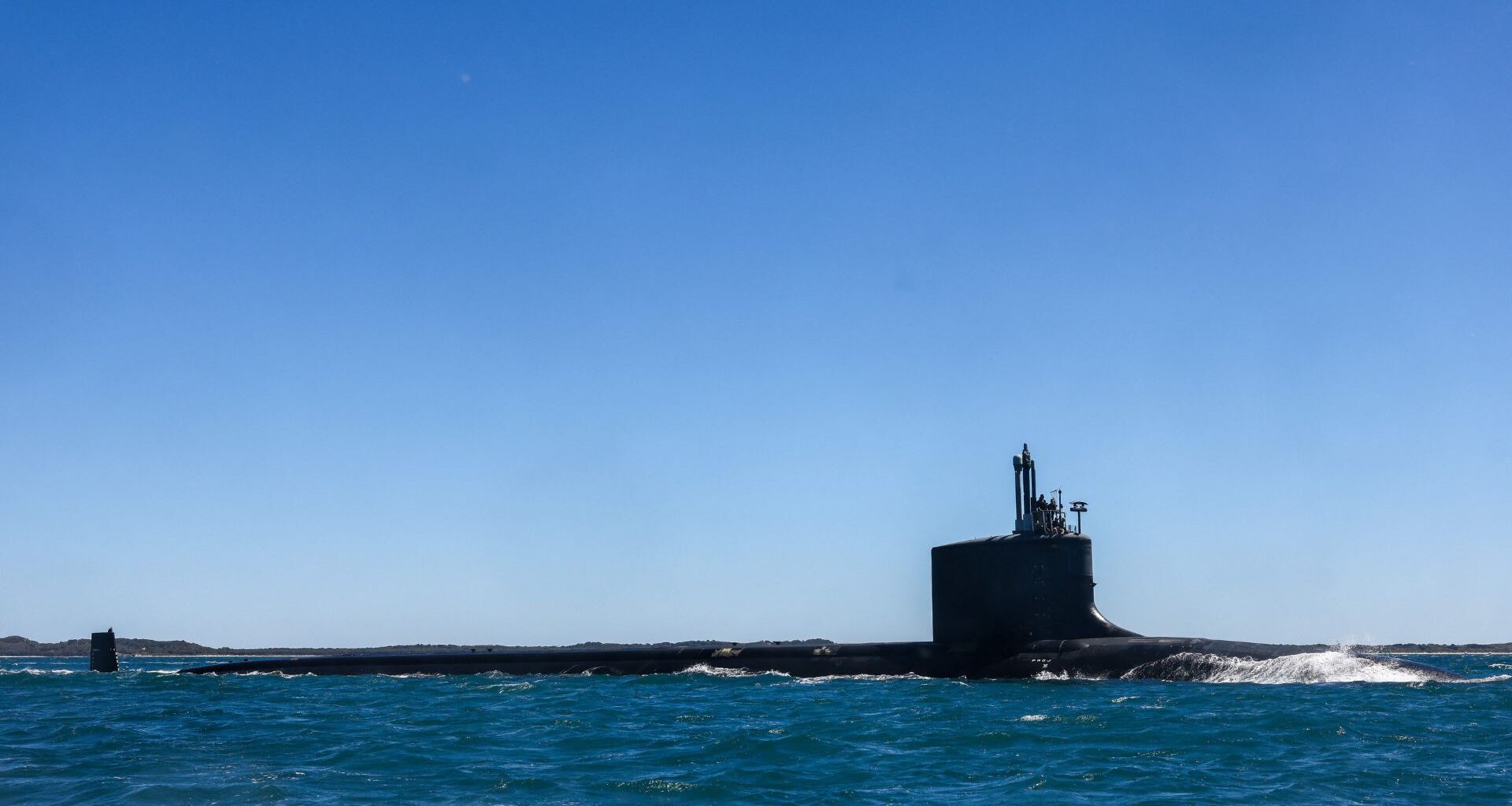
US nuclear-powered submarines that may carry nuclear weapons could dock at Australian ports without the knowledge of the Australian public or even its government, defense officials told a Senate hearing, reigniting debate over the country’s obligations under nuclear nonproliferation treaties and the long-term risks of the AUKUS security pact.
The comments were made during Senate estimates hearings as lawmakers questioned officials about plans for US Virginia-class submarines to begin rotating through Australian ports from 2027 under the first pillar of the AUKUS agreement between Australia, the United States, and the United Kingdom.
The Guardian first reported this development.
Australian law prohibits nuclear weapons
Australian law prohibits nuclear weapons on its territory. Yet Defense Department officials told senators there was “no impediment” to US submarines that are capable of carrying nuclear weapons visiting Australian ports, because Washington maintains a long-standing policy of neither confirming nor denying the presence of nuclear weapons on its platforms.
That policy of “strategic ambiguity” already applies to US B-52 bombers that periodically land at RAAF Base Tindal in northern Australia, which is being upgraded to host more US aircraft.
“We respect the United States’ position of neither confirming nor denying,” Defense Secretary Greg Moriarty told the hearing.
Anti-nuclear campaigners and some lawmakers said the testimony undermines Australia’s nonproliferation commitments and risks turning the country into what they called “a launchpad for nuclear war.”
They also said the position contradicts earlier assurances from Foreign Minister Penny Wong, who said in a 2023 speech that only conventionally armed submarines would visit Australia.
“The U.S. has confirmed that the nuclear-powered submarines visiting Australia on rotation will be conventionally armed,” Wong said at the time.
Under AUKUS, US Virginia-class submarines will begin rotating through Australian ports from 2027, while Australia prepares to buy and eventually build its own fleet of nuclear-powered, conventionally armed submarines.
Complicating the issue is the US development of a new nuclear-armed, sea-launched cruise missile known as the SLCM-N.
The US Congress approved funding for the weapon in 2024, the first new American nuclear weapon since the Cold War, and it is expected to become operational within a decade. Vice Adm. Johnny Wolfe has told Congress the missile is being designed for integration into Virginia-class submarines.
US nuclear-capable submarines
Defense officials told Australian senators that nuclear-capable missiles for the submarines are still in development and described the scenario as “hypothetical.”
Australia is a signatory to the South Pacific Nuclear Free Zone Treaty, also known as the Treaty of Rarotonga, which bans the stationing of nuclear weapons in Australia and across much of the Pacific.
However, defense officials argued that the treaty does not prohibit visits by foreign platforms that may be carrying nuclear weapons.
“The United States does not station nuclear weapons in Australia,” said Bernard Philip, an assistant secretary in the Defense Department.
“There is no impediment under the Treaty of Rarotonga and the Treaty on the Nonproliferation of Nuclear Weapons to the visit of dual-capable foreign platforms to Australia’s territory.”
Dual-capable platforms can carry either conventional or nuclear weapons. Gem Romuld, Australian director of the International Campaign to Abolish Nuclear Weapons, said Wong’s assurances were now “dead in the water.”
“It’s taken just two years for expectations of an AUKUS partner to shift, so what will come next?” she said. “If AUKUS is ‘not about nuclear weapons,’ then Australia’s assurances must be backed up with legal commitments.”
Romuld urged Australia to sign and ratify the UN Treaty on the Prohibition of Nuclear Weapons. The ruling Labor Party has pledged to do so while in government, but has not yet acted. Seventy-four nations have adopted the treaty, but none of the nine nuclear-armed states have joined.
Greens Sen. David Shoebridge pressed officials over whether Australia would ask US commanders if visiting submarines were nuclear-armed.
“Is it still ‘don’t ask, don’t tell’?” he asked. Moriarty replied: “We respect the United States’ position of neither confirming nor denying.”
Kapil Kajal is an award-winning journalist with a diverse portfolio spanning defense, politics, technology, crime, environment, human rights, and foreign policy. His work has been featured in publications such as Janes, National Geographic, Al Jazeera, Rest of World, Mongabay, and Nikkei. Kapil holds a dual bachelor’s degree in Electrical, Electronics, and Communication Engineering and a master’s diploma in journalism from the Institute of Journalism and New Media in Bangalore.