
Hello! Welcome to your weekly guide to the Russian economy, written by Alexander Kolyandr and Alexandra Prokopenko and brought to you by The Bell. This week we analyze the EU’s decision to put Russia on its financial blacklist, and what Putin hopes to bring back from his trip to India.
Before we start, The Bell is pleased to announce our upcoming webinar exclusively for our paid subscribers: Russia’s economy hit the brakes — is a full stop coming? hosted by our expert authors, Alexander Kolyandr and Alexandra Prokopenko, and our editor, Peter Mironenko.
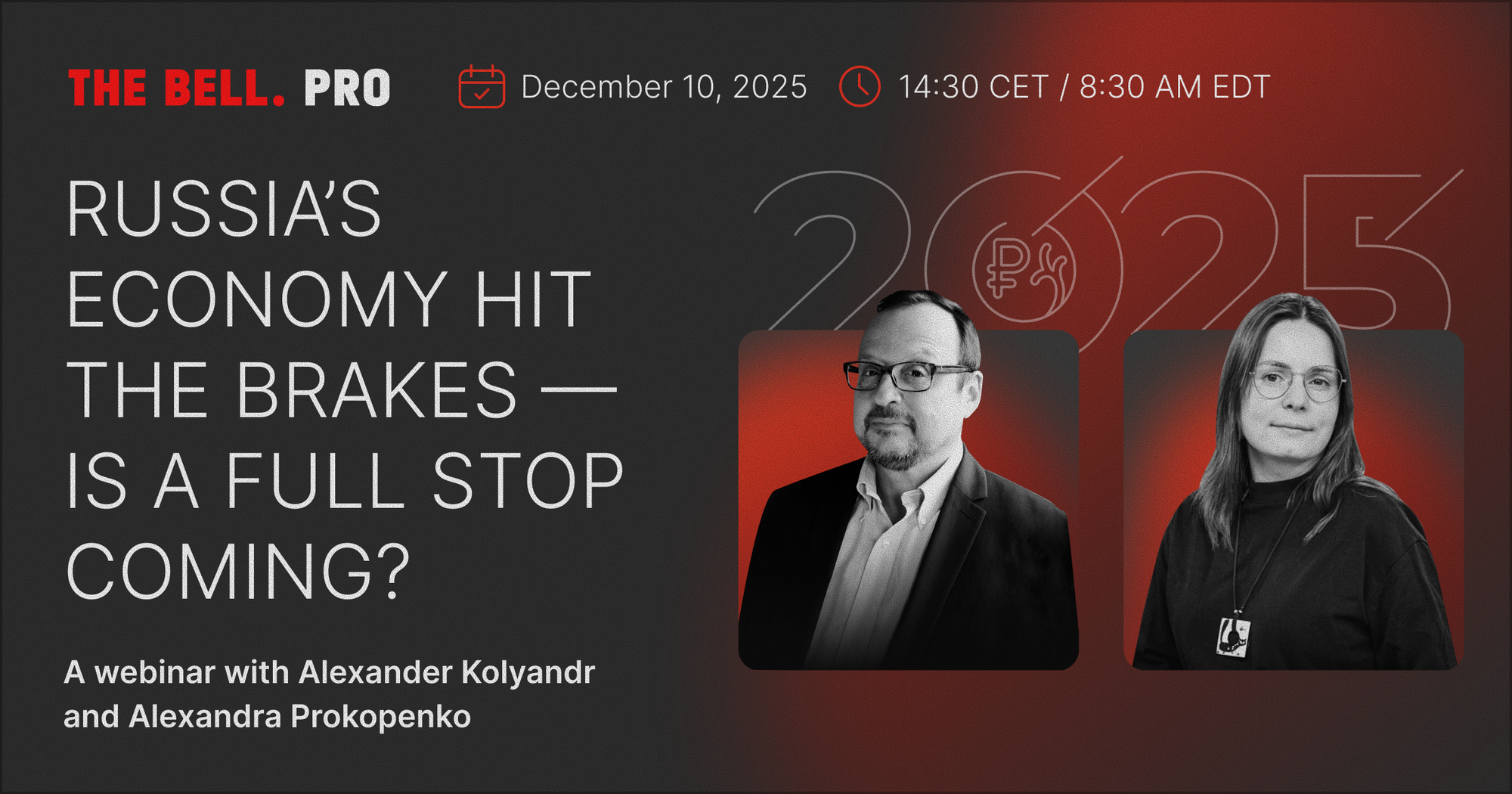
What a difference a year makes. The Russian economy lurched from spectacular growth to near-stagnation, from consumer spending sprees to belt-tightening. The contradictions that officials papered over for months finally caught up with them — and the true costs of the war are now impossible to ignore.
Join the authors of Inside the Russian Economy, Alexander Kolyandr and Alexandra Prokopenko, for an hour-long dissection of Russia’s economic unraveling. We’ll break down how we got here, what the data really shows, and where things go from here. And if there is a peace deal on the horizon? We’ll game out what that might mean for Russia’s battered economy.
The discussion will immediately be followed by a live Q&A session. Come with your toughest questions. We’ll have answers.
The webinar will take place on December 10, 2025 at 08:30 AM EDT / 14:30 CET.
To participate, there is no need to register in advance. We will send an invitation to your inbox ahead of the webinar – just check your email and join us by clicking the link.
Brussels steps up fight against Russian finance
While the campaign to get Russia added to the Financial Action Task Force (FATF) global blacklist has so far not succeeded, the EU has gone ahead and placed Russia on its own list of countries with an elevated risk of money laundering and terrorist financing. This does not have the same severe consequences as the FATF list, but in practice it will lead to stricter oversight of all financial transactions in Europe that are in any way connected with Russia.

This article is available
exclusively to our subscribers
Start for $1 in your first month

Unlimited access to an archive of over 300 articles, with 20 more articles added each month
Two in-depth weekly newsletters looking at recent events
Join The Bell’s editors and authors for webinars on the Russian economy and Russian politics
Already have an account?
Log in