![[Review] Computing the Climate: How We Know What We Know About Climate Change](https://www.europesays.com/wp-content/uploads/2025/12/Computing_the_Climate_cover_857x482.png)
Yet another popular book on climate modeling? Yes — but this one is unique because the author’s background is unique. After receiving a Ph.D. in computing and working as a software engineer, Steve Easterbrook became interested in how climate models oper- ate. For many years he (and his students) researched the subject, spending time at many of the world’s top climate modeling institutions — a stunning amount of work. From it he argues that climate model quality compares well even with the big mission-critical software he used at NASA. One caveat: to a computer scientist, high-quality code efficiently does what its creators want it to do. In the words of our colleague Michael Wehner, that could include “getting the wrong answers faster” due to uncertain assumptions about how the climate evolves. Fortunately, this book takes the uncertainties seriously. Computing the Climate describes how climate models have developed over time and how state-of-art models operate today, including their shortcomings.
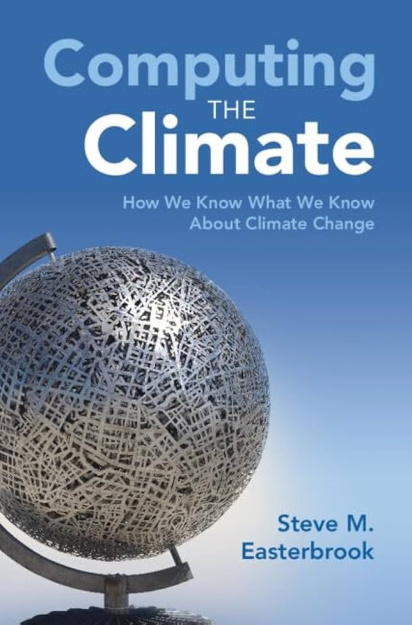 After an introductory chapter, the book dives into the surprisingly deep history of climate modeling, starting with “the work of the nineteenth-century scientists who discovered the greenhouse effect and first attempted to measure it,” in particular “the work of Svante Arrhenius, who developed the first global climate model, before there were computers.” This is an unusually sagacious approach. Easterbrook makes the important point that climate models are constructed at all levels of complexity, addressing a common criticism that climate predictions come only from computer models so complicated that no one really understands how they work. Detailed description of the Arrhenius model — as well as the first computer models of weather and climate — fascinated and enlightened us. We thought we knew most of that history, but we were wrong!
The middle chapters of the book give a detailed account of Easterbrook’s grand tour of climate modeling at the UK Meteorological Office, the US National Center for Atmospheric Research, the Institut Pierre-Simon Laplace in Paris, and Germany’s Max Planck Institute for Meteorology. Each location gets a chapter including many digressions into various aspects of climate modeling. These are all interesting but not all directly relevant, and some fit awkwardly into the narrative. Why, for example, entitle the chapter on MPI-M “Sound Science,” and why choose this chapter to describe intercomparison projects in which all the modeling institutions participate? Some readers may want to skim or skip these chapters and proceed directly to the final chapter.
In any case, this book will not be a quick read. It demands — and rewards — serious concentration. There are no equations in the main text, but plenty of detailed graphs, charts, and footnotes for readers wanting even more (for them, the next step up could be The Climate Modeling Primer [4th edition, 2014] by Kendal McGuffie and Ann Henderson-Sellers).
A book so densely packed with information will inevitably contain minor errors and points of confusion. For example, Chapter 1 says the models featured in a key 1979 report “focused on the physical climate system, particularly the global circulation patterns of winds and ocean currents,” but actually these early models omitted ocean currents. Later it says, “If our use of fossil fuels keeps growing, we are on track to double the CO2 in the atmosphere sometime in the 2030s or 2040s” (page 14). But pre-industrial CO2 was about 280 parts per million, so doubling would give 560ppm, not a plausible extension of the data shown in the nearby Figure 1.4. The possibility of doubling by 2030 may have been entertained back in 1979, but not today.
In addition, a few figures originally in color are reproduced here in black-and-white, with possibly misleading results. For example, Figure 9.1, illustrating different “storylines” used to estimate future CO2 emissions, shows one of them (A2) in a very faint shade of gray, suggesting it’s the least likely. But the text correctly points out that the report in question “takes no stance on which of these storylines is more likely, nor which is more desirable.”
The final chapter not only summarizes the previous ones but also ventures beyond climate modeling per se. Unsurprisingly, Easterbrook asserts that “consequences [of CO2 emissions] are all around us, and the need for urgent action has become clear.” We agree, along with a clear majority of climate scientists (in our informal observation). But both statements come with important caveats. Deciding how much responsibility CO2 emissions bear for particular storms, heat waves, droughts, etc., is a tricky business. Computing the likelihood of especially severe events is still in its infancy: as Easterbrook says, “Climate models are excellent at giving the big picture, but still leave us in the dark about exactly how each of us will be affected” (page 280). And any conclusion about “the need for urgent action” necessarily entrains socioeconomic, political, and even moral questions that no mathematical model can address. Indeed, Easterbrook acknowledges this point: “[C]limate models . . . do not make value judgments. Nor can they make policy recommendations” (page 286).
Most of this final chapter revolves around a simple goal for the future: limiting global average warming since the Industrial Revolution to 2 degrees Celsius (3.6 degrees Fahrenheit). It nicely summarizes both the reasoning behind this goal and recent criticisms that it’s insufficient — and that a more appropriate limit would be 1.5 degrees C (which has already been reached!). Easterbrook’s conclusion is that “the world must not burn more than a trillion tonnes [i.e., metric tons] of carbon. Ever” (page 287). As noted above, such conclusions depend on one’s political leanings as much as the science. Those with less confidence in the effectiveness of government management and more confidence in human ingenuity and free markets could rationally disagree.
Easterbrook set himself the task of “tell[ing] the story of how these models of the physical climate system came to be, what scientists do with them, and how we know they can be trusted.” He tells the story well, but unqualified use of the word “trust” (repeated in an advance-praise quote on the back cover) is problematic and even sells this book short. It’s actually much more than a set of talking points for climate activists. It carefully explains what parts of model output are trustworthy and what parts aren’t. (An example of the latter: details of weather beyond short- term predictions.) Opponents as well as proponents of a Green New Deal would benefit from reading it.