Israel is seeking to establish a security zone in the 400 square kilometres its military has seized in southern Syria since the fall of the Assad regime a year ago, disregarding pressure from the US to establish peaceful ties with the country’s new government, regional security sources say.
Repeated air strikes and raids, including one last week that killed 13 people, aim to clear the area of its inhabitants while also undermining Syrian President Ahmad Al Shara’s efforts to establish control over the entire country after 13 years of civil war, the experts said.
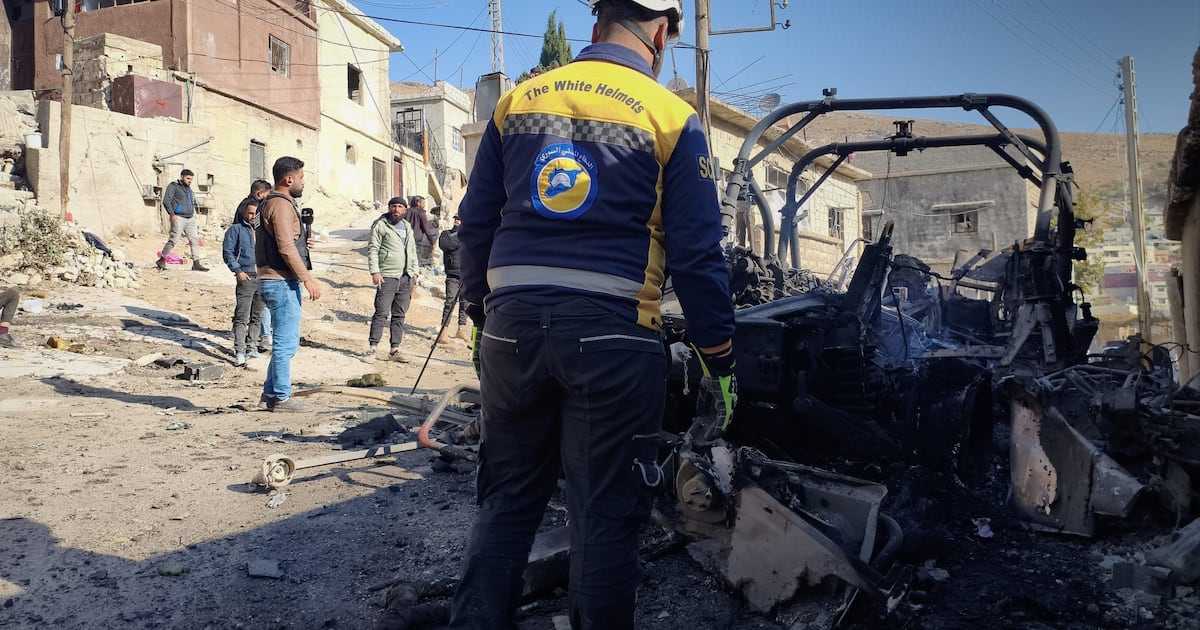
The November 28 raid on Beit Jin, a village in rural Damascus governorate, “was meant to show Al Shara that Israel will keep dealing with security threats from Syria the way it wants, regardless of the United States”, said a security source in Jordan whose brief is Syria.
Israel’s actions violate a 1974 armistice that led to the creation of a UN-controlled buffer zone between Syria and the Israeli-occupied Golan Heights, seized during the 1967 Arab-Israeli War. Israel sent forces across the zone within days of Syrian rebel groups, led by Mr Al Shara’s Hayat Tahrir Al Sham, toppling president Bashar Al Assad on December 8 last year.
Israel has said that its new territorial acquisitions in Syria are aimed at ensuring its security by enlarging the buffer zone. In the last two years of Mr Al Assad’s rule, groups linked to Hamas and Hezbollah, as well as other pro-Iranian factions, launched limited attacks against Israel from the Golan Heights frontier. But the 1974 armistice largely held.
Smugglers, not terrorists
Israel’s recent incursions did not meet any significant resistance until the raid on Beit Jin, a village close to both the Golan Heights and southern Lebanon. Dozens of residents engaged with Israeli forces and at least 13 were killed. Six Israeli soldiers were wounded.
Security sources said Israel failed to take into account social and economic factors that contributed to the armed, grass roots response. Beit Jin’s economy, dependent on smuggling cigarettes and other contraband over the border with south Lebanon, had been hit by increased Israeli incursions, they said.
The Israeli raid also focused on a family called Okasheh. Two brothers from the family had already been killed in air strikes over the past two years for alleged links with Hamas.
Israel said its military killed several “terrorists” in the operation against what it described as members of the Hamas-linked Al Jamaa Al Islamiya. The sources said one of those killed was Mohammad Okasheh, a brother of the two men killed earlier. At least 30 men from Beit Jin were detained and taken for interrogation.
“Beit Jin is a centre of smuggling, not terrorism. Going after the Okashehs again was too much. It prompted a fazaa,” said one source in Jordan, using the Arabic term for clan mobilisation in response to an external threat.
A day after the raid, US President Donald Trump urged Israel to keep up a “dialogue” with Syria and not hinder its “evolution into a prosperous state”. However, Israel appears to have paid little heed. Late on Wednesday, Syria’s official news agency reported an Israeli drone attack on Beit Jin, which it said left no casualties, as well as another incursion in an area closer to the 1974 line.
Washington has been trying for months to broker a security deal between the two countries, which would be the first since 1974. Mr Al Shara’s rise to power removed Syria from the orbit of Iran and Russia, and put Damascus on the cusp of a transformation into a US ally. But there has been no breakthrough in the relationship with Israel.
Mr Al Shara, who is from a Golan Heights clan displaced by Israeli occupation, has not engaged in public anti-Israeli rhetoric, but has refused to accept that the territory recently seized by Israel should be part of an expanded buffer zone.
‘Sights on Damascus’
Syria’s then president Hafez Al Assad accepted the current armistice, known as the Separation of Forces agreement, after repeated visits to Damascus by US secretary of state Henry Kissinger in the aftermath of the 1973 Arab-Israeli War,
Mr Kissinger pointed out to Mr Al Assad, who died in 2000 and was succeeded by his son Bashar, that a deal could lessen his strategic setbacks after Israeli forces advanced to within 40km of the Syrian capital.
“The location of military forces importantly determines the political outcome,” Mr Kissinger told the Syrian president, who laughed, according to official accounts of their meetings.
When Hafez Al Assad eventually signed the agreement, Israel withdrew from the approaches to Damascus but kept the Golan Heights. Regaining the strategic plateau had been Syria’s objective for launching the 1973 war.
A major factor behind Mr Al Assad’s decision to accept the 1974 armistice was the threat Israeli forces posed to his seat of power in Damascus.
“Damascus is again in their sights,” a regional security official said. “They don’t want to take it, but they want to extend their military advantage and keep Al Shara weak.”