There is an old wartime maxim—dating to the First World War—that “loose lips sink ships.” It warned American sailors and civilians alike that careless speech could reveal troop movements or naval deployments to enemy spies and lead to catastrophic losses at sea. The warning remains true, but today the stakes are vastly higher: loose talk can still sink ships, but now it can also help start a war.
If that war involves nuclear-armed powers, the consequences could extend far beyond the fate of any fleet. They could engulf the planet. The international discourse surrounding Russia, China, and the United States has grown not only alarming but increasingly unhinged. Statements that once would have been dismissed as dangerous hyperbole are now made openly by senior political and military figures—and treated as normal, even prudent.
Consider U.S.–China tensions over Taiwan. Beijing insists Taiwan is an internal issue and appears absolutely determined to achieve reunification, by force if necessary. Chinese leaders signal that any blockade or invasion would be a matter of sovereignty, while planners in Washington treat a Taiwan contingency as a core test of American credibility in Asia. Although nobody knows for certain whether the United States would intervene militarily if China blockaded or invaded the island democracy, the likelihood seems high. Pentagon operational concepts for a Taiwan war reportedly assume deep conventional strikes on PLA command nodes, air defenses, and missile sites on the mainland—targets Chinese strategists may see as threatening their nuclear deterrent, because some missiles and launchers are dual‑use and co‑located.
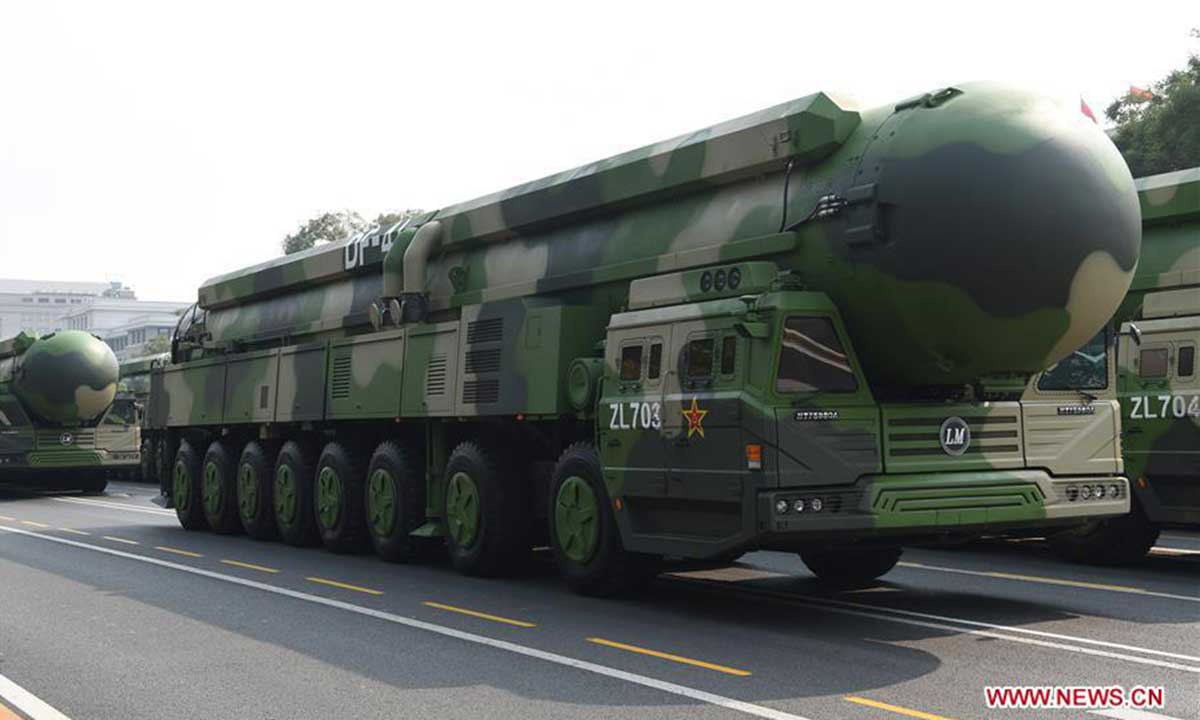
There is no formal declaratory policy tying U.S. conventional strikes on the mainland to automatic nuclear retaliation. Yet Chinese military writings and commentary discuss scenarios in which nuclear weapons could be used to deter or coerce U.S. intervention over Taiwan, including “first strike” or “demonstration” options. Studies of PLA publications describe repeated exploration of limited nuclear use in Taiwan contingencies, including possible shots near U.S. bases or in the open ocean to shock Washington into backing off.
Threatened Nuclear Strikes
Chinese state‑linked voices have issued more direct, nuclear‑tinged warnings toward U.S. allies. One widely publicized PLA‑linked video in 2021, for example, threatened nuclear strikes on Japan if it intervened over Taiwan. Regional experts now speak of a growing risk of “nuclear blackmail” in a Taiwan crisis: Beijing could brandish its arsenal or hint at escalation to dissuade U.S. and allied military action, even if it does not clearly spell out a nuclear response to specific U.S. moves.
Recent shifts in allied rhetoric matter here as well. A comment by Japan’s new prime minister, Sanae Takaichi, appeared to signal the certainty of Japanese military involvement alongside the United States in the event of a Taiwan crisis. Takaichi told lawmakers that if China used warships and military force against Taiwan, this could constitute a situation “posing an existential threat” to Japan under the 2015 security legislation—precisely the legal threshold that allows limited use of force in “collective self‑defense.” Her words thus implicitly link a Taiwan war to possible Japanese combat operations.
Takaichi’s phrasing moved beyond the more ambiguous language used by past governments, which had stressed that a Taiwan crisis would matter greatly for Japan but avoided specifying scenarios that could trigger collective self‑defense. In Beijing’s eyes, this shifts Japan from cautious ambiguity to open discussion of military intervention in the Taiwan Strait. By framing a Chinese blockade or invasion as a “survival‑threatening” situation for Japan itself, Takaichi appears to be internationalizing the Taiwan question and aligning Japan’s own security with the island’s fate and with U.S. war plans.
China reacted with fury. The foreign ministry accused Japan of sending a “shocking” and “seriously damaging” signal and demanded that Tokyo “correct and retract” the remarks, warning that Japan would “bear all the consequences” if it moved toward military involvement. Chinese diplomats and state‑linked voices escalated further; the consul general in Osaka even used violent imagery about “cutting off” a head that intrudes, language Tokyo protested as an implicit threat against the prime minister personally.
Explicit Russian Threats
Russia has been even more explicit in its threats. On December 2, 2025, Vladimir Putin declared that Russia is “ready” for war if Europe initiates one, fitting an established pattern of threatening rhetoric toward NATO that has recurred throughout the Ukraine conflict. He warned that if European states started a war with Russia, Moscow stood prepared to fight and deliver an absolute defeat, leaving no adversaries for negotiations, even as U.S.–Russia talks on Ukraine proceeded in parallel.
Similar warnings date back years, including repeated threats in 2023–2025 of nuclear retaliation against NATO‑backed actions in Ukraine. Dmitry Medvedev, former president and now deputy head of Russia’s Security Council, has said that if Russia’s occupied territories in Ukraine were lost, or if NATO troops entered the war directly, Moscow could use its full strategic nuclear arsenal against Western capitals, explicitly listing London alongside Washington, Berlin, and Kyiv. He has described such a scenario as leading to “global war” if the West tries to restore Ukraine’s 1991 borders.
Russian state TV hosts and nationalist politicians have repeatedly talked on air about using strategic missiles to “wipe out” or “sink” the United Kingdom, with graphics showing how quickly nuclear weapons could reach London from Russian territory. These programs do not constitute official doctrine, but they are broadcast on tightly controlled, Kremlin‑aligned channels and serve as deliberate nuclear saber‑rattling aimed at Britain and other NATO states. The Russian Foreign and Defense Ministries have formally warned that if the UK enables or participates in attacks on Russian territory—for example, via long‑range missiles provided to Ukraine—Russia may strike British military facilities or assets, coupling such warnings with announced nuclear exercises to underscore escalation risks.
These statements stop short of openly promising to “destroy” Britain, but they clearly seek to raise the specter of a broader confrontation, including nuclear dimensions, if London deepens its role in the war. Russian officials and propagandists present these threats as responses to UK military aid, training, and rhetorical leadership in support of Ukraine, portraying Britain as one of the most “hostile” NATO states. Analysts generally interpret this as coercive messaging designed to intimidate the UK public and policymakers rather than a concrete war plan, though it undeniably increases perceived nuclear risk around any possible NATO–Russia clash over Ukraine.
Germany’s New Strategy
Meanwhile, Germany has adopted a new military strategy that explicitly names Russia as an “existential” risk and openly plans for a time horizon in which a direct Russia–NATO confrontation is conceivable by 2029. Senior officials, including the inspector general of the Bundeswehr and the foreign ministry leadership, have warned that Russia could restore enough capacity within roughly four years to threaten a NATO member, with no guarantee it will not act sooner. Public statements now frame the prospect of a large‑scale war in Europe as something for which Germany must concretely prepare.
Defense Minister Boris Pistorius has repeatedly said that the Bundeswehr “must be capable of war” by 2029, arguing that only a credible ability to fight will deter Russia and prevent escalation. In practice, this means faster procurement, rebuilding heavy forces, strengthening air defense, and reversing decades of post–Cold War underinvestment. A central element is the Operational Plan Germany, a formerly classified 1,200‑page concept detailing how the country would act as a logistical hub in a major NATO–Russia conflict. The plan envisages the ability to move and support up to about 800,000 NATO troops through German territory toward the eastern flank, integrating rail, roads, ports, and civilian services with military needs.
To finance this shift, Berlin is planning a steep rise in defense outlays beyond the initial Zeitenwende special fund, a €100 billion off‑budget allocation announced after Russia’s 2022 invasion of Ukraine and now expected to be depleted by 2027. Internal debates and reporting describe medium‑term targets of around 3.5 percent of GDP for core defense and another roughly 1.5 percent for related infrastructure and societal preparedness, which would take annual German defense spending from a bit over €50 billion in the mid‑2020s to well above €150 billion by the end of the decade—roughly on par with or exceeding Russia’s current military budget in nominal terms.
Officially, these measures are framed as deterrence. Yet the rhetoric surrounding them is darker and more fatalistic than anything heard during much of the Cold War—almost as if major conflict is assumed to be inevitable and as if nuclear escalation could somehow be contained through sheer confidence. A political culture that treats war with a nuclear peer as a manageable contingency, rather than a last resort, is a culture already edging toward the brink.
Avoiding Disaster
Two urgent steps are needed if disaster is to be avoided. First, a policy of rhetorical de‑escalation: great powers cannot continue to speak as if war is a tolerable or even manageable option, because such language creates its own political momentum. Second, in parallel, a return to serious diplomacy—sustained, dispassionate efforts to understand the true intentions of China and Russia and to test whether there are stable bargains short of catastrophe.
What, precisely, does China want? Is its ambition limited to absorbing Taiwan, or is Beijing fundamentally bent on establishing military and economic dominance throughout the Asia‑Pacific region? Does it aim to rule the region or merely to ensure that no hostile power can organize a coalition capable of choking off China’s rise?
And what of Russia? Are Moscow’s aims restricted to Ukraine, or does it truly intend to reconstitute something approximating the Soviet empire—ruling over Poland and the Baltic states, and perhaps even aspiring to militarily dominate the rest of Europe? These are not academic questions. The answers determine whether appeasing Russia in Ukraine or China in Taiwan would avert a war—or make one inevitable under terms dictated by Moscow and Beijing, much as appeasement of Nazi Germany did in the 1930s.
Contrary to popular mythology, appeasement is not inherently immoral or strategically foolish. Its wisdom depends entirely on context—and, most critically, on the adversary’s intentions. In any serious foreign‑policy discussion, intentions matter as much as capabilities. That is especially true with Taiwan and Ukraine. The uncomfortable reality is that great‑power behavior turns not only on what states can do but on what they believe they must do.
Though it may sound harsh, significant degrees of accommodation toward China over Taiwan and Russia over Ukraine can make strategic sense if—and only if—their objectives are genuinely limited. For Beijing, that means a narrow, deeply rooted claim of reunification, however much others may dispute its legitimacy. For Moscow, it means holding the territory already taken in eastern Ukraine and preventing Ukrainian entry into NATO—objectives that Ukraine’s supporters may find objectionable but that still fall short of imperial expansion across Europe.
When Appeasement Becomes Catastrophic
Appeasement becomes catastrophic only when the adversary’s ambitions are unlimited. The central task for statesmen is to distinguish between a power seeking to secure what it views as vital national interests and one intent on overturning the entire regional order. Misreading those intentions—either by underestimating them or exaggerating them—risks unnecessary war on one side and disastrous concessions on the other.
Understanding limited aims is not capitulation; it is the essence of strategic clarity. Without that clarity, policy becomes reflex rather than calculation. Leaders flail between maximalist confrontation and panicked compromise instead of designing stable arrangements that reflect the balance of power and the hierarchy of interests.
The same is true of spheres of influence. Although controversial nowadays, spheres of influence are, as the founder of modern realist theory Hans J. Morgenthau argued, not inherently immoral. They are an enduring feature of international politics—a practical mechanism by which great powers seek security, prestige, and predictability within an anarchic world system. Morality lies in how power is exercised, not in the mere existence of influence.
Confronting these strategic realities demands a certain kind of leadership—namely, statesmanship. What sets the statesman apart from the politician is the capacity to recognize that an adversary, too, has legitimate interests. The politician defends only his own side; the statesman must understand both. It is difficult, disciplined work—and never more vital than in a nuclear age.
In an era when nuclear powers trade threats as casually as press releases or social‑media postings, the world cannot afford leaders who confuse bravado with strategy. It needs disciplined speech, sober analysis, and diplomacy grounded in a clear‑eyed understanding of adversaries’ intentions. The alternative is to set in motion, through words as much as weapons, a dynamic whose endpoint could be a catastrophe from which no nation would emerge unscathed.