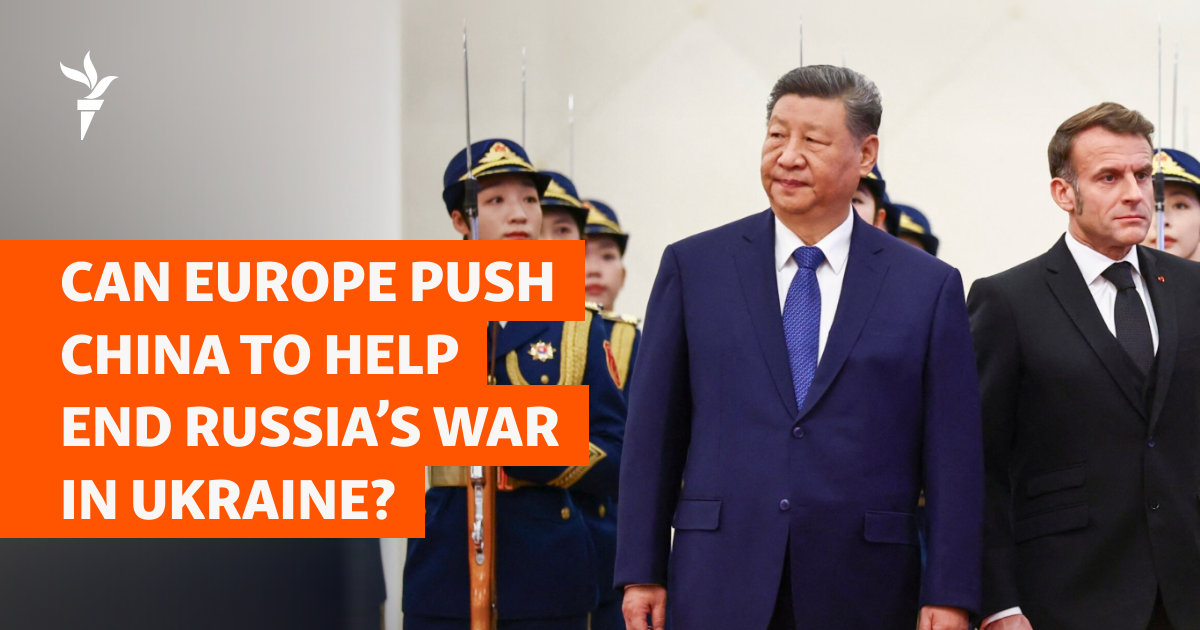
BRUSSELS — French President Emmanuel Macron wrapped up a trip to China where he sought Beijing’s help in pressuring Russia to agree to a cease-fire with Ukraine amid a recent burst of diplomacy over a US proposal to end the war.
But analysts and European officials who spoke to RFE/RL doubt that Beijing will heed to Macron’s calls for Chinese leader Xi Jinping to push Russian President Vladimir Putin to drop his maximalist demands to settle the nearly four-year war.
While rich in symbolism and focused on trade opportunities, Macron’s visit was low on tangible outcomes. Experts say China’s sustained support for Russia throughout the war is unlikely to waver and that Xi has few reasons to expend his influence with Putin on a peace plan that the Russian president has essentially dismissed.
The original US 28-point peace plan to end the war in Ukraine appeared to heavily favor Russia, although the proposal has since been revised to take Kyiv’s concerns more into account.
“I don’t think there is any incentive for Beijing to step in and try to end the war,” Claus Soong, an analyst at the Berlin-based MERICS think tank, told RFE/RL. “Europe is not worth as much to China as Russia.”
Following a red-carpet welcome and military honor guard in Beijing on December 4, Macron warned about the pressure on the international political system brought by the war in Ukraine and the need to reach a lasting peace during his meeting with Xi.
“We are facing the risk of the disintegration of the international order that brought peace to the world for decades, and in this context, the dialogue between China and France is even more essential than ever,” Macron said.
The French president also urged Xi to join European efforts to “to achieve, as soon as possible, at the very least a cease-fire in the form of a moratorium on strikes targeting critical infrastructure.” Xi did not directly respond to Macron’s call but said that “China supports all efforts that work toward peace” and called for a deal that all parties will accept.
Beijing has never referred to Moscow’s 2022 full-scale invasion as a war, instead calling it a “conflict.” And while multiple European officials have called for China to rein in Moscow, Beijing’s position has remained static.
“China can inflict very serious economic damage on the EU,” Yurii Poita of the Kyiv-based Center for Army, Conversion, and Disarmament Studies told RFE/RL. “That’s why Macron’s calls for China to influence Russia are mostly symbolic. Nobody in Europe believes Beijing will comply.”
Why Macron Went To China
Those economic ties were also a key reason for Macron’s visit, which concluded on December 5 with a sightseeing tour of the southwestern city of Chengdu with Xi.
Ahead of the trip, French officials shared new data with reporters in Brussels on the “significant” trade imbalance between France and China, pointing to a 47-billion-euro ($54 billion) deficit, double what it was a decade ago.
Those officials said that their “goal is to rebalance these [trade] flows” during the visit, with Macron accompanied by 35 heads of major French companies — from cognac producers to luxury retail brands.
A meeting in the Chinese capital on December 4 only resulted in 12 cooperation agreements covering areas such as population aging, nuclear energy, and panda conservation, and no monetary total was disclosed.
The 27-member EU, overall, runs a massive trade deficit with China: over 300 billion euros ($348 billion) last year.
Analysts say that Beijing may use friendly ties with France to expand its influence within the EU but is currently constrained by its inability to offer Paris major concessions.
A long-anticipated 500-jet Airbus order is not expected to move forward, as it could affect Beijing’s leverage in ongoing trade talks with the United States, which is pressing China for new orders of US-made Boeing planes.
Xi also made no commitments to ease conditions for French cognac makers or pork producers, as doing so would weaken Beijing’s negotiating position with Brussels over tariffs on Chinese-made electric vehicles.
Despite those headwinds, Soong of the MERICS think tank says that Macron still has “an obvious incentive” to appeal to Beijing as officials in US President Donald Trump’s administration increasingly call to shift attention toward the Western hemisphere.
“Macron needs to leverage his ties with China and see what he can get from this relationship,” Soong said.
China And Russia’s ‘Friendship of Calculation’
China remains a top market for European exports — from aviation to industrial chemicals — and has become even more crucial after US tariffs were imposed on European imports.
China is also Europe’s main supplier of raw materials and rare-earth elements, making it indispensable to the continent’s strategic supply chains.
Estonian Foreign Minister Margus Tsahkna, who visited Beijing in early November, told RFE/RL that dialogue with China still serves a purpose, even if Beijing is “the main enabler” of Russia’s ability to wage war, a comment he relayed to his Chinese counterparts during his trip.
China has maintained that it is neutral in the war but also continued to deepen its political and economic ties with Russia. Kyiv and its Western allies have long complained that Beijing has supplied dual-use items to Moscow that can be used on the battlefield against Ukraine. China is also the top customer for oil from Russia.
Despite that, China remains deeply invested in Europe, which is one of its largest markets for goods. “That’s a leverage we need to push with as well for China not to support Russia anymore,” said Tsahkna.
How Europe can apply that leverage remains an open question.
Chinese Foreign Minister Wang Yi visited Moscow this week and met with his Russian counterpart Sergei Lavrov, even popping by to greet US special envoy Steve Witkoff and Trump’s son-in-law, Jared Kushner, on December 2 as they met with Russian officials for talks over ending the war in Ukraine.
China’s top diplomat was at the Kremlin for what was billed as routine strategic talks, but its timing coincides with the new US diplomatic push to end the war.
“This is a friendship of calculation,” Nataliia Butyrska of the Kyiv-based New Europe Center think tank told RFE/RL. “China has no interest in Russia returning to the Western camp. It needs Russia’s resources — and its role in jointly opposing the West.”
Nicolas Tenzer, a former French official and senior fellow at the Center for European Policy Analysis, says “China is using Russia as a tool to fragment the West.”
“[Xi] certainly wants to completely rewrite the international order,” Tenzer said. “Xi also fears a kind of democratic contagion, like all the dictators. And for this reason, I think that Xi is backing Putin.”
Tenzer added that China is eager to maintain its strong economic links to Europe, as that would help shield Beijing from possible sanctions if it attacked Taiwan — the self-governed island that Beijing claims as its own and has vowed to unify, including by force if necessary.
Beijing looked to France for support over Taiwan during Macron’s trip amid a deepening diplomatic spat with Tokyo. Japanese Prime Minister Sanae Takaichi suggested last month that a conflict over Taiwan could pose an existential threat to Japan.
Macron did not address Taiwan publicly during his trip, but European officials are closely watching tensions in the region, mindful that a prolonged war in Ukraine could weaken Russia and the West simultaneously and divert attention away from China and the Indo-Pacific.
“China is developing its military capabilities far beyond what it needs for self-protection or self-defense. So, the question always is why?” Latvia’s Foreign Minister Baiba Braze told RFE/RL on the sidelines of the NATO foreign minister meeting in Brussels on December 3.
“We also clearly see that China is enabling Russia’s war in Ukraine. It’s important to present these challenges to China in an open dialogue. Russia is not China, China is not Russia”
Ukrainian Service correspondent Zoriana Stepanenko reported from Brussels. China global affairs correspondent Reid Standish reported from Prague.