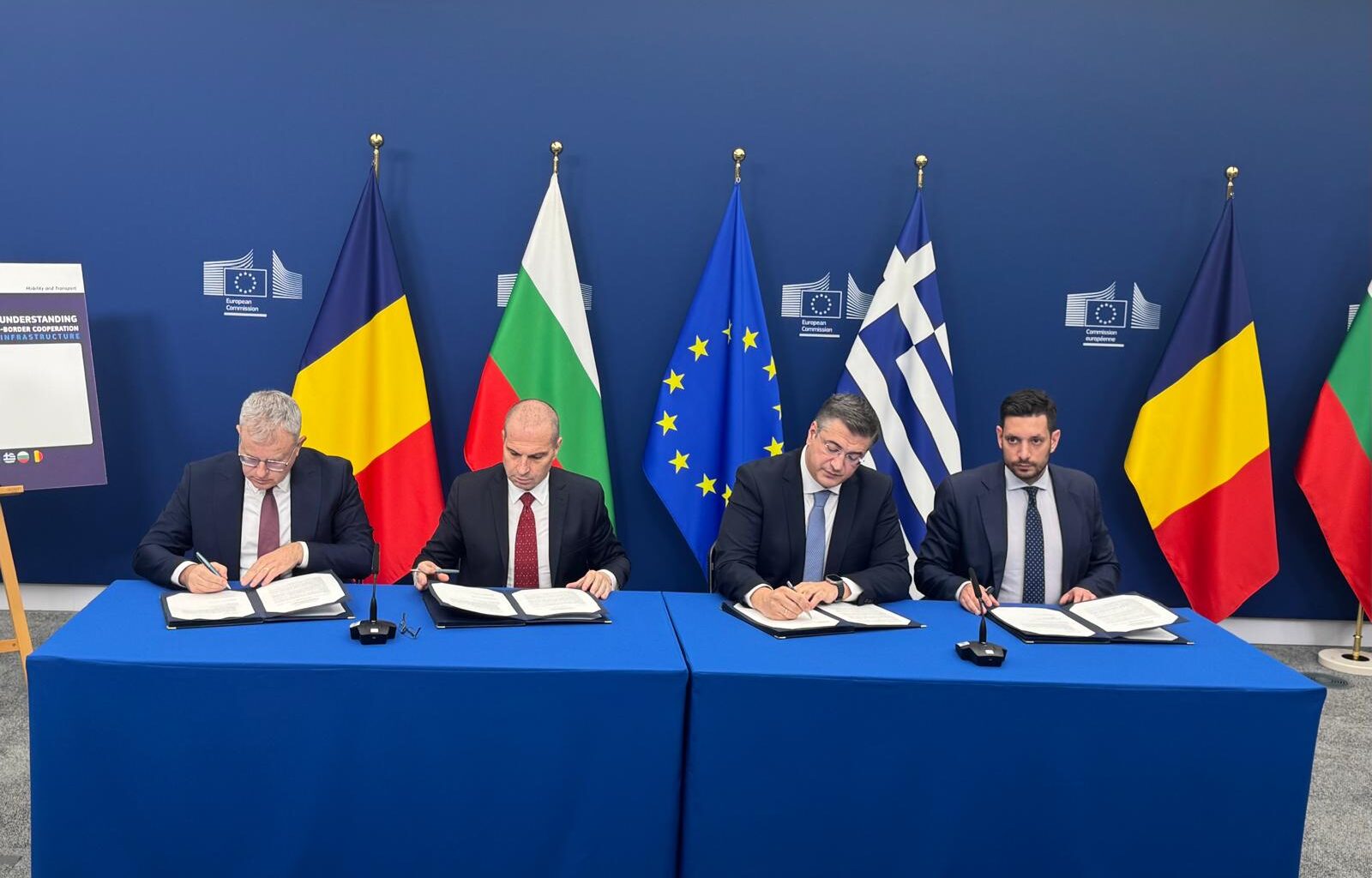
 Greece, Bulgaria, and Romania have signed a Memorandum of Understanding to intensify cross-border cooperation in the field of transport infrastructure, contributing to better regional integration and improved connectivity in Southeast Europe.
The Memorandum of Understanding marks a shared determination to accelerate the modernization and interoperability of strategic rail, road, and inland waterway links.
“Greece, Bulgaria, and Romania are committed to taking a decisive step in strengthening the most strategic north-south corridor in Southeast Europe. By deepening cooperation, we are strengthening connectivity for citizens and businesses and enhancing Europe’s security, competitiveness, and resilience in the Aegean, Black Sea, and Danube regions. The European Commission will be with them every step of the way,” said Commissioner for Sustainable Transport and Tourism Apostolos Tzitzikostas.
The three EU Member States have decided to create the Black Sea-Aegean Corridor Platform (BACP), which will serve as a regional cooperation framework dedicated to the development and modernization of cross-border transport infrastructure, as well as the efficient planning and implementation of projects. The aim of this initiative is to ensure a continuous and uninterrupted logistics flow by coordinating the efforts of the three countries. The strategy involves the joint mobilization of European Union funds and national resources, the simplification of administrative procedures, and the acceleration of the implementation of multifunctional infrastructure adapted to the challenges of climate change along the corridor. The implementation of the measures provided for in the platform will be supported by European coordinators and European Union institutions, and activities will be carried out at a technical level, ensuring the efficient and integrated implementation of projects.
Modernization of three key corridors
Black Sea Corridor – Aegean Sea Corridor will have multimodal connections within the TEN-T network structured along three axes and will include inland waterways (Danube), railways, roads, ports, airports, multimodal terminals, bridges, and urban nodes as part of the core, extended, and comprehensive TEN-T networks. According to the agreement signed, three corridors connecting Greece, Bulgaria, and Romania in a north-south direction have been established, which will be modernized and adapted to create interoperable rail traffic and optimal road infrastructure.
One includes the western axis, on the route Athens – Thessaloniki – Promachonas (in Greece) – Kulata – Sofia (Bulgaria) – Vidin/Calafat – Craiova – Bucharest (Romania).
The central axis includes a corridor on the route Thessaloniki/Alexandroupoli – Ormenio (Greece) – Svilengrad – Ruse (Bulgaria) – Giurgiu – Bucharest – Siret (Romania-border with Ukraine) – Ungheni (on the border between Romania and the Republic of Moldova).
The third axis includes an eastern orientation and involves the route Alexandroupoli – Ormenio (Greece) – Svilengrad – Stara Zagora – Burgas/Varna (Bulgaria) – Constanta (Romania).
The objectives of the three countries
Through the BACP, the countries have set a series of objectives that will contribute to an infrastructure that allows the smooth movement of passengers and goods, stimulates regional trade, and strengthens economic and social ties between the participating countries. In addition, by strengthening this strategic corridor, Greece, Bulgaria, and Romania aim to facilitate access to regional and European markets, reduce transport times, and promote sustainable mobility, thereby contributing to the reduction of carbon emissions and the development of a more environmentally friendly infrastructure.
The platform will provide a stable framework for coordinating investments, prioritizing projects of European interest, and constantly exchanging information on national infrastructure plans. This includes major projects in the TEN-T network and other initiatives that will accelerate the development of rail, road, and river transport between the three countries, creating the conditions for a more competitive, connected, and secure region. Through this initiative, Greece, Bulgaria, and Romania are demonstrating their commitment to transforming the south-eastern European area into a strategic transport hub, capable of responding to future challenges and generating sustainable benefits for the entire region.
The states have set themselves the common goal of implementing cross-border projects with dual civil-military use, in accordance with technical and operational standards, and of integrating climate resilience and military mobility objectives. Action will also be taken on the pillar of interoperability and harmonization of standards for projects to install ERTMS, as well as those allowing 740-meter-long freight trains, thus forming an integrated and interoperable infrastructure that ensures uninterrupted multimodality at cross-border crossings.
The three countries will also work together to introduce large-scale innovations and digital solutions, including 5G infrastructure, digital platforms for logistics, and traffic optimization.
Share on: 


