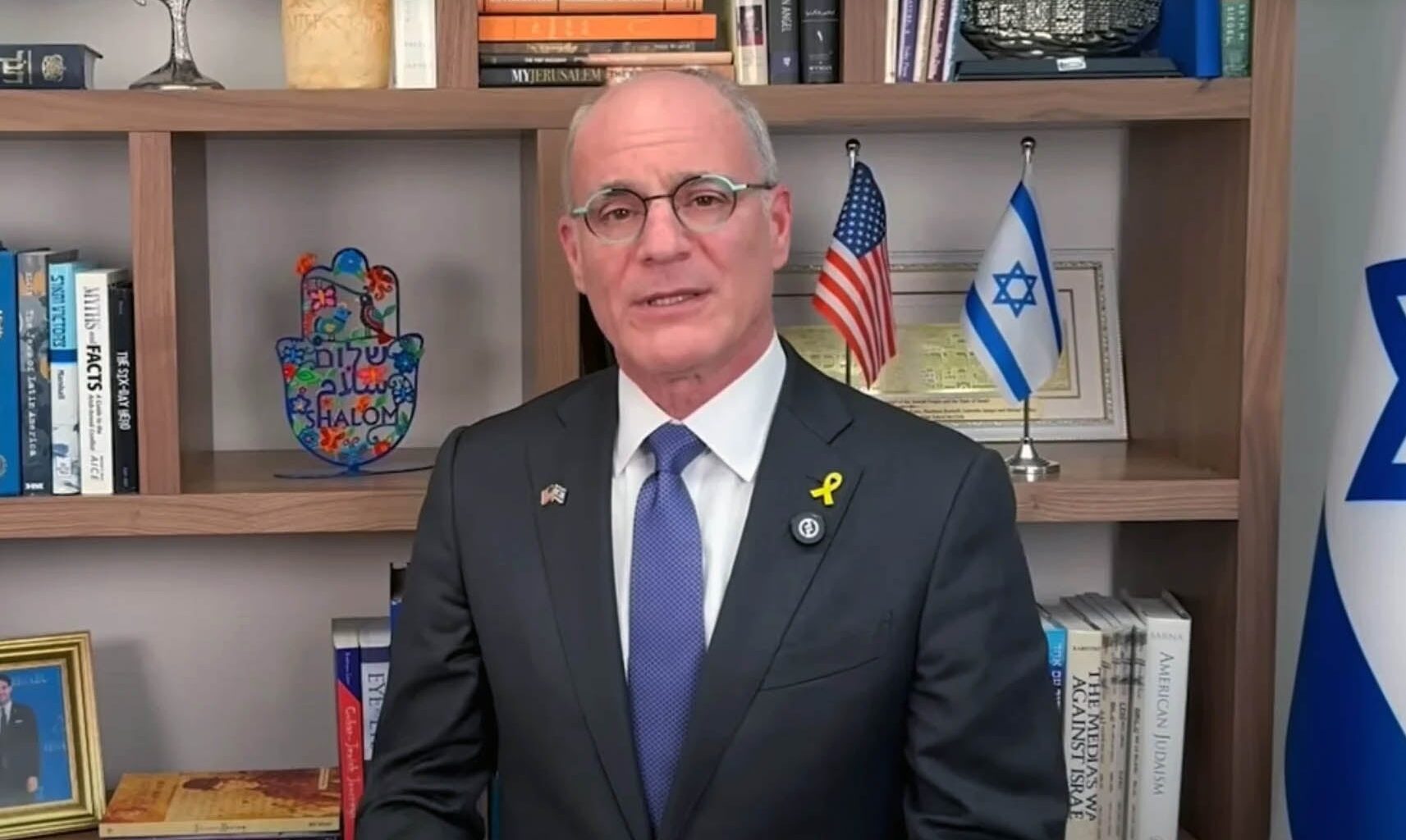
In a recorded message published Friday by English-language Lebanese outlet This is Beirut, Israeli Ambassador to the US Yechiel Leiter addressed Lebanese citizens, telling them: “We want very much to pursue peace with you.”
The video outreach came as Israeli and Lebanese officials held the first direct talks in decades, even as Israel has ramped up strikes on Hezbollah targets in Lebanon in what it says are responses to repeated violations from the Iran-baked terror group, a year after the two sides agreed to halt the conflict that smoldered into full-scale war in southern Lebanon last fall.
In his message — billed by the Lebanese outlet as an exclusive interview, but with only Leiter seen in the shot, and speaking to camera — the ambassador, who is close to Prime Minister Benjamin Netanyahu, emphasized that Israel’s concerns are solely security-related, saying, “We have no issues with your territory. We have issues only with our security… When we’re threatened, we have to respond.”
Continuing, the Israeli envoy said that Lebanon has been “raped by foreigners,” such as Iran, which has been “pumping money into an organization which has really robbed you of your peace,” referring to Tehran’s backing of Hezbollah.
Looking ahead, he said he envisions potential bilateral economic and tourism ties, with “Israelis visiting Beirut” and “Lebanese visiting Jerusalem.”
Get The Times of Israel’s Daily Edition
by email and never miss our top stories
By signing up, you agree to the terms
He compared the possibilities for Israeli-Lebanese relations to the Abraham Accords signed with the UAE, Bahrain and Morocco, adding, “I think we can clearly move into Abraham Accords 2.0… We have to expand the broad relationship of moderation within the Middle East.”
But “you can’t move forward,” he continued, “if there is civil war, if there is a foreign influence which is compromising the peace and harmony within the country.”
“If there is peace, and we have an agreement over the border,” then Lebanese people can move towards a better future, he added.
“But because we had missiles raining down on our civilians,” he continued, “we had to move 70,000 people out of their homes for a year. This was very traumatic for the entire country.”
Hezbollah began firing into Israel on October 8, 2023, a day after the Hamas massacre in southern Israel, forcing an evacuation of civilians from Israel’s northern border.
“We can’t go back to a situation where we send men, women and children back to their homes and then we have to remove them again because Hezbollah decides they’re going to start firing missiles at us again,” Leiter said.
“We have no territorial designs in Lebanon,” he insisted. “We want Lebanon to be secure.”
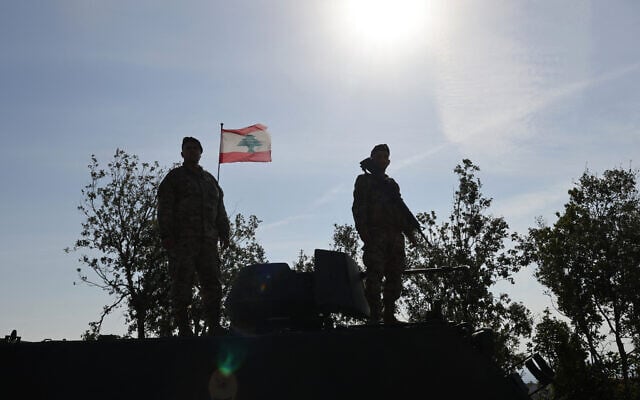
This photograph, taken during a press tour organized by the Lebanese army, shows Lebanese soldiers standing atop a military vehicle in Alma Al-Shaab, near the border with Israel in southern Lebanon, on November 28, 2025. (Anwar AMRO / AFP)
Touting recent talks between Israeli and Lebanese representatives in Naqoura, the first direct talks between the two countries in decades, Leiter said that he believes that if the two sides “sit together and do business,” then the issues between them can be solved.
While the meeting was a major step, the two sides gave different accounts of its content. Ahead of the sit-down, the Prime Minister’s Office called it “an initial attempt to create a basis for a relationship and economic cooperation between Israel and Lebanon.”
However, Lebanon’s Prime Minister Nawaf Salam contradicted this, stressing that his country was “far from” diplomatic normalization or economic relations with Israel.
A second meeting is scheduled for later this month.
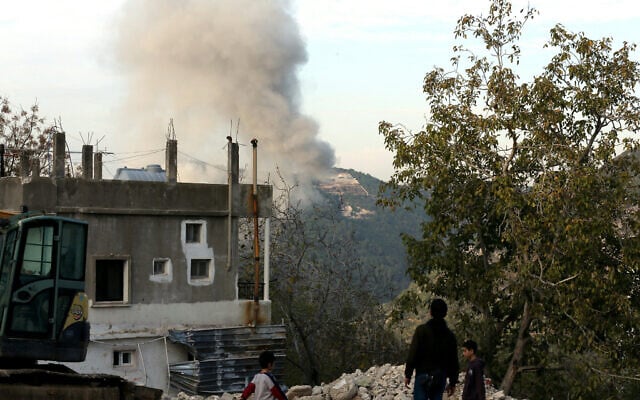
Smoke rises from the site of an Israeli airstrike in southern Lebanon on December 4, 2025. (MAHMOUD ZAYYAT / AFP)
Amid the new talks, tensions in Lebanon have ratcheted up in recent weeks. The IDF accuses Hezbollah of violating the November 2024 ceasefire and has intensified its strikes against terror group targets, including killing its chief of staff in a rare strike in Beirut last month.
Under the terms of the ceasefire, Hezbollah was required to vacate southern Lebanon, while Israel was given 60 days to do so. The IDF later withdrew from all but five posts along the border with Lebanon, citing the incomplete dismantling of Hezbollah’s infrastructure in the country’s south.
The latest Israel-Hezbollah war began a day after Hamas attacked southern Israel on October 7, 2023, with Hezbollah firing rockets into Israel in solidarity with Hamas. Israel’s response operation, which included bombardment and a ground operation last year, has severely weakened Hezbollah.
You appreciate our journalism

You clearly find our careful reporting valuable, in a time when facts are often distorted and news coverage often lacks context.
Your support is essential to continue our work. We want to continue delivering the professional journalism you value, even as the demands on our newsroom have grown dramatically since October 7.
So today, please consider joining our reader support group, The Times of Israel Community. For as little as $6 a month you’ll become our partners while enjoying The Times of Israel AD-FREE, as well as accessing exclusive content available only to Times of Israel Community members.
Thank you,
David Horovitz, Founding Editor of The Times of Israel
Already a member? Sign in to stop seeing this