 Réalisation Le Lab Le Diplo
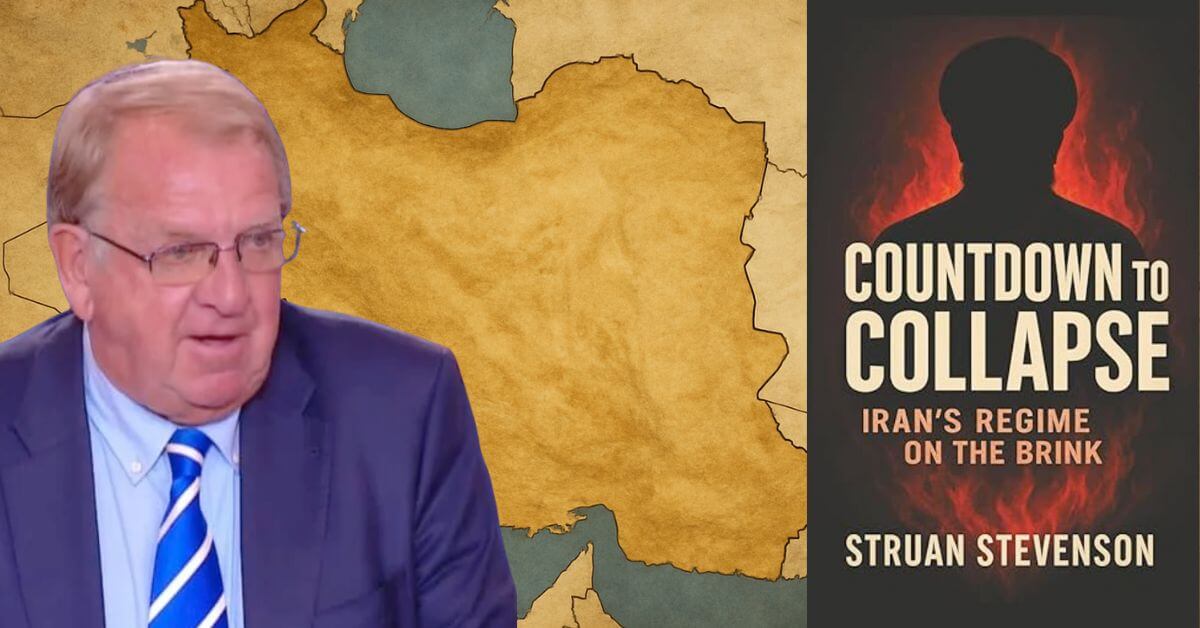
A former Scottish Member of the European Parliament (1999–2014), former chairman of the Parliament’s delegation for relations with Iraq and of the “Friends of a Free Iran” intergroup, Struan Stevenson is now the coordinator of the Campaign for Iran Change (CiC) and president of the Committee for the Search for Justice (ISJ). On the occasion of the French publication of Dictatorship and Revolution: Iran, a Contemporary History (Les Presses du Midi) and of his new book Countdown to Collapse: The Iranian Regime on the Brink, he speaks to Le Diplomate about the regime’s internal weakening, the role of the NCRI and the resistance units, as well as the “third option” that he sets against both Western complacency and military adventurism.
Le Diplomate : You recently travelled to Paris, where you met with senators and journalists. What were the reasons for these meetings, and why now?
Struan Stevenson : I travelled to Paris to launch my latest book ‘COUNTDOWN TO COLLAPSE – Iran’s Regime on the Brink”. The book is built on two simple but powerful propositions. First: The religious dictatorship ruling Iran is the principal source of war, insecurity, and instability in the region — the head of the snake. Its overthrow is a prerequisite for peace, not only in the Middle East, but across the world. Second: That transformation cannot come through foreign military intervention or appeasement. Real, lasting change will come only through the courage and determination of the Iranian people themselves — and through their organised resistance.
You have written numerous books on Iran, addressing both the country’s contemporary history and your personal experience as a Member of the European Parliament from 1999 to 2014. Your latest book, Countdown to Collapse: Iran’s Regime on the Brink, has attracted the attention of the political world. What is the main message of this book?
In June this year, the Middle East entered a new and dangerous era. Following the Hamas atrocities of 7th October 2023 — financed, trained, and directed by Tehran — the conflict eventually reached the mullahs’ doorstep. For ten days, Israel launched devastating airstrikes on Iran’s nuclear and military sites, while the regime responded with volleys of missiles aimed at Tel Aviv and other Israeli cities. The United States then joined in, striking three major Revolutionary Guard facilities. But, despite the blows inflicted on the mullahs’ nuclear programme, the underlying problem remains. The regime is still there — wounded, but not destroyed. The focal point of instability in the Middle East remains Tehran. Change in Iran is not only necessary — it is inevitable. And the power of that change lies not in Washington or Brussels, but in the streets and cities of Iran itself. Let’s be clear: This would require an organized force on the ground, historically rooted, popular, and independent of the influence of foreign powers and states. In my latest book, I observe and demonstrate how the rapidly expanding Iranian resistance units, coordinated by the main opposition group, the People’s Mujahedin Organization of Iran (PMOI or MEK), can overthrow the mullahs’ regime. The ayatollahs’ power is relentlessly targeting these resistance units, carrying out arrests, torture, and harsh sentences, sometimes even issuing death sentences, but it is failing to stop this phenomenon, which is spreading among a youth eager to confront the entire regime.
À lire aussi : Interview: Yury Istomin on the European AI Act
Your previous book, Dictatorship and Revolution: Iran, a Contemporary History, was translated into French this year. In it, you trace the history of the last Iranian dynasty and analyse the prospects for a return to the monarchy, as well as the question of alternatives to the mullahs’ regime. What are your conclusions, and why?
For decades, the name Reza Pahlavi has loomed over the Iranian-opposition diaspora like a dark cloud. The exiled heir of the hated Pahlavi dynasty is a living reminder of why the Iranian people rose up in revolt against his tyrannical father the Shah. Yet never one to neglect a chance to reclaim the Peacock Throne, Pahlavi has launched a series of initiatives that always begin with great fanfare and publicity and then fade into bleak irrelevance. The most recent example is the “100 Cities – One Voice” project, first unveiled at the Munich Security Conference on February 16 this year, with Pahlavi in attendance. The project promised synchronized demonstrations worldwide, uniting Iranians under his leadership. Its first planned action on April 19 was to span 19 cities. In reality, only 14 events occurred, the largest in Frankfurt with around 20 participants. Other gatherings were tiny, in some cases a single person with a table and flags yet were counted as “actions in support of Reza Pahlavi.” Over three decades, these projects have consistently failed to survive beyond launch. Differences of ideology, Pahlavi’s arrogant authoritarianism, leadership rivalries, and the absence of sustained grassroots engagement have splintered efforts.
The repeated cycle of short-lived initiatives, often ambitious in name but thin in structure, illustrates how the exile-based opposition under Pahlavi has struggled to present a cohesive alternative to the regime. Pahlavi’s failures stem from three interlocking weaknesses. Exiled since 1979, he has no sustained internal presence. While ordinary Iranians suffer repression and destitution, he has lived a life of wealth and opulence on the back of the billions stolen from the Iranian people by his father. At a press conference in Paris on 23 June, Reza Pahlavi proclaimed that he was already in “direct communication” with Islamic Revolutionary Guard Corps (IRGC) officers, seeking to build “a formal channel for military, security and police personnel to reach out” to him. He claimed that “these officers… these brave men” were contacting him and expressing a desire to join “this national salvation”.
This is not merely rhetoric, it is a dramatic shift in posture for a man who styles himself as the heir of the monarchy, and yet now appears prepared to enlist the mullahs’ very enforcers as instruments of his comeback. Even more troubling, his inner circle reportedly includes Parviz Sabeti, a longtime deputy of the Shah’s secret police, SAVAK. That Pahlavi would court the IRGC, an institution whose very purpose has been the preservation of the clerical regime, and resurrect ties to the SAVAK era, should sound alarm bells across the Iranian diaspora and to the West alike. In the end, the path to freedom in Iran will not be paved by alliances with the apparatus of dictatorship, whether cloaked in green uniform or crimson sash. It must spring from the people themselves, the women and men on the street who cried: “Death to the oppressor, whether it’s the Shah or the (Supreme) Leader,” not from exiles negotiating with their oppressors’ cohorts. Anything less is a betrayal of their sacrifice. The Iranian people have made their verdict clear; they reject both the mullahs’ tyranny and the return of the crown. Between the turban and the throne, they choose neither. They choose freedom.
This complicity between the current regime and the pretender to the monarchy has just been exposed since the new location feature on X revealed the true origin of posts supporting the return of the monarchy or praising the Shah’s son. Overnight, a series of accounts supposedly located around the world—and presented as proof of Reza Pahlavi’s massive following—switched to locations in Iran. X is banned in Iran, and users using a VPN, to avoid identification, see a foreign environment, but never the Iranian Android application itself. Thus, the accounts that continue to display this application from Iran are not ordinary internet users: they connect without any protection, via networks under direct state control. In other words, they are part of the regime’s cyber army or benefit from its explicit approval.
This revelation profoundly shakes the digital narrative constructed around Reza Pahlavi. A significant portion of the online activity presented as spontaneous popular support now appears to be a mechanism orchestrated, encouraged, or even directly manufactured by the Islamic Republic itself. This is not due to ideological adherence, but because this “pretender,” lacking any real roots, constitutes a useful tool: a substitute opponent, incapable of threatening the regime but able to distract public opinion. This confirms that the regime has long invested in creating false rivals to better divide the genuine opposition and divert attention from the forces that represent a far more serious danger to it.
Your current engagement with the Iranian issue is remarkable: Chair ISJ Committee on the Protection of Political Freedoms in Iran and Coordinator of the Campaign for Change in Iran (CIC). You also chaired the European Parliament Delegation for relations with Iraq (2009–2014) and the Intergroup “Friends of a Free Iran” (2004–2014). Why is a Scottish MEP so interested in Iran?
When does a person reach their tipping point? For me it was the hanging of a 16-year-old girl in Iran for ‘acts incompatible with chastity’. Atefeh Rajabi Sahaaleh was hanged in public from a crane in the city of Neka in August 2004. She had been raped and tortured for three years by a 51-year-old former Islamic-Revolutionary-Guard-member-turned-taxi-driver. He was sentenced to 100 lashes, and she was arrested, tortured, and then hauled before Neka’s local chief religious judge Haji Rezai. Atefeh was so outraged at the injustice of her treatment that she tore off her headscarf and threw one of her shoes at the judge, committing the ultimate offence of contempt of court. The judge not only sentenced her to death but acted as her executioner as well, placing the rope around her neck before the crane dragged the child, choking into the air. Judge Rezai stated that this would “teach her a lesson and silence her sharp tongue.”
I was sitting in my office at the European Parliament in Brussels, in the Autumn of 2004 when the Ambassador to the EU from the Islamic Republic of Iran arrived for a pre-arranged meeting. As he launched into a lengthy discourse on the achievements of the Islamic Revolution in Iran, I held up my hand to silence him and said: “Last week your country hanged a 16-year-old girl in public. This was an outrage against all of our core European values of human rights, the rights of women and the rights of children. I am utterly appalled at this barbarous crime. I have watched in dismay as your country has condoned torture, stoning, amputations and public executions. I can no longer stand on the sidelines. I do not want any explanation or attempts to justify this crime from you. I would ask you now kindly to leave my office and I can assure you that you will not be welcome here again.” The ambassador looked stunned. He started to speak, and I interrupted him calling on my staff to show him out. I was shaking with rage. That day I told two representatives of the NCRI who worked in the European Parliament that I was willing to help the Iranian opposition in their campaign to overthrow the mullahs’ cruel regime.
À lire aussi : EXCLUSIVE – Le Diplomate’s Grand Interview with Hermann Kelly, Champion of Irish Sovereignty
In your opinion, what are the chances of the current regime being overthrown, and what do you suggest to Western countries, particularly France?
The regime today is crumbling under the weight of its own corruption and deceit. Khamenei’s years of duplicity, pretending his nuclear ambitions were peaceful while chanting “Death to America”, have collapsed spectacularly. The Revolutionary Guards, and their Quds Force, became the regime’s long arm of repression and terror. They bankrolled Hezbollah in Lebanon, propped up Bashar al-Assad in Syria, armed the Houthis in Yemen, and funded Hamas in Gaza. In Iraq, they built militias that continue to subvert democracy and sovereignty. Wherever there is turmoil in the Middle East, Tehran’s fingerprints are there. And yet, while billions have been poured into foreign wars and proxy militias, the Iranian people are left destitute. Inflation is out of control. Unemployment is soaring. Corruption is endemic. The rial is virtually worthless. Millions of young Iranians, bright, educated, full of talent, see no future in their own country. But despite the fear, despite the repression, the people of Iran have never stopped resisting. With the collapse of Bashar al-Assad, the decapitation of Hezbollah, the destruction of Hamas and the targeting of the Houthis in Yemen, Khamenei is now at his weakest point ever. The next nationwide uprising will almost certainly lead to the overthrow of the regime. Western nations must show their support for the Iranian people and their main democratic opposition movement the NCRI. France, the EU and the UK, must follow the example of America, Canada and Australia by blacklisting the IRGC, while also closing all Iranian embassies and expelling their diplomats and withdrawing our own diplomats from Iran.
Why do you consider the National Council of Resistance of Iran (NCRI) to be a credible alternative to the current regime?
This is the longest-lasting political coalition in Iran’s contemporary history. The National Council of Resistance of Iran (NCRI) is capable of transforming Iran and the Middle East as a whole by implementing Maryam Rajavi’s ten-point plan for peace, democracy, justice, and an end to the regime of tyranny, torture, executions, and the nuclear threat. This plan for a free, democratic, and secular Iran, is a plan that envisions gender equality, freedom of expression, the abolition of the death penalty, and peaceful coexistence with Iran’s neighbours. That is the vision we must support. That is the future Iran deserves. Imagine what the fall of this regime would mean. No more Iranian missiles in Yemen. No more Hezbollah stranglehold on Lebanon. No more Hamas armed with Tehran’s cash. No more militias undermining Iraq. No more nuclear blackmail threatening the world. The collapse of this regime would not only liberate 90 million Iranians, it would transform the entire Middle East.
The NCRI is an effective Parliament-in-exile, which possesses all the structures of a government in the making. It is largely supported by the Iranian diaspora, particularly by young people from the second generation after the revolution, as well as by the multitude of experts, intellectual elites, highly qualified individuals, and academics who were forced into exile in Europe and the United States. But, as I mentioned, it is a force deeply rooted in Iran through its history, but also thanks to the structures of the resistance units that operate effectively on the ground. It is fully prepared to take initial control after the overthrow of the mullahs’ regime, maintaining security and planning a new constitution for a secular, democratic republic, after which the Iranian people would be free to vote for the government of their choice.
À lire aussi : PARTIE 2 – Le Grand Jeu Vert – Impensé stratégique : l’enfer est pavé de bonnes intentions
How do you respond to accusations from certain diplomatic or journalistic circles that describe the People’s Mujahedin or the Iranian Resistance as a “sect,” a “Marxist-Islamic” movement, or an organization without popularity in Iran?
How is it that such diverse figures, including leading Western leaders, can support a truly controversial movement? Could you imagine a Scottish Conservative MEP like myself, or Mike Pompeo, or Mike Pence, or Charles Michel, and many other leaders, supporting a “Marxist-Islamic” movement? It would indeed be absurd. In reality, in its ongoing effort to persuade Western governments to maintain a policy of engagement and appeasement, the Islamic Republic of Iran has orchestrated a sophisticated and costly propaganda campaign. At the heart of this narrative lies a calculated assertion: while the regime’s domestic repression and regional aggression may be indefensible, there exists no viable or credible alternative with which the West can engage. This argument, cloaked in the language of Realpolitik, appeals to the familiar adage that it is better to “deal with the devil you know.” To reinforce this perception, Tehran has launched a sweeping disinformation campaign both within Iran and abroad.
Domestically, the regime has invested heavily in the production of hundreds of feature films, television series, books, and articles, all aimed at vilifying the NCRI and its principal member, the PMOI/MEK. These state-sponsored narratives portray the Resistance as a fringe cult, devoid of popular support, and engaged in terrorism, claims that have been thoroughly discredited by independent research and analysis. Internationally, the regime has enlisted the services of ‘friendly’ journalists and academics, many of whom are of Iranian descent. Some of these individuals were later revealed to be part of a covert influence operation orchestrated by the Iranian Foreign Ministry, known as the “Iran Experts Initiative.” This network, reportedly infiltrated by Iranian intelligence, produced a stream of misleading articles and policy papers echoing Tehran’s talking points, further muddying the waters of public discourse in Western capitals.
Another striking indication of the regime’s deep anxiety over the growing influence of the MEK and NCRI, particularly in the United States and Europe, has been the farcical spectacle of an in-absentia trial launched in Tehran in December 2023. In this show trial, 104 senior PMOI/MEK leaders were charged in a highly politicized proceeding. The so-called judge, who is nothing more than a mullah serving the dictatorship, not only declared that any public expression of support for these individuals constitutes a criminal offense – for example, participating in a peaceful demonstration in Paris or London – but also issued an extraordinary call for their arrest and extradition from host countries to Iran, where they would face the regime’s harshest punishments. This brazen demand, made in defiance of international legal norms, underscores the regime’s desperation to silence its most organized and persistent opposition.
Ironically, the sheer scale and intensity of the regime’s campaign to discredit the NCRI and MEK betray its underlying fear of their influence. If, as Tehran claims, the Resistance were truly irrelevant and despised by the Iranian people, why expend such vast political, financial, and human capital to suppress and malign it?
What have been your personal experiences in this area? Have you been pressured for supporting the NCRI or for meeting with Ms. Maryam Rajavi?
I have also been personally affected by the regime’s campaigns. After making a speech at the UN Human Rights Council in Geneva where I attacked the theocratic regime’s use of cyberwarfare against its opponents, I returned home to find that my entire website had been destroyed. When I contacted the company that managed security on my website in London, they told me that among the thousands of websites they managed, mine had been the only one hacked. They said it had clearly been a sophisticated operation. It cost me several thousand pounds to rebuild my web-site and I now have a password that is around a mile long! When I was an MEP, I was repeatedly warned by MPs, MEPs and even Prime Ministers and Heads of State, from many different political factions and Member States, and even by Ministers from my own UK government, not to have any dealing with the NCRI and not to meet Mrs Maryam Rajavi, due to the pressure exerted by the Iranian regime on their states or political formations. This was quintessential appeasement policy in action, which has never worked.
Your friend Alejo Vidal-Quadras, former First Vice-President of the European Parliament, was the target of an attack in Madrid, and the investigation revealed the involvement of the Tehran regime. Do you feel threatened? Have you been threatened by the Iranian regime?
Following the attempted assassination of my great friend and colleague Alejo Vidal Quadras, I have been visited regularly by the Scottish Police Service Specialist Counter Terrorism Division. The investigation revealed that the regime has used drug trafficking mafia gangs with close ties to the Revolutionary Guards in Europe. This attack, and the threat to individuals who support the Iranian Resistance, demonstrates above all that our efforts to denounce this regime are the most effective.
What, in your opinion, is the NCRI’s vision for the Iran of tomorrow, and how can this movement succeed in overthrowing the current regime?
Iran’s oil industry has been under crippling Western sanctions since the United States withdrew from Barack Obama’s ‘deeply flawed’ 2015 nuclear deal in 2018, during Donald Trump’s first presidency. Since returning to office, Trump has pursued a “maximum pressure” strategy against Iran to cripple its economy. Inflation in Iran is running at around 38.7% due largely to rising food prices. Combined with the collapse of the Iranian currency, the rial, which has lost more than half its value since Masoud Pezeshkian took office as president in August 2024, poverty in Iran has reached unprecedented levels. It is estimated that up three quarters of Iranians now struggle to survive on incomes below the international poverty line.
The Iranian people are fed up with billions being spent on warmongering, international terrorism, nuclear developments and ballistic missiles, while they starve. The next hike in fuel prices could trigger a nationwide uprising that could drive the mullahs from power. But under these conditions, a regime that practices such severe repression will not collapse on its own. The fall of such a system requires the action of an organized force, present on the ground, with popular support, democratic leadership methods, and the capacity to guide an uprising and a non-chaotic transition. The NCRI’s organisational capabilities, its ability to mobilise, its resilience over more than four decades, the coherence of its leadership, and the clarity of its programme provide it with the necessary means to lead a transfer of power to the sovereignty of the Iranian people.
À lire aussi : The Green Great Game – PARTIE 1 Le Grand Jeu Vert : la lutte contre le changement climatique n’est pas la fin des luttes
What is your message to Europeans and the international community for resolving the current crisis with the mullahs’ regime?
For years, Iran’s regime has pursued nuclear weapons, supported terrorism and fuelled regional instability. Decades of talks have failed to moderate the regime, and the recent war showed that foreign military attacks cannot bring about change either. Twenty-one years ago, Maryam Rajavi – the president-elect of the National Council of Resistance of Iran (NCRI), proposed an alternative solution: the ‘Third Option’. Rejecting both appeasement and foreign war, it instead advocates change driven by the Iranian people and their organised resistance. Today, this proposal seems more relevant than ever. The Iranian regime and its Western apologists are promoting two false narratives in order to undermine democratic change. Firstly, they claim that the regime is too powerful to be overthrown, citing the recent war as proof of its stability. Secondly, they claim that regime change would lead to chaos, citing Iraq, Libya and Syria as examples. They claim that there is no alternative and that the West must continue to engage with the regime, which aims to undermine international resolve while ignoring Iran’s unique social fabric and organised opposition. However, the reality inside Iran tells a very different story.
In your opinion, does Islamic fundamentalism represent a global threat? Should we target Islam itself or radical Islamism?
Hitler’s ‘Thousand Year Reich’ only lasted 12 years. On that basis, the Iranian regime is well past its sell-by-date. The 1979 revolution in Iran, which overthrew the despotic rule of the Shah, was quickly hi-jacked by the mullahs and their psychotic figurehead, Ayatollah Ruhollah Khomeini. Khomeini appointed himself as God’s representative on earth, changing Iranian society overnight and giving birth to what is now known as Islamic fundamentalism. Khomeini’s legacy of repression and corruption has been steadfastly maintained ever since. For the past 46 years the mullahs’ revolutionary creed of radicalised Islam in reality boils down to a policy of hatred. Hatred of the West and in particular America, a hatred of Sunnis, a visceral hatred of Saudi Arabia and Israel and a hatred of religious minorities of any kind. When the mullahs’ theocratic regime falls, it will be a deathblow globally for Islamic Fundamentalism.
The victims of this Islamic fundamentalism have been, first and foremost, Muslims. This harmful phenomenon claims a monopoly on Islam. We must not give it carte blanche by conflating Islam with Islamism. Those who can rid the world of this threat are, above all, democratic Muslims, as can be seen in Iran. The most resilient force against the caliphate of the ayatollahs is made up of enlightened Muslims.
What do you think of the mindset of the European political leaders you have met?
Too many European leaders have adopted a policy of engagement or appeasement, rather than confronting Iran’s authoritarianism, human-rights abuses, and external aggression. This represents a sheer poverty of diplomatic principles among some political leaders. This mindset has tied the hands of decision-makers who might otherwise have responded firmly to Tehran’s “hostage-taking strategy”, terrorism abroad, repression at home, and nuclear/military expansion. The involvement of European governments, for example in supporting mechanisms that bypass sanctions, as part of appeasement, is reprehensible. Western leaders have effectively legitimised or enabled the Iranian regime’s conduct, by continuing diplomatic, economic, or symbolic relations, which are a betrayal of human-rights concerns and of the opposition inside Iran. In reference to the banning of opposition-group rallies and crackdowns on exiled dissidents, some European-led decisions are a disgraceful breach of international law and justice … the manifestation of fawning appeasement toward the regime in Tehran. Overall, where some EU politicians see diplomacy, trade or engagement as pragmatic or stabilising, this is in fact moral cowardice, complicity with repression, and failure to confront tyranny. “Engagement diplomacy” without moral backbone is not just naïve, it is dangerous, because it gives the Iranian regime leeway to operate without real consequences.
Your book, The Course of History: Ten Meals that Changed the World, was a great success in the United Kingdom. In your opinion, what is the connection between meals and politics?
It is interesting to answer this question after attending a working breakfast with Members of the French Senate in Paris on 25th November 2025. It is my experience in attending such events that led me to write the book. The conversations we have while sharing a meal can be part of some of the most important discussions of our lives. Look behind the scenes of major upheavals, wars and ideological disputes and you’ll often find a carefully crafted meal bringing the protagonists together. “Diplomatic dining” has involved some of the most important meals in history. The power behind the plate and the underlying psychology of shared dining has been shown again and again to be an art form of the most exquisite nature, at which the French and French cuisine are past-masters. For centuries, the dining table has been recognized as a unique forum where negotiations can be fought, differences settled, and relationships sealed.
My book. ‘The Course of History: Ten meals That Changed the World’ explores in detail some of the most significant decisions that were taken over the dinner table, often with world-shattering outcomes. Diplomatic dining has been deployed as a political tool before, during and after many of the major upheavals, wars and ideological disputes of the 19th and 20th centuries. Even today it continues to be a useful diplomatic mechanic between nations, in the interests of maintaining cordial and constructive working relationships, although it would be facile to suggest it could be a panacea for the scale of some of the problems the world is facing right now. However, rest assured: I do not advise sitting down to a meal with the devil, and I will never break bread with the Iranian leaders who represent this evil power.
À lire aussi : TRIBUNE – Nigel Farage, the British tsunami that will shake Europe?
STRUAN STEVENSON
Struan Stevenson is the Coordinator of the Campaign for Iran Change (CiC). He was a member of the European Parliament representing Scotland (1999-2014), president of the Parliament’s Delegation for Relations with Iraq (2009-14) and chairman of the Friends of a Free Iran Intergroup (2004-14). He is an author and international lecturer on the Middle East.
#Iran, #StruanStevenson, #CountdownToCollapse, #IranRevolution, #IranProtests, #NCRI, #MEK, #FreeIran, #RegimeChange, #MiddleEastSecurity, #IranNuclear, #IRGCterrorists, #HumanRightsIran, #MaryamRajavi, #IranResistance, #IranDemocracy, #IranWomen, #IranYouth, #TehranRegime, #IslamicFundamentalism, #IranOpposition, #EuropeIranRelations, #USIranPolicy, #Geopolitics, #LeDiplomate, #PoliticalInterview, #DictatorshipIran, #CollapseIran, #AntiTerrorism, #MiddleEastConflict, #IranianDiaspora, #FreedomMovement, #SecularIran, #SanctionsIran, #IslamicRepublic, #Ayatollahs, #FreeMiddleEast, #ResistanceUnits, #IranFuture, #IranChange