US demands for larger S. Korean regional role and China’s quiet acceptance of N. Korea’s nuclear status are narrowing Seoul’s room for maneuver
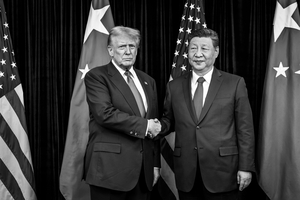
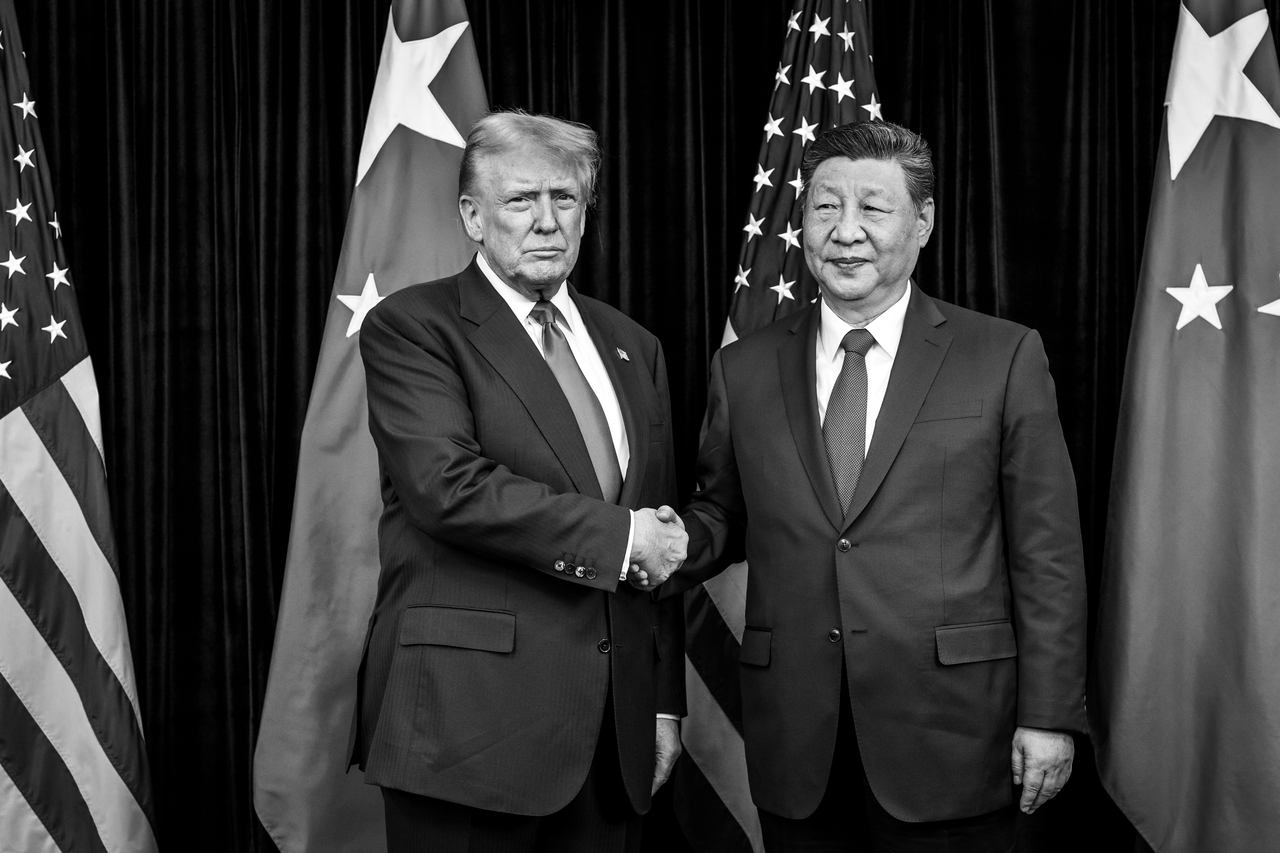 US President Donald Trump (left) greets Chinese President Xi Jinping before a bilateral meeting at the Gimhae International Airport terminal on Oct. 30 in Busan, South Korea. (White House)
 The mantra of “complete denuclearization of the Korean Peninsula,” once a strategic objective for both Washington and Beijing, has now vanished from their key official strategy documents as intensifying US-China rivalry reshapes regional priorities.
The shift, observers said, reflects how North Korea’s nuclear threat is being relegated to a lower priority for both powers, overshadowed by a widening Indo-Pacific contest that is shrinking South Korea’s room for maneuver, particularly on the North Korean nuclear issue.
The 2025 US National Security Strategy under the second Trump administration did not mention North Korea at all, while recasting South Korea as a frontline security actor in the Indo-Pacific region, with a strong emphasis on alliance burden-sharing and military capabilities.
“Given President Trump’s insistence on increased burden-sharing from Japan and South Korea, we must urge these countries to increase defense spending, with a focus on the capabilities — including new capabilities — necessary to deter adversaries and protect the First Island Chain,” according to the National Security Strategy released Thursday local time.
The omission marks a stark contrast with the National Security Strategy issued in December 2017 during US President Donald Trump’s first term, which identified North Korea as a second-tier threat alongside Iran and stipulated the goal of achieving “complete, verifiable, and irreversible denuclearization on the Korean Peninsula.”
Beijing walks back denuclearization
At the same time, China dropped the term “complete denuclearization” from its arms control white paper updated on Nov. 27 for the first time since 2005, signaling a departure from the core of its Korean Peninsula policy, which had centered on denuclearization.
“China calls on relevant parties to desist from an approach based on aggressive deterrence and coercion, restart dialogue and negotiations, and play a constructive role in resolving the Korean Peninsula issue through political means and realizing lasting peace and stability in the peninsula,” read the latest white paper titled “China’s Arms Control, Disarmament, and Nonproliferation in the New Era.”
The 2005 version of the white paper explicitly stated that “China supports the denuclearization of the Korean Peninsula.”
The move came amid growing concerns over China’s apparent acquiescence to North Korea’s possession of nuclear weapons, concerns that intensified after the summit between Chinese President Xi Jinping and North Korean leader Kim Jong-un on the sidelines of China’s “Victory Day” celebrations on Sept. 3.
Neither China nor North Korea referred to Pyongyang’s pursuit of “denuclearization” in their post-summit statement, unlike the five Kim-Xi summits from 2018 to 2019, when the term appeared consistently.
The omission is noteworthy in the context of China’s growing reluctance to invoke denuclearization in its official policy documents.
For instance, the joint declaration issued after the trilateral summit among the leaders of South Korea, Japan and China in May 2024 also omitted any reference to a shared commitment to the “complete denuclearization of the Korean Peninsula,” unlike the declarations released after the seventh and eighth summits in 2018 and 2019.
Seoul under growing strategic strain
George Hutchinson, editor-in-chief of the International Journal of Korean Studies, said that “over the past 24 hours, strategic pressures on Seoul intensified across every tier of the international system.”
“A US security blueprint that downplays North Korea while elevating South Korea’s role along the first island chain collided with China’s quiet normalization of Pyongyang’s nuclear status, squeezing the peninsula’s diplomatic room,” Hutchinson said.
“The result is a strategic picture in which Korea is being asked to shoulder greater regional and global burdens just as the alliances, partnerships … needed to support them are becoming less reliable,” he added.
However, the muted treatment of North Korea in the 2025 US National Security Strategy prompted differing interpretations among experts. Some viewed the US decision not to invoke denuclearization in the document as a tactical opening.
Yang Moo-jin, an honorary professor at the University of North Korean Studies in Seoul, said the omission of the term denuclearization “indirectly reflects President Trump’s relatively low level of hostility toward North Korea and his willingness to pursue renewed US-North Korea dialogue, while highlighting his personal rapport with Chairman Kim Jong-un.”
“It suggests an intention not to provoke North Korea for the time being and could help raise the prospects for renewed US-North Korea talks next year,” Yang added.
Tressa Guenov, a senior fellow at the Atlantic Council’s Scowcroft Center for Strategy and Security, said the omission reflects “a bid to signal a new chapter for the United States where it is less encumbered by the strategic irritants of the post-Cold War era and is free to pursue a bolder interest-based agenda.”
Guenov, however, pointed out that “the reality remains that US adversaries do not want to see this NSS realized whether the United States names them or not. US strategy must continue to take those factors into account.”
“North Korea is not explicitly named in the strategy, yet Pyongyang surely will have designs on global attention over the next three years,” Guenov warned.
dagyumji@heraldcorp.com