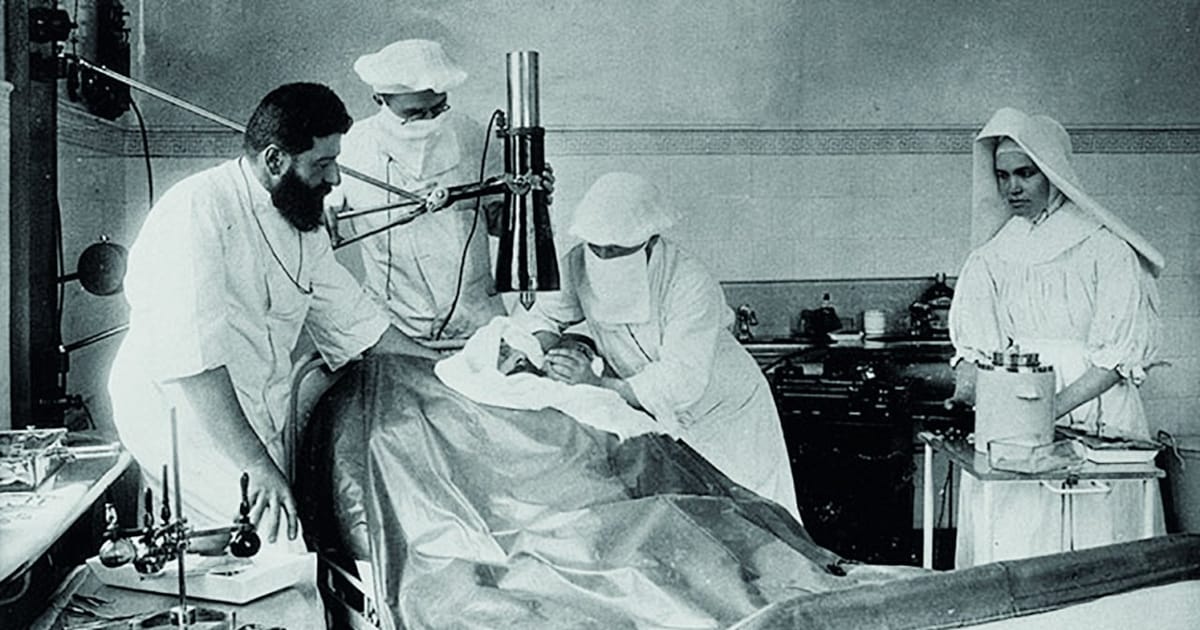

Eduard Konrad Zirm|Photo: Oční klinika Fakultní nemocnice Olomouc
At the beginning of the 20th century, blindness caused by corneal damage was practically untreatable. Eduard Konrad Zirm, then head of the ophthalmology department at the Provincial Hospital in Olomouc, nevertheless dared to attempt a procedure that no one had ever successfully performed.
His patient was a 45-year-old smallholder, Alois Glogar, who had lost his sight after his eyes were burned by quicklime. Zirm transplanted into him a healthy cornea taken from a young boy whose eye had to be removed for unrelated medical reasons. The operation, carried out on 7 December 1905, succeeded — Glogar regained his sight. It was the first successful transplant of a human organ in the history of medicine.
Czech ophthalmology in the modern era

Pavel Stodůlka|Photo: Pavel Sedláček, Czech Radio
The tradition of pioneering procedures continued into the new millennium. In 2004, chief surgeon Pavel Stodůlka at the Gemini Eye Clinic in Zlín performed the first DMEK corneal transplant in Czechia — one of the earliest operations of its kind in the world. In DMEK, the entire cornea is not replaced, only its thin inner layer. The surgery is gentler; patients heal faster, see better and require fewer medications than after a traditional transplant.
This tradition was later carried on by the University Hospital Ostrava, which in January 2020 became the first in the Moravian-Silesian Region to perform a corneal transplant using a unique 3D-imaging method. Patients thus gained access to a modern procedure directly within the region, without having to travel to Prague or other specialized centres.