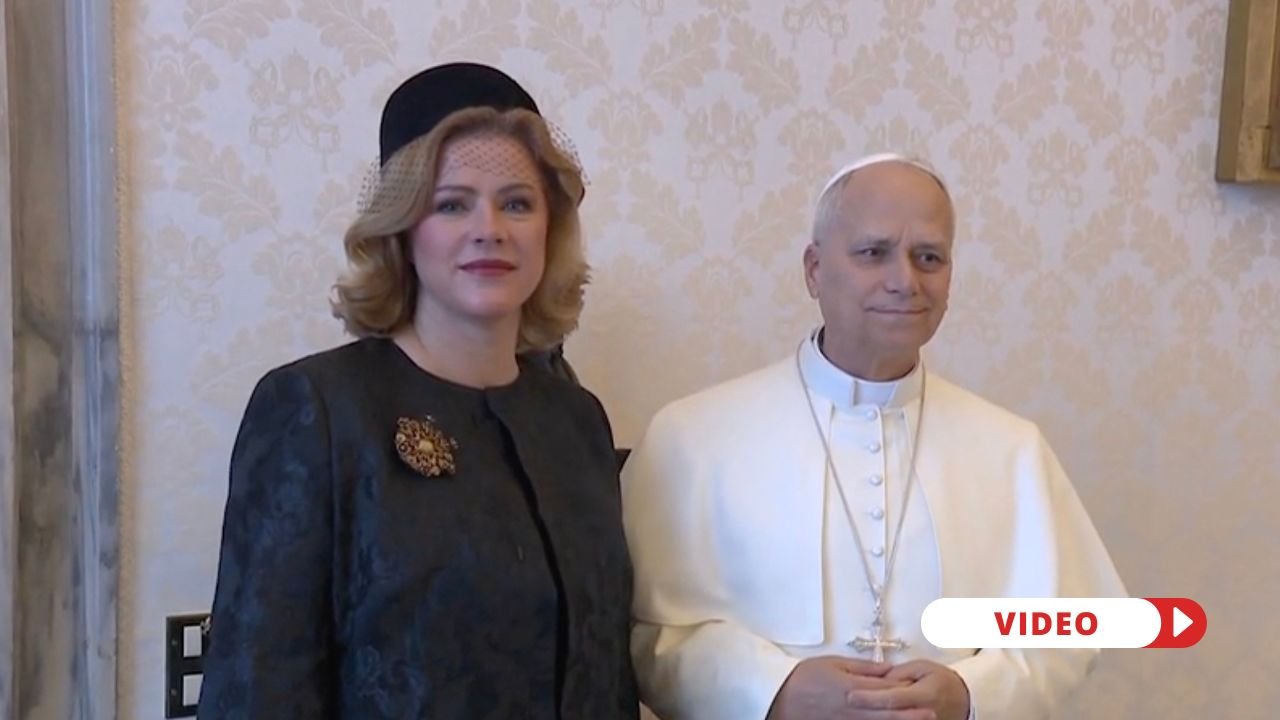
Latvia marked a significant milestone as Prime Minister Evika Siliņa joined a national pilgrimage from Latvia to Rome, commemorating 100 years since the country’s first official visit to the Eternal City. The historic journey brought together Latvian faithful to celebrate their Christian heritage and strengthen ties with the Holy See.
Latvia’s Pilgrimage to Rome
At the Vatican, Pope Leo XIV received the Latvian pilgrims, acknowledging their fears amid the ongoing war in Ukraine. He encouraged them not to lose hope and urged them to seek the peace that only God can give.
Following the audience with the pope, Prime Minister Siliņa met with Fr. Rihard Rasnacis, head of EWTN Latvia, to discuss Latvia’s Christian roots, its ecumenical traditions, and the nation’s relationship with the Holy See.
On the importance of the visit, Siliņa said:
“This visit to Rome was also very important for me, to show that the Latvian government works together with our Latvian people who are believers, for whom being in the Vatican is very important… and the new Pope was very pleasantly surprised and happy that so many pilgrims from Latvia came to the Vatican.”
Siliņa emphasized Latvia’s ecumenical approach, where the government participates alongside churches in national celebrations. She explained:
“I told him that we actually have an ecumenical tradition, whereby the government also participates. For example, on our State Independence Day many churches come together and pray for our country and our people. And what is important is peace in the world right now.”
She added that Pope Leo XIV is well aware of the geopolitical challenges Latvia faces, particularly regarding Russia and Ukraine, and appreciates the country’s efforts to remain resilient.
The Prime Minister identified shared cultural and religious celebrations as key areas for cooperation between Latvia and the Vatican. She noted: “The Aglona celebrations, where the government also usually participates and many, many people come from different churches, not only Catholic, to celebrate this day of the Virgin Mary.”
Siliņa highlighted the government’s ongoing support for Latvia’s Christian communities, particularly in preserving sacred heritage:
“Every year, our budget includes a special program for many Christian denominations and churches, which can be used for historical sites and reconstruction work. Each year there are specific needs, and we try to decide how we can help the Church, because we truly know how important it was after the Soviet period, when Christians were not allowed to go to church and pray, not to give up those Christian values for our people.”
She added that Christianity continues to inspire younger generations, especially in Latvia, where many young people belong to churches. She posits that it’s because “in such a troubling time, with social media, it can give hope… I know how much Christianity can contribute to your inner strength. And I am a believer, so I believe we can show the younger generations that we can be strong in our values and not give up.”
Regarding the Jubilee’s motto, “Pilgrims of Hope”, Siliņa emphasized the Church’s role in nurturing hope and unity, as she thinks that “it unites people, because we are united by one holy God. What always unites us is our hope and our freedom—for example, that you can speak your own language and love it. The Church can always go to people and help them, and when you feel forgiven, you see the world a little differently.”
The visit reinforced Latvia’s enduring Christian identity while highlighting the nation’s connection to the Vatican and its commitment to peace, unity, and spiritual resilience.
Adapted by Jacob Stein. Produced by Alexey Gotovskiy. Edited by Giada d’Ottavi. Camera by Alberto Basile, Fabio Gonnella.