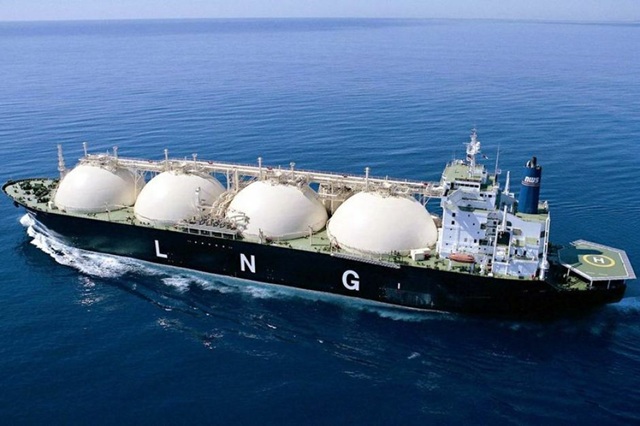
US natural gas prices are climbing at their fastest pace in years, driven by record exports of liquefied natural gas and an increasingly strained domestic supply — a combination that is deepening a cost-of-living squeeze and creating political headaches for President Donald Trump.
Wholesale prices have risen more than 70 per cent over the past year, with the Henry Hub benchmark closing at $5.29 on Friday, its highest since late 2022, when Russia’s invasion of Ukraine sent global energy markets into turmoil. The sharp increase undercuts Trump’s repeated claims that he has sharply lowered energy costs during his first year back in office.
A prolonged cold snap sweeping the US has further inflated demand for gas-fired power generation to heat homes and businesses, intensifying pressure on the domestic market. At the same time, Trump has championed a sweeping expansion of LNG exports and natural gas production — a cornerstone of his push for “US energy dominance” and a policy designed to power the explosive growth of energy-hungry artificial intelligence data centres.
But the surge in prices is fuelling public frustration and industry pushback, with manufacturers and consumer advocates warning that high energy bills are worsening the affordability crisis and undermining US competitiveness. “As North America exports more natural gas, it imports higher and more volatile gas prices as a result,” said Clark Williams-Derry of the Institute for Energy Economics and Financial Analysis. “This is great news for the gas industry… but not for consumers who rely on gas for heating or power.”
Analysts say the price spike reflects more than just the weather. A structural tightening is underway as LNG export volumes rise and AI-related electricity demand ramps up. In winter cold snaps, LNG facilities now compete directly with households and businesses for the same supply, said Wood Mackenzie analyst Eric McGuire — a dynamic that can leave the market short of gas during extreme weather.
Large industrial users warn that policymakers must prioritise domestic customers over exporters. Paul Cicio, CEO of the Industrial Energy Consumers of America, said rising export volumes increase both price and reliability risks: “We do not have an alternative. We are stuck at the end of a pipeline.”
The politics are increasingly fraught. A Yahoo/YouGov poll last week found Americans believe by a two-to-one margin that Trump has raised prices rather than lowered them. The president this week dismissed cost-of-living concerns as a “con job by the Democrats,” but government data show energy bills continuing to rise. According to the Bureau of Labor Statistics, electricity prices climbed 5.1 per cent in September year-on-year, while piped gas rose 11.7 per cent. The Energy Information Administration expects power-sector gas costs to jump 37 per cent this year and industrial gas prices to rise 21 per cent compared with 2024 averages.
Meanwhile, US LNG exports hit a record 9.41mn tonnes in September, up nearly 20 per cent from a year earlier. The surge has helped supply Europe during its post-Ukraine energy crisis, with shipments flowing heavily to Spain, France, the UK and the Netherlands.
Gas producers and the LNG industry reject claims that exports are driving domestic price inflation. Executives instead blame political barriers to new pipelines and storage infrastructure. Toby Rice, CEO of EQT — the country’s largest natural gas producer — argued that “political force” in the form of infrastructure blockages, not AI or LNG exports, is distorting prices. Pipeline constraints have left regional markets increasingly disconnected: while EQT expects to sell gas at roughly $4 per mmbtu this winter in Appalachia, consumers in Boston and New England will pay close to $14 due to limited pipeline access. “This isn’t just the most expensive natural gas in the country — it’s the most expensive natural gas in the world,” Rice said.
Still, analysts warn that the combination of massive new LNG capacity, expanding data-centre demand, and rising extraction costs in certain basins such as the Haynesville will continue to put upward pressure on prices. “Between now and 2030, LNG export capacity on the US Gulf Coast will double what it is currently,” said Rystad analyst Mathieu Utting. “That will definitely have an impact on price.”