
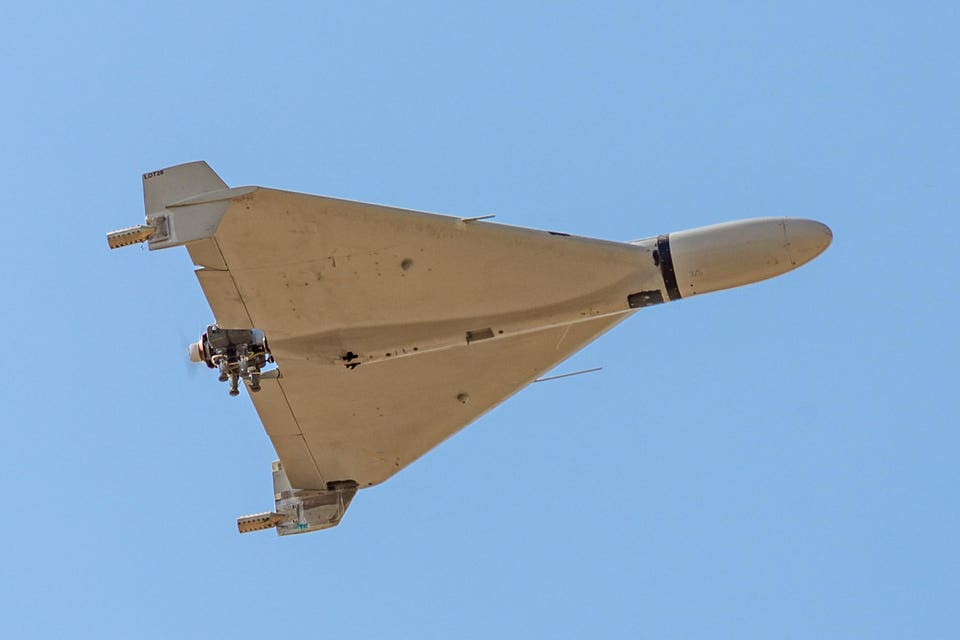
Iranian-made Shahed-136 drone flies over the sky of Kermanshah, Iran on March 7, 2024. (Photo by ANONYMOUS/Middle East Images/AFP via Getty Images)
Middle East Images/AFP via Getty Images
As part of its scramble to develop and deploy “affordable drone technology,” the U.S. military has launched Task Force Scorpion Strike. TFSS is a squadron of Low-cost Unmanned Combat Attack Systems, LUCAS, one-way attack drones, known as loitering munitions, based in the Middle East. Interestingly, the LUCAS system strongly resembles the Iranian-designed Shahed-136 loitering munition. And the U.S. openly admits it reverse-engineered technology from a captured Iranian Shahed-136 when developing LUCAS. The move came after decades of Iran producing unlicensed derivatives of U.S. weapons systems.
United States Central Command, responsible for U.S. military operations in the broader Middle East region, announced the formation of TFSS and the deployment of a LUCAS drone squadron in an official Dec. 3 press release.
“LUCAS drones deployed by CENTCOM have an extensive range and are designed to operate autonomously,” read the release. “They can be launched with different mechanisms to include catapults, rocket-assisted takeoff, and mobile ground and vehicle systems.”
For years, Iran and its militia proxies have used Shahed-136 and other Shahed model loitering munitions against U.S. troops in the Middle East, often causing injuries and sometimes even fatalities. Furthermore, Iranian-designed Shaheds have been used extensively by Russia against Ukraine’s cities and electricity grid since Moscow’s 2022 invasion. Russia has also built local derivatives of the Shahed, reportedly to an extent and scale that upset Tehran. The relatively low price of Shahed loitering munitions means operators can afford to use them in substantial numbers to saturate enemy air defenses and terrorize entire population centers, as Russia does daily in Ukraine.
U.S.-made drones like the long-endurance General Atomics MQ-9 Reaper are far more advanced than single-use drones such as the Shahed and perform different tasks. However, the higher price tags and more sophisticated technology mean it can deploy far fewer in the field and tolerate much fewer losses. The Reaper has proven particularly vulnerable to surface-to-air missiles during the intensified U.S. air campaign against the Iran-backed Houthis in Yemen earlier this year.
Deploying less advanced drones, such as the LUCAS, enables the U.S. to tolerate much higher losses and deploy many more against its adversaries in the Middle East. It can even retaliate to Shahed attacks against U.S. troops, especially ones that don’t result in fatalities, and regional bases in a tit-for-tat manner rather than dispatching high-performance jet fighter-bombers armed with expensive precision-guided munitions, or even strategic bombers flying directly from the U.S. mainland.
The U.S. can afford to deploy and potentially lose large numbers of LUCAS munitions compared to more advanced multirole drones like the Reaper. As CNN reported, the LUCAS has a similar price tag to the Shahed upon which it’s based, approximately $35,000 per unit. That’s a minuscule sum compared to the estimated $30 million that each Reaper costs. It even suggests that the U.S. could build as many as 857 LUCAS drones for the price of a single Reaper!
Additionally, the CNN report confirmed American companies studied and reverse-engineered a damaged Shahed-136 that the U.S. captured a few years ago when developing the LUCAS.
It’s worth remembering that the Shahed-136 and the similar Shahed-131 model have been found to contain large amounts of U.S.-made components, such as the GPS and microchips. So, the drone the U.S. copied arguably wasn’t a wholly homegrown Iranian drone to begin with.
Still, the development of the LUCAS represents a remarkable turnaround. After all, for over four decades, it was post-revolutionary Iran that invariably copied American-made weapons and systems without Washington’s consent.
When Iran was a close U.S. ally under the rule of its last Shah, Mohammad Reza Pahlavi, it bought vast quantities of advanced American military hardware. Its air force had flew large numbers of McDonnell Douglas F-4 Phantom IIs, Northrop F-5 Tigers and, most significantly, Grumman F-14A Tomcats, the only non-U.S. air force to fly that iconic fourth-generation fighter jet. On the ground, the Iranian Army used American-made M60 Patton tanks and several American-made arms, including the BGM-71 TOW anti-tank missile.
After the 1979 revolution deposed the Shah and Iranians took American diplomats hostage in the U.S. Embassy in Tehran, the U.S. imposed an arms embargo on Iran that continues to the present day. That’s except for the covert transfer of TOW missiles and other American weapons via Israel in the 1980s in the infamous Iran-Contra Affair. With few countries willing to sell it arms, Iran had to get creative during its depleting 1980-88 war with Saddam Hussein’s Iraq. By the end of that costly war, it was already producing its version of the American TOW, the “Toophan,” a Persian word meaning “typhoon.”
More recently, reports since 2022 indicate that Russia has transferred some more advanced American-made FGM-148 Javelin anti-tank missiles to Tehran for reverse-engineering as partial payment for the supply of Shahed loitering munitions, which included technology transfers. U.S. and allied troops and armor may one day encounter an Iranian version of the deadly Javelin.
For years, Israel justified its refusal to send any weapons to Ukraine on the grounds that they could end up in Iran’s hands and be used against Israel. Such claims are not groundless. Much like the Toophan, Iran developed its Almas family of advanced missiles by reverse-engineering Israeli-made Spike-MR missiles captured by the Hezbollah group in Lebanon during the 2006 Lebanon war and transferred to its patron in Tehran. More recently, on Dec. 6, Iranian media reported that Hezbollah has provided Iran with images and parts of an intact U.S.-made GBU-39B Small Diameter Bomb Weapon System dropped by Israel in the most recent conflict. The U.S. already asked Lebanon days earlier to return the unexploded bomb for fear it could fall into the hands of rivals like Russia, China and, of course, Iran.
Rebuilding, repurposing and reverse-engineering unexploded munitions certainly isn’t a new phenomenon in the war-plagued Middle East. The Hamas in the Gaza Strip built a large amount of its rockets and anti-tank weapons using unexploded Israeli munitions previously dropped on that narrow coastal enclave.
The most famous American weapons system Iran reverse-engineered was arguably the Lockheed Martin RQ-170 Sentinel drone. Tehran got its hands on one of these advanced, stealthy drones, which has a flying-wing design, that strayed over the border from Afghanistan and landed in the country in late 2011. Iran has since built local derivatives such as the jet-powered Shahed 171 Simorgh, which bears a striking resemblance. Since 2011, Iran is believed to have built at least five radar-evading drone models, attack and reconnaissance variants, based on the RQ-170 design.
An Iranian man rides his motorcycle past a Shahed drone in Tehran’s Bahrestan Square on September 27, 2025, as part of an exhibit to mark the “Sacred Defense Week” commemorating the 1980-88 Iran-Iraq war. (Photo by ATTA KENARE / AFP) (Photo by ATTA KENARE/AFP via Getty Images)
AFP via Getty Images
The RQ-170 capture was the exception rather than the rule for Tehran. Most of its reverse-engineered systems are from the Shah-era arsenal that the Islamic Republic inherited. An interesting development in recent years was the Karrar main battle tank, which analysts observed contains myriad elements copied from other tanks Iran has operated, including the Soviet T-72, American M60 and M48, and the British Chieftain. It even seems to have taken some inspiration from the American M1 Abrams tank, which Tehran, of course, has never operated.
More recently, Iran has modernized its M60s, creating the Soleiman-402 variant. Iranian media and officials boast that the upgrades to the tank’s armor put it on par with the most modern tanks in service today.
Other Shah-era systems Iran has produced derivatives of include the MIM-23 Hawk surface-to-air missile system, the Mersad. At sea, the Iranian Sayyad-2 is a reverse-engineered RIM-66 Standard Missile with some Iranian modifications.
Iran’s F-14As were truly cutting-edge air superiority fighters back in their day. Armed with the long-range AIM-54 Phoenix air-to-air missile guided at distant targets by the F-14’s AWG-9 radar, it was a real pioneer in beyond-visual-range air-to-air engagements. Iran understandably used its Phoenix missiles sparingly. In the 1980s, it attempted to modify the surface-to-air MIM-23s for use on the F-14, with mixed results. Decades later, it unveiled the Fakour-90, a long-range air-to-air missile based on the AIM-54 and MIM-23 mentioned above, and used on Iran’s remaining operational F-14As, which are the last ones still flying anywhere in the world today.
Similarly, Iran’s Bina-2 laser-guided, air-to-surface missile appears to be Iran’s version of the AGM-175 Maverick missile used by Iran’s F-4 fighters.
With all these precedents of Iran reproducing American-made equipment, it’s hardly surprising that the U.S. didn’t hesitate to copy an Iranian design when producing a cheap drone for deployment in the Middle East.
Here, Washington has essentially put the proverb “turnabout is fair play” into practice.