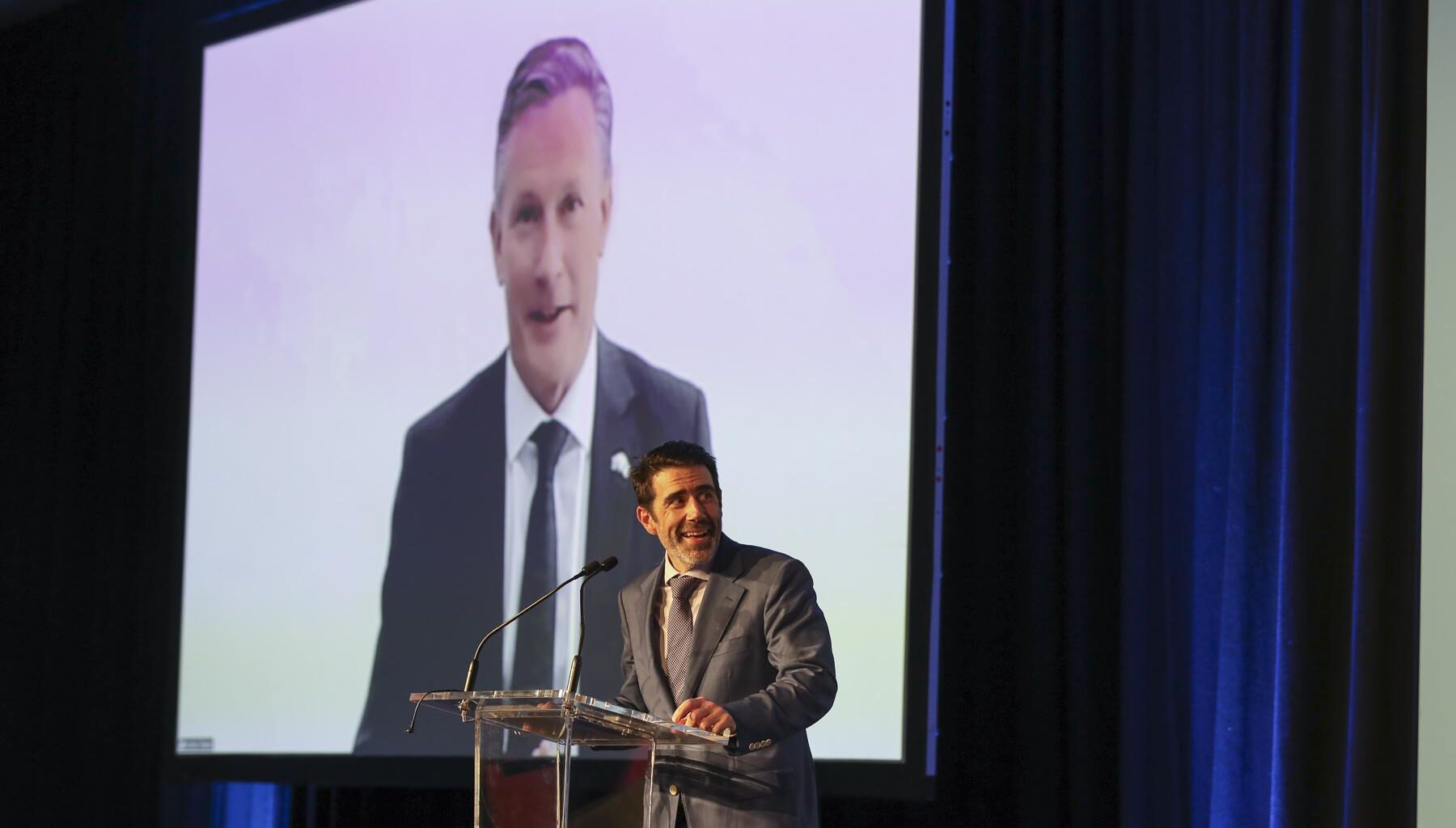
Don’t despair but don’t relax. It was a profoundly important message delivered last week by Australia’s director-general of national intelligence, Andrew Shearer.
The placid period that followed the end of the Cold War, so comfortable for the democracies, is gone, but that doesn’t mean we’re already in a new world order, that the authoritarians have won. Don’t despair.
But we are in a period in which the authoritarians must be resisted. Don’t relax.
And it’s the entire country that must not relax. Resistance demands a whole-of-nation effort, not least because so much of the battleground is in information and communications technology, leadership of which passed decades ago from governments to the private sector.
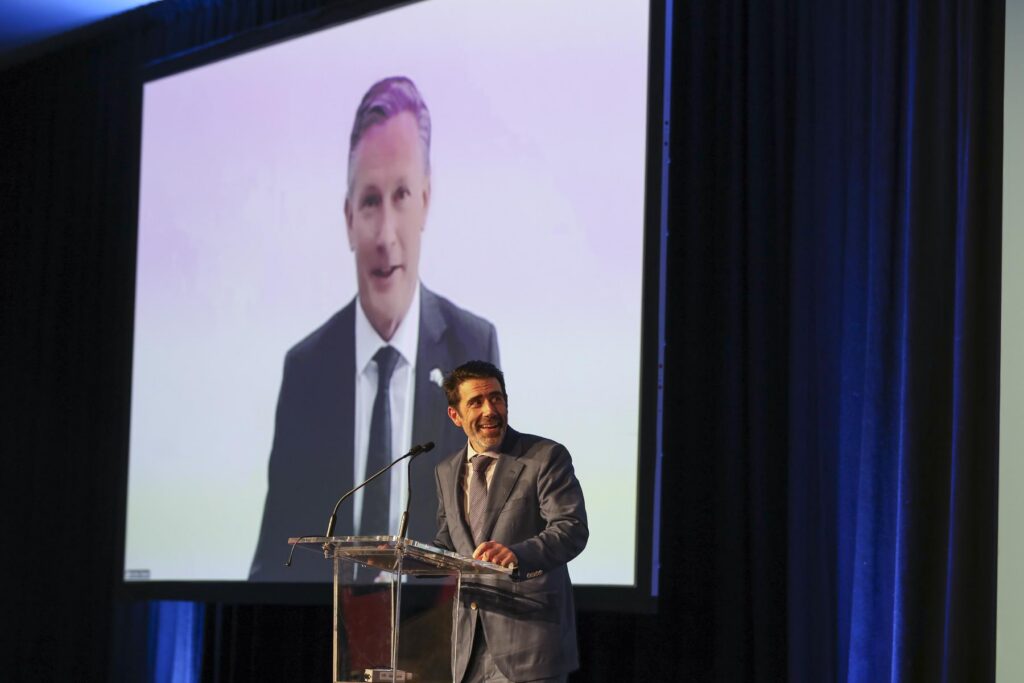
Speaking from Tokyo to me on stage at ASPI’s Sydney Dialogue conference on 5 December, Shearer repeatedly emphasised that he remained optimistic.
He recalled that the Berlin Wall had fallen almost as soon as he had started his career in the late 1980s by joining Australia’s signal-intelligence agency. ‘And with that, of course, came … decades of relative global stability, an end to the Cold War, of course, and the start of what we now call the era of globalisation,’ he said. ‘That world is now gone, I would argue, and we’re in not a new world order but a new period of global disorder ….’
‘But that doesn’t mean that our history or the world’s history is predetermined, notwithstanding that President Xi and President Putin, in this sort of Marxist-Leninist way, do believe that the forces of history are inevitably moving to their advantage and to our disadvantage.’ We must not give in to fear and fatalism, both of which would be paralysing.
Australia, in particular, has advantages in the struggle, and Shearer listed some for the technology-and-security conference.
‘Our geography is a huge plus for us. We don’t enjoy the strategic depth we did for the last couple of centuries because modern weapon systems, including cyber, are radically reducing the geographical benefits of distance. But we still occupy critical geostrategic terrain at the hinge of the Indo-Pacific region, which makes us an important partner for many countries across the region’
‘We have natural resources. We have energy. We have food. We have a well-educated, well-informed, outward-looking population. We have strong institutions, notwithstanding some of the strains on our social cohesion we’ve experienced in recent years.’
‘And critically, we have alliances and partnerships. Our most important strategic ally is the world’s leading power. It’s not just the world’s leading military power but, relevant to this conference, it’s by far the world’s leading technological power, even though that is obviously being challenged. We have the Five Eyes partnership, which is, of course, at the heart of our intelligence communities’ efforts, and we have new partners, including Japan.’
Meanwhile the threshold for conflict had fallen, he noted, pointing particularly to Russia’s full-scale invasion of Ukraine in 2022. ‘And we’ve seen a troubling increase of paramilitary activity through much of the Indo-Pacific, dangerous interceptions involving Australian and allied ships and aircraft.’
‘All of this, I think, points to the fact that we’re going to have to work harder to shore up the military balance, we’re going to have to work harder to respond to these grey-zone challenges, right across our region, and ultimately we are moving into an era where deterrence is becoming more important.’
So, we cannot relax. As Shearer said, complacency is also paralysing.
Gratifyingly for anyone looking for signs of a whole-of-nation effort, Shearer described markedly greater interest in national security among business leaders.
They became keener for briefings on the subject early this decade. ‘And when we provide high-level context for them—about what’s happening in the world, the drivers of change, where we see the key threats—we can have a much richer, much more detailed and, frankly, much more trusting conversation about how some of our major businesses fit in, not only to Australia’s future prosperity, but to our security. And that’s providers of critical infrastructure, obviously, but it extends well beyond that.’
‘And overwhelmingly—and I don’t find this particularly surprising—our business leaders are patriots and they do care about Australia’s national interests. And I think many people who are there [at the conference in Sydney] might be a little bit surprised at how deeply we are partnering with industry in Australia, in terms of protection of our critical infrastructure, in particular, in our systems, but also increasingly in our region globally to Australia’s advantage.’
Heeding Shearer’s main message is vitally important. We face immense geopolitical challenges from rising authoritarian regimes. But all is not lost, as the foundations of our democracy remain strong, as do those of our democratic allies and partners. We can win, and shape a new order consistent with our principles, but it means working harder and together.