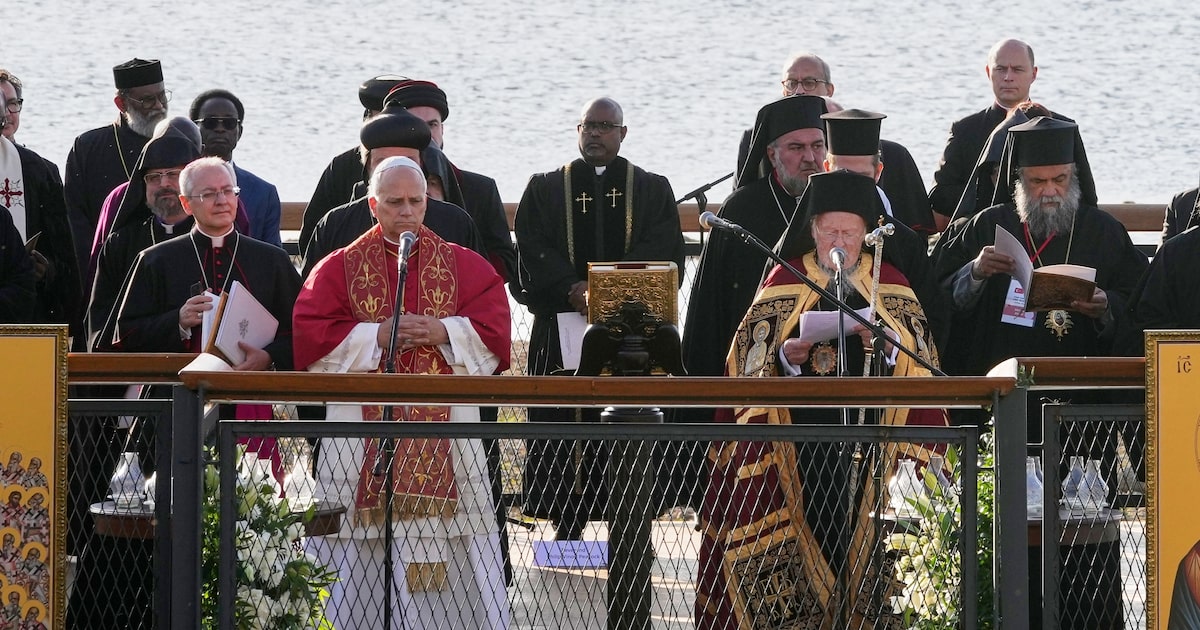

On Nov. 28, Pope Leo XIV visited Turkey and Lebanon. His purpose, he told reporters before leaving Rome, was simply to draw close to the Christians in those two countries, to pray for Christian unity, and to “proclaim how important peace is throughout the world.”
In many ways, it was just another papal field trip, one among the many that mark modern papacies, filled with all kinds of forgettable ecclesiastical ceremonies and diplomatic courtesies, none of it all that interesting. That is, save for an odd stop on the papal itinerary at a small town called Iznik about 60 miles southeast of Istanbul.
Now leave it to Christians to make global headlines out of gathering around ruins at the bottom of a lake, but that’s exactly why the pope went there, along with the Ecumenical Patriarch, Bartholomew I, and other Catholic, Orthodox and even Protestant leaders. They all gathered in Iznik to commemorate the 1,700th anniversary of the Council of Nicaea. Modern-day Iznik, you see, was ancient Nicaea, the site of the first great ecumenical council in 325.
That’s important because at Nicaea the bishops of that council articulated faith in Christ’s divinity, his full divinity, which as God the Son he shares by nature with God the Father. The bishops of Nicaea declared that Jesus was “consubstantial” with the Father. They were refuting the teachings of a priest named Arius who, although he would have been comfortable enough calling Jesus divine, nonetheless wanted to make a distinction between the created divinity of the Son and the uncreated divinity of the Father. This, without getting too lost in theological weeds, was the heart of the controversy.
And, again without going into too much complexity, this is why Nicaea is such a big deal for Christians still today, because it was at this council where traditional Christian belief that, yes, Christ is God, was articulated with a philosophical precision theretofore unknown in the Christian world.
Now, to be clear, Christians since the beginning had always believed Christ to be God because Christ himself claimed equality with God, but at Nicaea such belief was given its own proper terminology and creed.
And that creed, the Nicene Creed, remains the standard of belief for millions of Christians today. It’s a creed that has been recited each Sunday in the Catholic world for over 1,000 years. That’s why the pope and other leaders were there.
They all stood by the side of the lake because it overlooked the submerged ruins of an ancient church, the Basilica of Saint Neophytos. Ruins had been known to rest just underneath the surface since the 19th century, yet only in 2014, thanks to aerial photography, was the church rediscovered and then properly excavated.
Instantly hailed as one of the most significant archaeological finds in decades, debate quickly arose as to what exactly this church was and what role, if any, it played in the Council of Nicaea. The church and its namesake, Neophytos, certainly pre-date Constantine, but was it in fact the site of any portion of that great council? This is where scholarly arguments, back and forth, begin. And, honestly, too much has likely been lost to history to ever come to any solid conclusions.
But they are not questions about history or archaeology that ultimately matter. Rather, they are the questions about our understanding of power and even politics. That is, embedded in our memory of Nicaea is the notion of a power beyond politics, beyond the nonsense of our age.
The Council of Nicaea was held during a time of great instability, at the end of an age in which the Roman Empire was ruled by no less than four emperors, two major emperors called Augusti and two junior emperors called Caesars, the “Tetrarchy.” The Caesars were supposed to succeed the Augusti, but it rarely worked out that way. It was a terrible way to run an empire, and Constantine put a violent end to it.
One of the ways these emperors established their legitimacy was to claim divinity for themselves. Now emperors had long been acclaimed divine after their deaths, but these latter emperors began to claim divinity while they still lived. Before his conversion, even Constantine did this. Diocletian did it too; he insisted that he be called Kyrios, “Lord.” It was a way, in a very violent and unstable time, to claim for oneself some kind of legitimacy. This, by the way, is why when Christians called Jesus Kyrios it was one of the most subversive things they could’ve said.
And so, what does it mean that Christians would come together and acclaim that Jesus of Nazareth, Son of the Father, is the “one Lord” in whom they believe, “God from God, Light from Light, true God from true God”? Not you, Diocletian, but Jesus. Not even you, Constantine, but Jesus. I am certain that Constantine did not fully grasp the power he was ceding to his new God. Nonetheless, cede such power he did.
What does it mean for Christians today to remember that ancient Nicene claim? Troubled by our unstable politics, by our politicians who talk so foolishly about God, by foolish talk of Christian nationalism, what might it mean to remember that God is “not made” but that he always transcends what we’ve made? What might Pope Leo XIV and those Christians have been remembering, praying by those underwater ruins, but that there is indeed a divinity not subject to the stupidities of the elected and the foolishness of bad preachers?
That maybe there is a God we Americans can’t control?