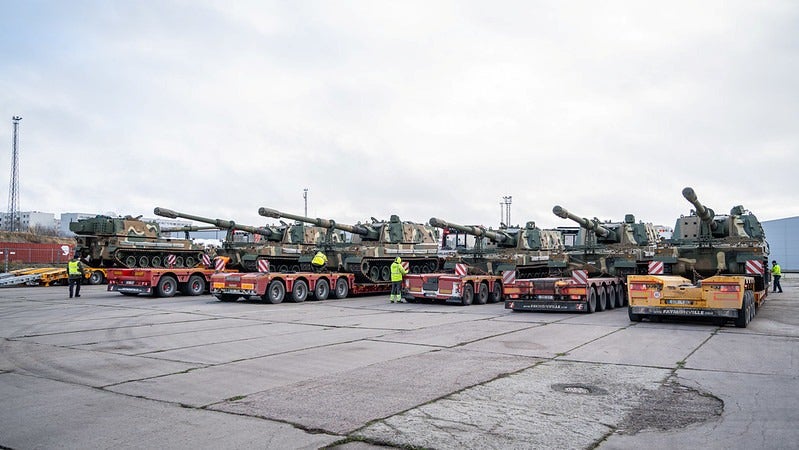
The Estonian Ministry of Defence has announced that six new K9 Thunder self-propelled howitzers have arrived at the Port of South Paldiski. In its statement, the ministry said: “The newly arrived K9 ‘Thunder’ howitzers reflect our long-term commitment to readiness, resilience and cooperation. Estonia invests in security because our freedom is worth defending.”
The delivery marks the first tranche of a procurement contract worth approximately €36 million, signed between Estonia and South Korea’s Hanwha Aerospace in January 2023, and brings the K9 fleet to 30 units. Estonia had previously ordered 24 K9 Thunder systems under three separate contracts valued at roughly €82 million; these mobile artillery pieces are already in service with the 1st and 2nd Infantry Brigades.
Under the 2023 contract, the remaining six units are scheduled to arrive in 2026, enabling the country to achieve its goal of a fully operational artillery battalion composed of 36 K9 Thunder systems.
Before entering formal service with the Estonian Defence Forces, the newly arrived K9 Thunder howitzers will undergo the same comprehensive “Estonization” process applied to earlier batches. The work is carried out by GoCraft, the owner of Estonia’s first private military weapons repair and production facility, and converts the systems into the K9EST Kõu variant.
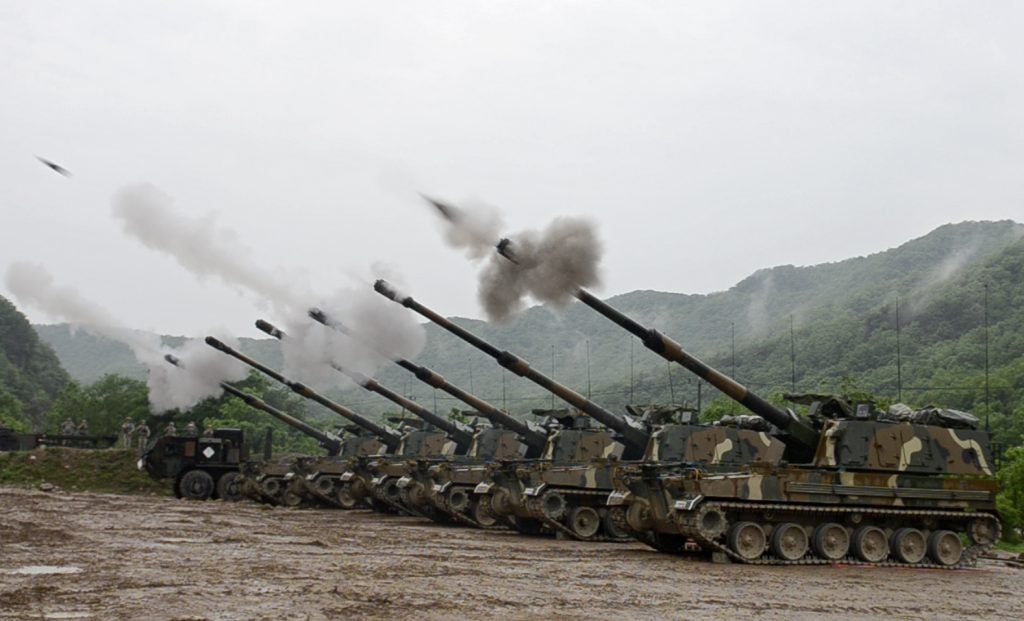 K9s of the ROK’s 631st Field Artillery Battalion, 26th Mechanized Infantry Division Artillery (U.S. Army)
This process includes the installation of NATO-compatible communications and command-and-control systems, new paintwork, replacement of the fire-suppression system, electrical modifications, climate and environmental adaptations, additional stowage for crew equipment, and the integration of various auxiliary components.
Produced by Hanwha Defence, the K9 Thunder is also operated by Norway, Finland and Poland. With a range exceeding 40 km, a 1,000-horsepower MTU diesel engine that delivers strong mobility, and straightforward integration into command-and-control networks, it has become one of the fastest-adopted self-propelled howitzer platforms among NATO partners. The spread of the system has also been shaped by lessons learned from high-intensity fighting in Ukraine and by the broader security concerns posed by Russia.