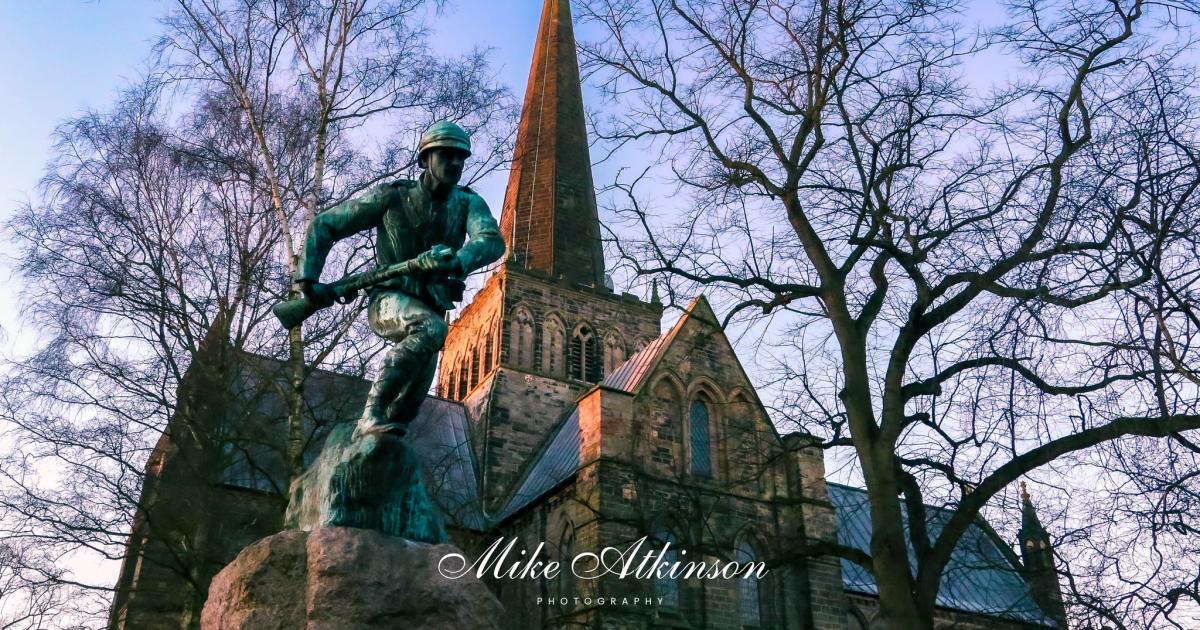
In the grounds of St Cuthbert’s Church, Darlington, stands a bronze statue of a British infantryman advancing with rifle and fixed bayonet.
It was erected in 1905 as a memorial to those from Darlington who served in the South African War, better known as the Boer War, fought between 1899 and 1902.
The statue was commissioned by Darlington Corporation and funded by public subscription.
The total cost was £500, with the work carried out by the Leeds Slate and Quarry Company.
The figure is mounted on a pedestal of Peterhead granite, with steps of Shap granite. Originally placed on St Cuthbert’s Green at the bottom of Tubwell Row, it was later relocated to the churchyard where it remains today.
The unveiling ceremony took place on August 5, 1905, and was a major civic occasion.
Earl Roberts, Baron of Kandahar and Freeman of Darlington, unveiling the South African War Memorial in St Cuthbert’s churchyard on August 5, 1905 (Image: THE NORTHERN ECHO)
Earlier that morning, Field Marshal Lord Roberts, one of Britain’s most distinguished military leaders, processed in an open carriage to Central Hall, now part of the Dolphin Centre. There he was made the first freeman of the borough.
From his place on the stage, Roberts spotted Sergeant Thomas Coates of Yarm Road in the audience. Coates was wearing the star he had been awarded nearly 30 years earlier for marching with Roberts from Kabul to Kandahar during the Second Afghan War.
With the speeches concluded, Roberts marched behind a military band to St Cuthbert’s churchyard, where he unveiled the newly built memorial. The dedication was performed by the Reverend FW Mortimer, vicar of Darlington.
The Darlington and Stockton Times described the scene in vivid terms.
“The scene, with Lord Roberts in his field marshal’s uniform, his breast covered in medals and orders, the members of the corporation in their robes, the volunteers in their uniforms, the members of the fire brigade, and spectators on the grandstands, the venerable church tower, roofs and windows, and filling the streets as far as the eye could reach, and the memorial as the central point, was one of the most impressive ever beheld in Darlington.”
Lord Roberts, who carried out the unveiling, was a figure of national importance.
Born in India in 1832, Frederick Sleigh Roberts had a long military career, serving in campaigns in India and Afghanistan before rising to prominence during the Boer War. His leadership earned him the title Earl Roberts of Kandahar, Pretoria and Waterford.
By 1905 he was a Field Marshal and widely respected as one of the leading soldiers of his generation. His presence gave the Darlington ceremony considerable prestige.
The ceremony concluded with Roberts departing on the 4pm train from Bank Top station.
Recommended reading:
The soldier figure is mounted on a pedestal of Peterhead granite, with steps of Shap granite (Image: MURRAY McLAREN/THE NORTHERN ECHO CAMERA CLUB)
Today, more than 120 years later, the statue remains in St Cuthbert’s churchyard, although the bayonet is no longer present, broken off at some point in the middle of the last century and never replaced.
The front panel includes the inscription: “Dedicated to the memory of brave men of Darlington who volunteered and served in the South African War, 1899–1902.”
The remaining three sides of the pedestal carry the names of those who served and died in the conflict.