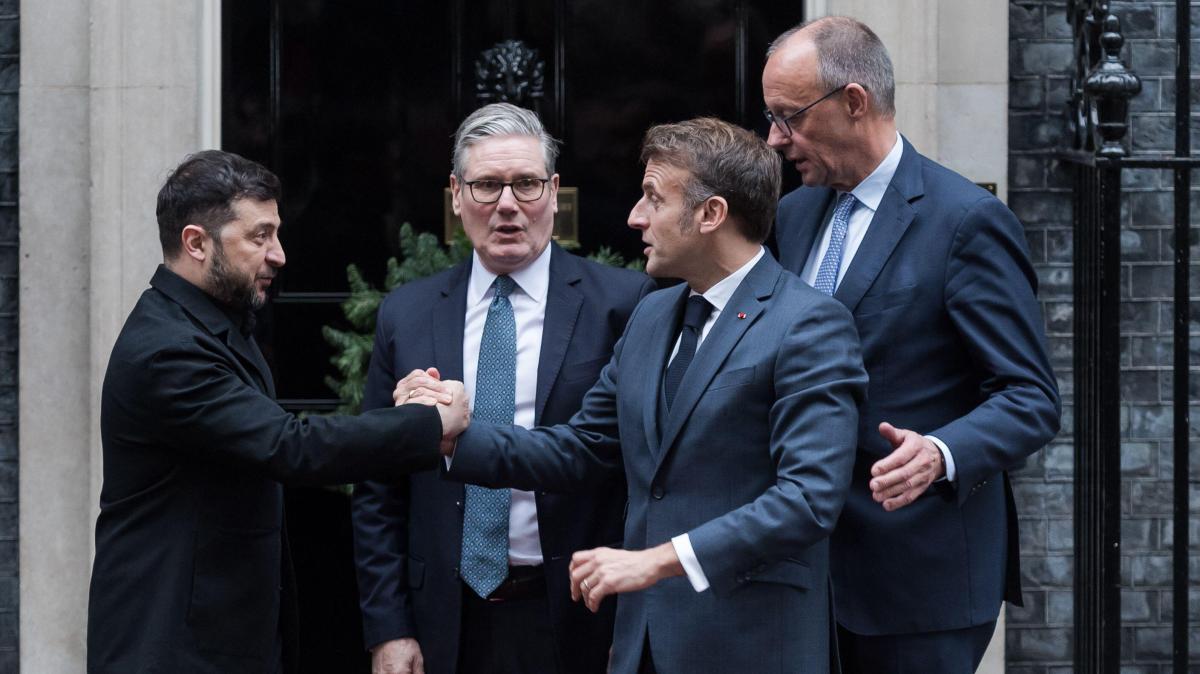
A deal to release up to £100 billion of frozen Russian assets in Europe to aid Ukraine is just days away, Sir Keir Starmer believes, as he said negotiations to end the war had reached a “critical stage”.
The prime minister held talks with President Zelensky on Monday, along with his French and German counterparts, to discuss the latest US peace proposals.
The four men also discussed European efforts to free up the funds, which are frozen in European bank accounts — either to fund Ukraine’s continuing war effort or to pay for the reconstruction of the country in the event of a peace deal.
Afterwards, senior government sources expressed optimism that the deal was close and would be announced either this week or next. The money includes around £8 billion held in UK bank accounts.
The funding is seen as critical leverage for the Europeans and Ukraine in the peace talks being led by President Trump. It would provide a viable source of funding for Ukraine’s war effort for a further two years, increasing pressure on Moscow at a time when European leaders are concerned that President Putin is gaining the upper hand.
The money, which has been frozen since the start of the conflict, is also seen as one of the few cards the Europeans have in the peace negotiations to prevent any deal effectively being imposed on Ukraine by Washington.
However, a deal has so far been held up by Belgium, where the vast majority of the European assets are held. The Belgian government has been opposed to transferring the cash for Ukraine because of fears it could become legally liable for the sum, which is equal to a third of its annual GDP.
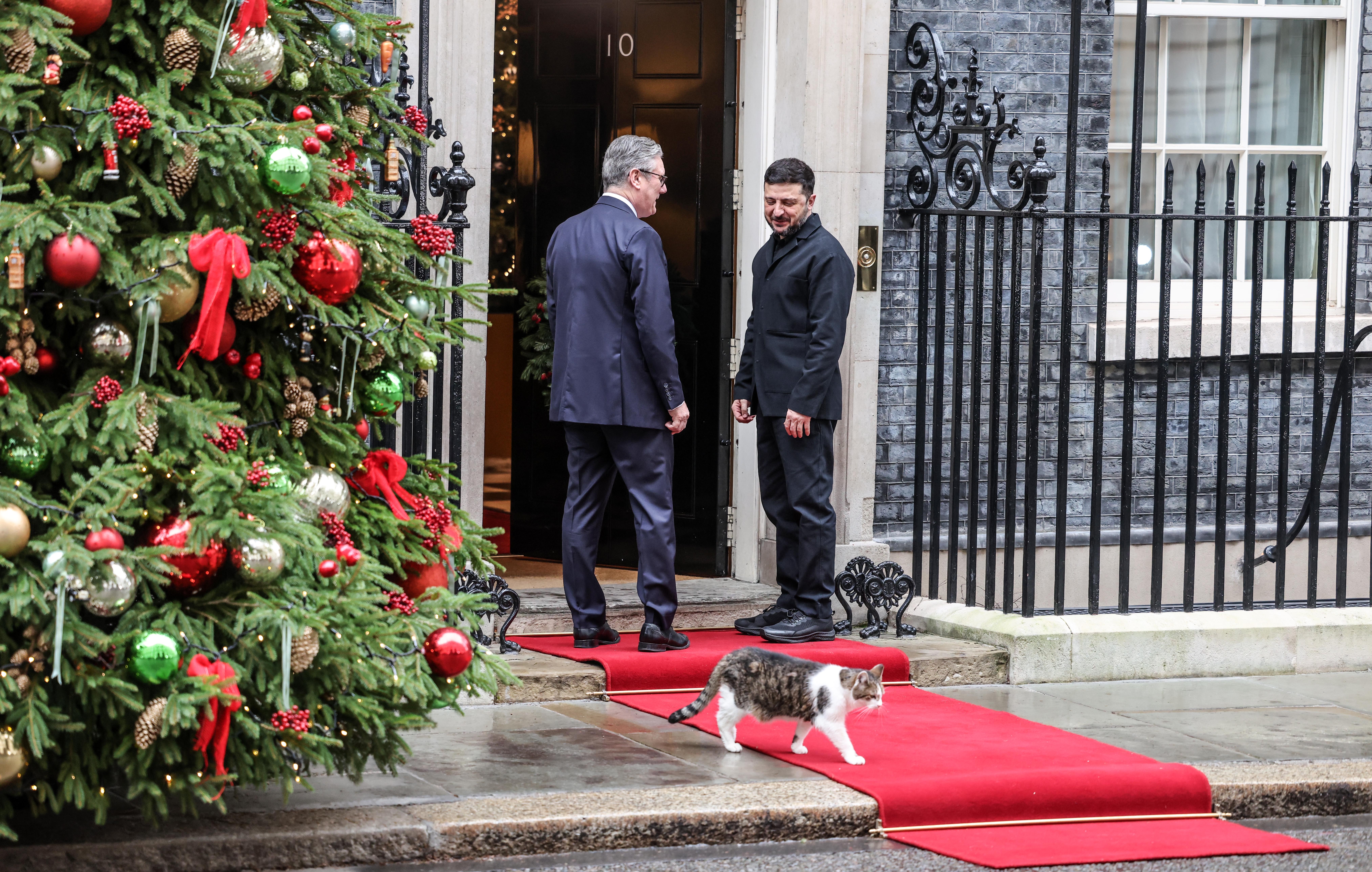
Larry the cat came out to greet the Ukrainian leader
TIMES PHOTOGRAPHER RICHARD POHLE

But a UK government official said: “We are hopeful that a deal is going to be done in the next week or so.”
A Downing Street spokesman said after the meeting that the four leaders had “discussed positive progress made to use immobilised Russian sovereign assets to support Ukraine’s reconstruction”.
Speaking after the meeting, Zelensky suggested that Ukraine and European leaders would send their own counterproposals to the US in the coming days.
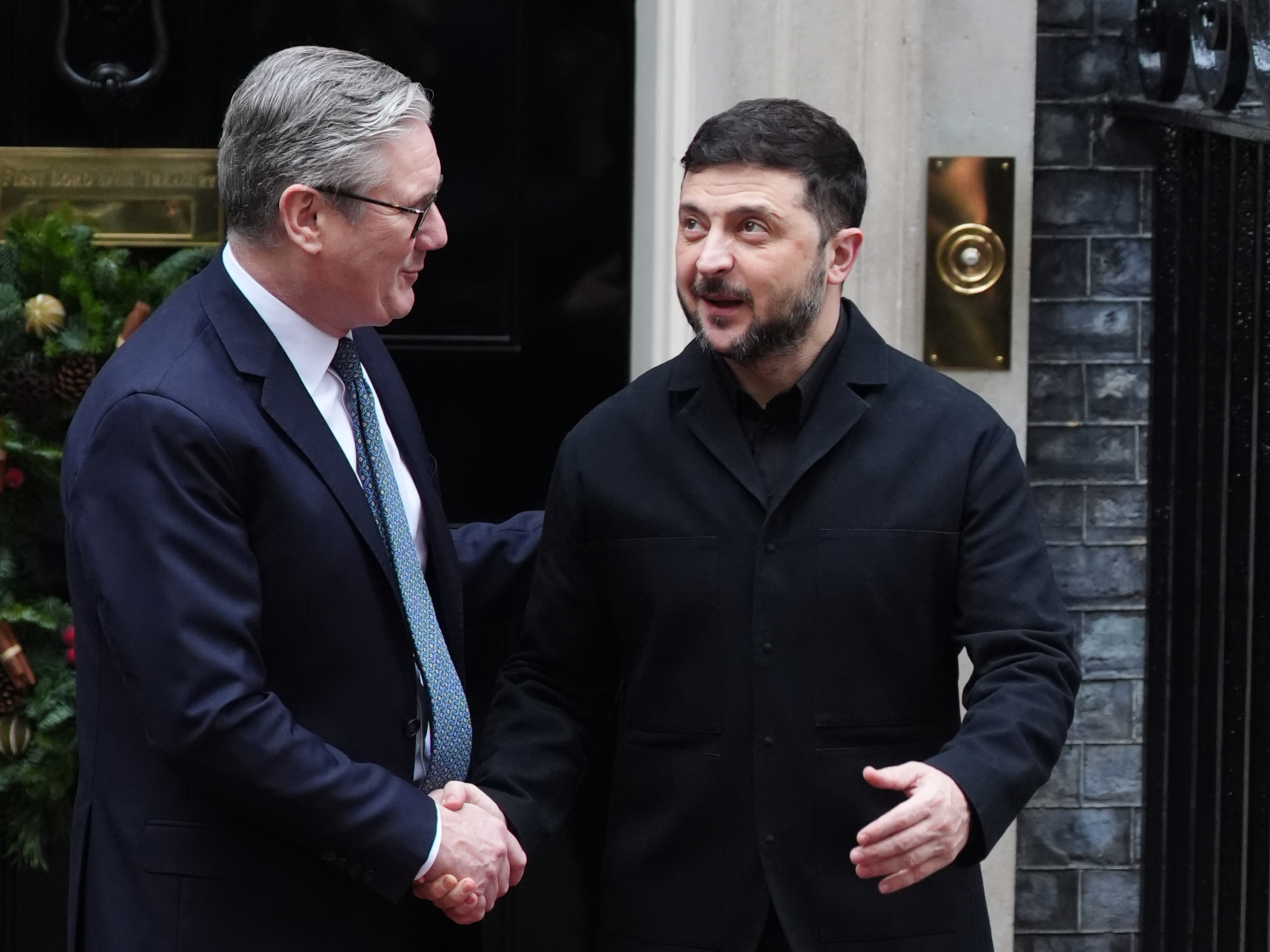
“I think the plan will be ready tomorrow, sometime in the evening,” he said. “I think we will look at it again and send it to the US.”
Speaking before the meeting with Zelensky, President Macron of France and the German chancellor, Friedrich Merz, Starmer said Europe was at a “critical stage in the push for peace”.
He said: “The principles remain the same: we stand with Ukraine, and if there is to be a ceasefire, it needs to be a just and lasting ceasefire.”
Starmer added this would have to involve “hard-edged security guarantees” for Kyiv.
“It is important that we bear in mind that this conflict is nearly four years old, that Russia is the aggressor, and therefore, if there is to be a ceasefire, it needs to be just,” he said.
“We know Putin does not respect agreements that don’t have hard-edged security guarantees behind them.”
The Downing Street spokesman said they expected diplomatic talks to “intensify” in the coming days, adding that the current US-brokered proposals represented the “furthest we’ve got [towards peace] in four years”.
“It’s self-evident that things have stepped up,” they said. “You’ve seen discussions between both the Ukrainians and US over the weekend, and those efforts are significant to bring peace to Ukraine.

A railway station that was damaged by shelling in Fastiv, southwest of Kyiv, at the weekend
IHOR KUZNIETSOV/GETTY IMAGES

Another building in Fastiv suffered damage
VALENTYN OGIRENKO/REUTERS
“The meeting today is further evidence of the desire to make further progress in this area and you’ll continue to see those diplomatic efforts intensify over the coming days.”
On Monday evening Zelensky met Ursula von der Leyen, president of the European Commission, and Mark Rutte, secretary-general of Nato, in Brussels. Writing on Telegram, he described the meeting as “good and productive”, adding that “we are acting in a co-ordinated and constructive manner”. On Tuesday he is expected to meet Giorgia Meloni, the Italian prime minister.
Downing Street said Starmer had asked his national security adviser, Jonathan Powell, to engage with his counterparts on both sides of the Atlantic to “continue discussions” over the tentative peace agreement.
Macron, meanwhile, insisted Ukraine’s allies had “a lot of cards” in the negotiations.
He pointed to the funding of equipment and arms for Ukraine, the Ukrainian resistance and the economic impact of sanctions imposed by the US and Europe on Russia as positive signs.
“Now I think the main issue is the convergence between our common positions — Europeans and Ukrainians and the US — to finalise these peace negotiations and re-engage in a new phase that means the best possible conditions for Ukraine, for the Europeans, and for collective security,” he said.
Merz said he was “sceptical” about some details in documents released by the US. But he added: “We have to talk about it. That’s why we are here. The coming days could be a decisive time for all of us.”
US and Ukrainian negotiators completed three days of talks on Saturday aimed at trying to narrow differences on the US administration’s peace proposal.
Zelensky said on Telegram that talks had been “substantive”.
A sticking point in the plan is the suggestion that Kyiv must cede control of the Donbas region of eastern Ukraine to Russia, which illegally occupies most but not all of the territory. Ukraine and its European allies have balked at the idea of handing over land.
In an exchange with reporters on Sunday night, Trump appeared frustrated with Zelensky, claiming the Ukrainian leader “hasn’t yet read the proposal”.
“Russia is, I believe, fine with it, but I’m not sure that Zelensky’s fine with it,” Trump said in Washington. “His people love it, but he hasn’t read it.”
On Monday, Trump appeared to suggest European countries were “impotent”.
The president posted a link on Truth Social to an opinion piece by the New York Post entitled “Impotent Europeans can only fume as Trump rightly sidelines them from Ukraine deal”.