LONGVIEW – The best way to solve the problem of having “orphaned” oil wells is to find someone to adopt and repurpose them, said a candidate for the state agency regulating the oil and gas industry.
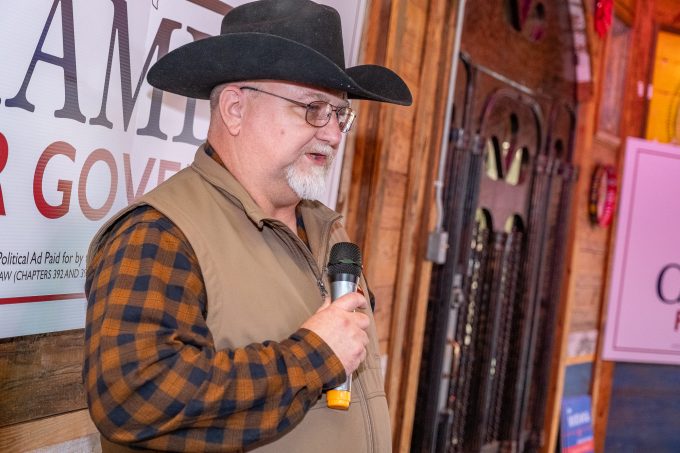
James Matlock, a Republican candidate for a seat on the Railroad Commission of Texas, told East Texas Republicans this past week that he’ll work with oilfield operators willing to continue producing or find new uses for thousands of defunct oil wells that otherwise will have to be plugged using state money – and will otherwise remain environmental hazards. He’ll also advocate for recycling oilfield wastewater and other changes to help the industry and the environment alike. Matlock will be on the March 3 primary ballot.
“Part of my campaign is Texas first,” he said. “We need to protect our independent producers. We need to make some rule changes that would help them and make it easier for them to adopt some of these orphaned wells.”
Matlock is running against incumbent railroad commissioner Jim Wright, who has served on the commission since 2021. Matlock spoke to dozens of people during a forum hosted by the Republican Party of Harrison County at the Jalapeno Tree in Longview.
Matlock began his career in the oil and gas industry in 2005 driving trucks, then transitioned to well completion and saltwater disposal jobs. He’s now an oilfield business consultant.
That’s where he learned about the inner workings of the Railroad Commission of Texas and “got tired of having to deal with them,” he said. Sitting commissioners have a “hands-off” approach and believe the oil and gas industry should regulate itself, which Matlock said he takes issue with.
The Railroad Commission of Texas has nothing to do with railroads, though it once did. Now, it’s the state agency responsible for regulating the oil and gas industry, and the agency’s role in solving problems stemming from defunct oil wells is becoming increasingly relevant to the general public and public safety.
Scattered across the oil-rich Lone Star State are nearly 9,000 oil wells that are no longer in use and haven’t been plugged to prevent cancer-causing gasses, toxic saltwater and crude oil from rising to the surface – or contaminating groundwater supplies below, according to railroad commission data reported by the Texas Tribune. The process of plugging a well generally involves filling the hole in the ground with cement and other materials.
It’s the Railroad Commission of Texas’ job to plug so-called “orphaned” wells. They get their name because they’re no longer being operated, and oftentimes, the last company to operate the well has gone bankrupt and doesn’t have the money to plug it. Those wells become wards of the state, with the railroad commission spending tens of thousands of dollars or more to plug each well.
Matlock said he has been working with startup oil companies interested in taking over the operations of the state’s so-called “orphaned” wells.
Matlock said he believes finding companies willing to continue producing oil and gas from those wells – or repurpose those wells to capture other substances such as plutonium, lithium or geothermal energy – is better than spending state funds plugging them.
Oil wells plugs also can fail, allowing the same toxic substances to flow to the surface or contaminate aquifers. In some cases, homes and businesses have been built on top of plugged oil wells, and when those plugs fail, liquids and gasses have come bubbling up into structures.
“A lot of these wells still have a lot of life to them,” Matlock said. “They could plug them, but it’s a lot better if they belong to somebody and make people check on the integrity of the well.”
Matlock said the railroad commission should loosen restrictions on the adoption of orphaned oil wells.
The Nacogdoches resident also advocates for recycling oilfield wastewater. Typically, water used during hydraulic fracturing (called “fracking”) is reinjected into the ground at injection wells, also called disposal wells. Environmental advocates fear that the injection of toxic water back into the ground could contaminate aquifers.
Matlock previously worked in the injection well business, and he advocates for repurposing and recycling wastewater for irrigation and other oilfield purposes. Of course, that water must be handled properly, Matlock said. It contains lithium, uranium, plutonium and other harmful – but potentially useful – substances. He’s seen how contaminated water used for irrigation purposes can do more harm than good.
“We need to make sure that we’re testing the water before it’s used for irrigation purposes,” he said.
Matlock also said he’s concerned about allowing Chinese companies to drill for and purchase Texas oil and gas.
He also wants oil producers to capture natural gas that is produced as a byproduct of drilling for oil. Oftentimes, natural gas is burned or “flared” rather than being captured and sold, wasting a valuable resource. It could be used instead to power generators that produce electricity, he said.
Matlock addressed a few issues that are specific to East Texas, the first being controversy surrounding a wastewater injection well near Waskom owned by McBride Operating. East Texans have raised concerns about the railroad commission’s decision to allow the facility to operate despite having roughly 70 violations. Residents fear the facility could contaminate groundwater.
Matlock said he wouldn’t have voted to grant the permit renewal for the facility, but his opponent did.
“We need to make sure that our aquifers and our properties are taken care of,” Matlock said. “We need to make sure that we’re protecting the people first.”
He also said the proposed Marvin Nichols Reservoir in Northeast Texas could become an “environmental disaster” because of the number of plugged oil wells that would be beneath it. If those plugs failed, toxic substances could bubble up into the water above, which would be piped to Dallas.
The weight of water in the proposed 66,000-acre reservoir could force some well plugs to fail, Matlock said. Many were plugged in the 1940s and ‘50s, when technology and standards were more primitive.
Matlock said he’s running for office to ensure that farmers, independent landowners and mineral owners have a voice in Austin, “not just big corporations and investment firms,” he said.
“We need somebody that’s going to represent the people in rural communities, where the majority of the [oil and gas] activity is,” he said.
To learn more about his candidacy, visit https://matlock4rrc.com/.