Latvia’s Ministry of Defence has published a so-called ‘White Book’ (Baltā Grāmata) detailing its spending plans for 2026 following the recent passing of the state budget.
With officials keen to stress Latvia’s rapidly-increased defence budget in recent years, many of the facts contained within the pages of the White Book are likely to become familiar in coming months, so we have taken a look and extracted a few of the more memorable ones.
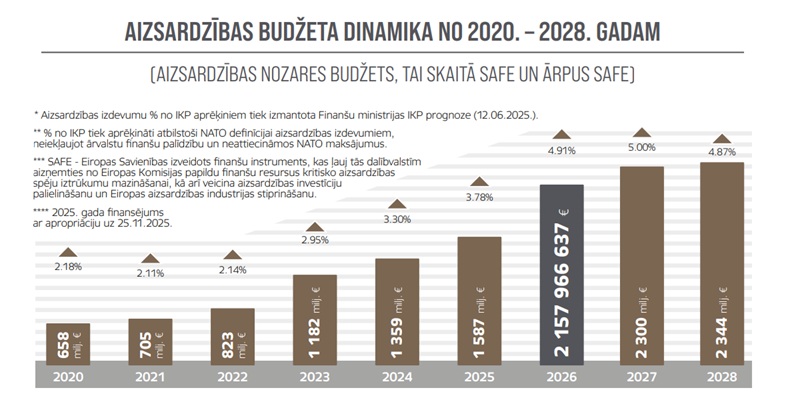
The thing that has already become the most-cited item by officials is the fact that in 2026 Latvia’s defence budget will be “close to” or “heading towards” an amount equivalent 5% of gross domestic product (GDP). The figure is in fact 4.91% – the highest such figure ever – so it seems that talk of being close to 5% is justified. And as previous experience shows, if GDP does not increase by as much as expected, the figure could very easily end up being above the 5% mark.
Regardless, Latvia will consolidate its place as one of NATO’s top defence spenders on a percentage of GDP basis.
The turnaround in Latvia’s defence spending says a lot about the geopolitical realities in the region. Last year it was equivalent to 3.78% of GDP and as recently as 2021, Latvia spent 2.1% of GDP on defence – which at the time was seen as quite a respectable amount with the NATO recommended minimum being 2%. A little more than a decade ago, in 2014, Latvia spent just 0.9% of GDP on defence.
In terms of raw cash, Latvia will spend 2 157 966 637 euros on defence next year – the largest amount ever and the first time it has exceeded 2 billion euros.
Support for Ukraine will remain pegged at an amount equivalent to 0.25% of GDP, and given that Ukraine continues to fight on behalf of all democratic countries against Russia’s genocidal aggression, it this might be argued that this is the best bang-for-your-buck investment in the entire defence budget. It amounts to 110 million euros in 2026.
More than half (53%, 1.14 billion euros) of Latvia’s 2026 defence budget will be spent on enhancing the capabilities of Latvia’s National Armed Forces (NBS) with military hardware, equipment, and drones to the fore. 53% might not seem like a large proportion but in fact is pretty respectable by NATO standards as things like soldiers’ pay and pensions, administration, amortisation and various write-offs, insurance and other items usually eat up huge chunks of military budgets.
Among the big-ticket items are fighting vehicle platforms (303 million euros), air defence systems (200 million euros), munitions and equipment (181 million euros), and indirect fire support – mortars, missiles, howitzers etc. – (159 million euros).
Reinforcement of the eastern borders with Russia and Belarus will add another 55 million euros and drones will cost 50 million euros. Strengthening Latvia’s sea border by means of surface-to surface rocket systems and anti-mining measures adds a further 22 million euros to the bill.
Among the less glamorous but no less necessary contributions are military wages (386 million euros), pensions (23 million euros), cartographic and geodesic services (10 million euros), and costs relating to the NBS’ real estate and buildings (184 million euros). Separate from that is a 2 million contribution to operate the Latvian War Museum and its archives.
Speaking at a press conference (below) to mark the publication of the White Book, Defence Minister Andris Sprūds (Progressives) said significant spending was necessary now to ensure stability in the future. He repeatedly stated that publication of this second ‘White Book’ would help to ensure “maximum accountability” and transparency, following its debut last year.
If you would like to read the full document yourself, you’ll find it here.
Select text and press Ctrl+Enter to send a suggested correction to the editor
Select text and press Report a mistake to send a suggested correction to the editor
Tell us about a mistake