Editor’s note: Writer Sasha Abramsky, who wrote a
photo essay on Sacramento’s Afghan community
last year, checked in with his sources and other community
members for their reactions to the suspension of asylum cases for
Afghans.
The day before Thanksgiving, a 29-year-old man named Rahmanullah Lakanwal shot two National
Guard members from West Virginia who were involved in the
Trump-ordered military patrol of Washington, D.C. Both guard
members were critically injured; one, Sarah Beckstrom, died of
her injuries shortly after.
Lakanwal had reportedly
worked with the
CIA during the
United States’ 20-year engagement in Afghanistan. He was allowed
into the U.S. in 2021 after the Taliban regained control in the
country and received asylum status in the early
months of the Trump presidency.
In the immediate aftermath of
the killing, allpending asylum cases were put on hold. All
Afghans trying to get visas to come into the U.S. were told their
visa applications would not be processed. All immigration and
green card hearings for residents of 19 countries put on a
“travel ban” list were cancelled, and the administration
announced it would re-examine all asylum, green card and other
visa statuses gained by Afghans living in the U.S. since
2021.
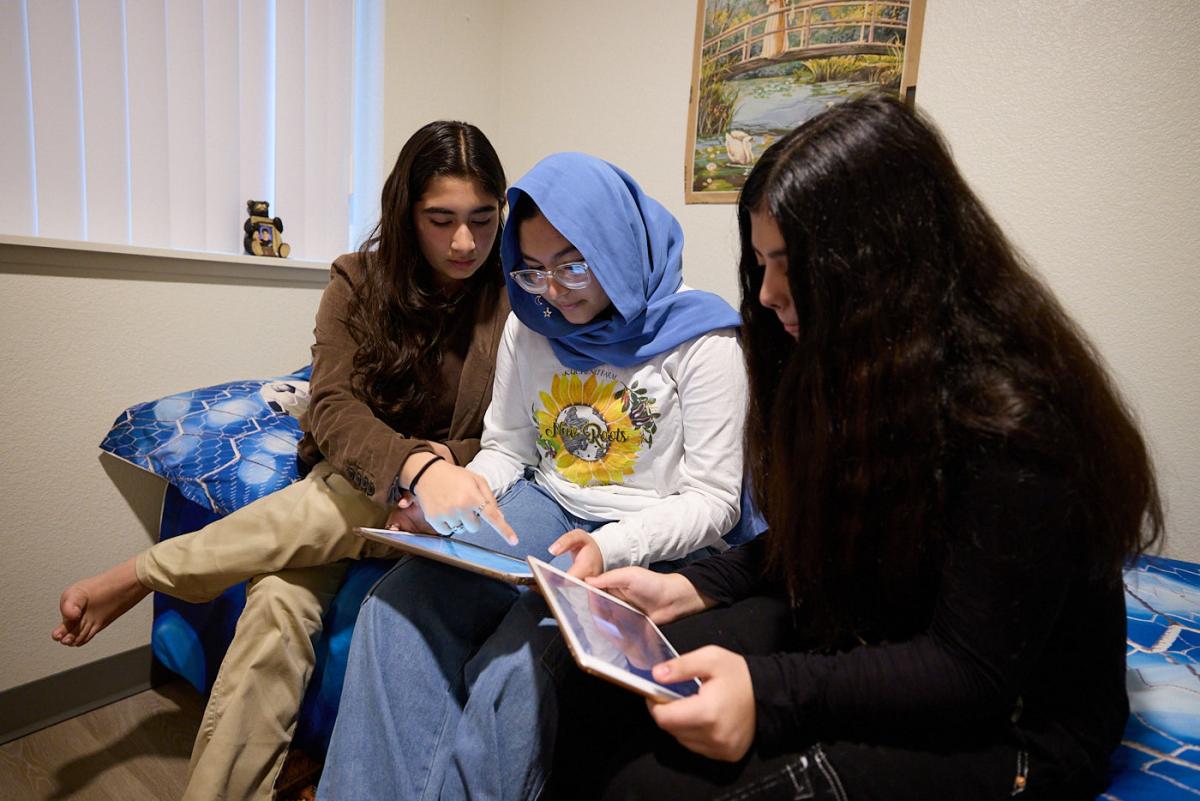
Middle school girls, including Maryam (center), daughter of
Afghan artist Aziz Tokhi, study at home in Sacramento.
Overnight, hundreds of
thousands of men, women, and children had their status thrown
into jeopardy. Thousands of them live in the Sacramento region,
one of the top relocation destinations for Afghans and home to
the country’s largest Afghan American community, according to
the
Migration Policy
Institute. Many of
the adults who have fought with, or otherwise aided, the U.S. and
its allies in Afghanistan are at risk of torture or execution
should they be returned to that country.
“It shouldn’t be generalized,”
says Zaki Raihan, owner of the Lapis Grill, a Carmichael
restaurant that serves Afghan cuisine. “In every nation, every
country, there are people with mental issues. … We should not
associate that with a religion, a tribe, a nationality.” Raihan
says that he, personally, isn’t scared, but he increasingly
worries that “we live in a country where we are dealing with ICE.
They assume everyone and every immigrant are bad people.”

Zaki Rahain works in the food truck associated with his
Carmichael restaurant, Lapis Grill.
Farzana Karimi, a woman who
came to the U.S. on a special immigrant visa after working with
U.S. forces for five years, and who now has U.S. citizenship,
agrees with this sentiment. “The person who commits the crime is
solely responsible for it; not his family, community, ethnicity,
language group, religion. Personal responsibility is one of the
central pillars of justice systems around the world,” she
says.
Several other Sacramento-area
Afghans spoken to for this article didn’t want their names used.
“There is a lot of fear and anxiety, and a greater sense of
collective punishment by the government toward the Afghan
community,” one man said. “This community helped the U.S. in
their war in Afghanistan. That’s why they’re here. In Sacramento,
the families are fearful to go outside. It’s difficult to take
their children to the park.”
The suspension of asylum
processing “is a major blow to the community. They feel betrayed
by the administration,” he continued. “I have family members
here, my kids, siblings with asylum cases pending. There’s
uncertainty here for people who have applied for asylum. And
people with green cards and approved asylum cases are afraid of
being reevaluated and deported.”

Abdul Basir, a lawyer now helping fellow Afghans resettle in
Sacramento, helps a boy choose a donated winter coat.
He told Comstock’s that the
reason his family was in the U.S. was because they had been vocal
in their criticism of what the Taliban was doing, including the
group’s abysmal human rights record and removal of girls’ access
to education. “Yesterday,” he says, “they hanged a person in
public. That’s the situation in Afghanistan — especially for
people who backed the U.S.” And, now, he felt, the net was
closing in in the U.S. as well.
“You cannot do anything. If
you raise your voice, you’ll be labeled by the administration.
It’s a very terrible situation to be in,” he says. “I love
America. I have been here for the last 10 years. My kids go to
school, my wife to college. I have a job. A community should not
be punished for an individual’s act.”
Another local Afghan-born
resident, who worked with U.S. forces in a psych-ops task force
in Afghanistan, bitterly reflected on the irony of working to
root out terrorists in Afghanistan only to now be labeled a
potential terrorist and criminal by the current administration
because of the acts of another person.
“This is something unfair,” he
says. “When a person is committing a crime, it is totally and
only a personal event. The government is trying to punish people
collectively. This is, I believe, against humanity. I worked with
U.S. forces, came to this country legally, was vetted by lots of
organizations in Afghanistan. I was polygraphed three times while
working with U.S. forces. I am asking President Trump to not
generalize and single out a whole community.”
–
Subscribe to the
Comstock’s newsletter today.