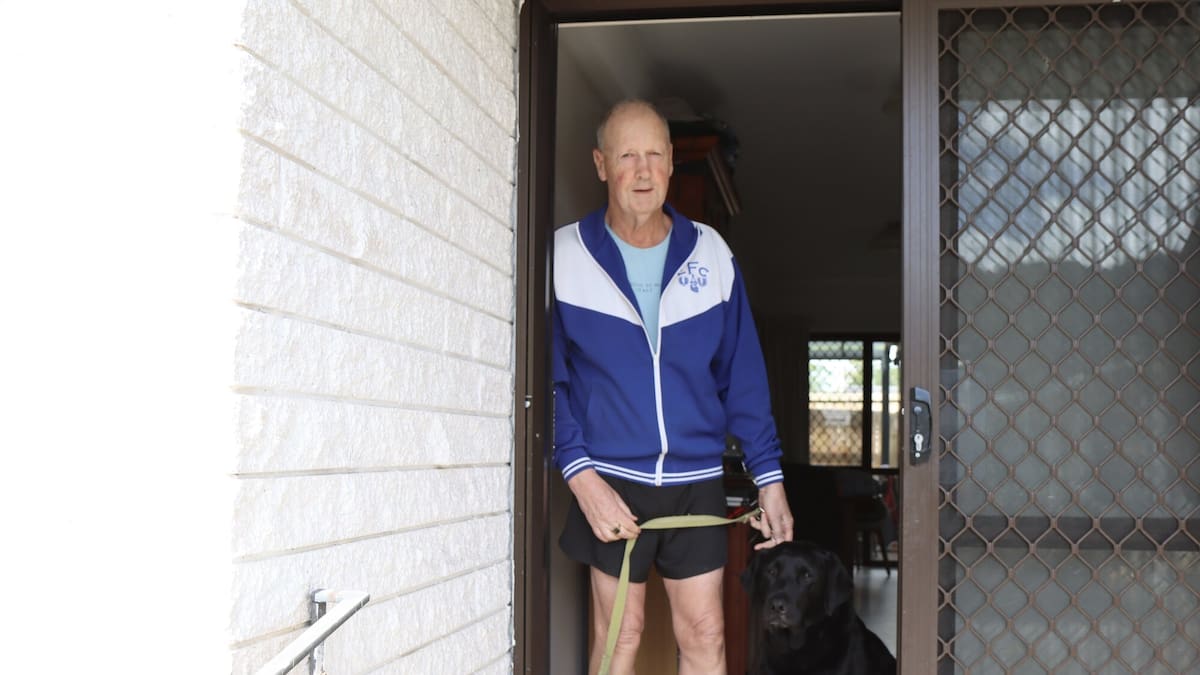
Bradley considered himself one of the lucky ones because as his vision got worse, technology advanced.
For the past 25 years he has used Jaws – Job Access With Speech. The technology is reportedly the world’s most popular screen reader, developed for computer users with vision loss that prevents them from seeing what’s on the screen or being able to navigate a mouse.
Jaws works by converting on-screen text into speech or Braille output. It allows people to navigate the internet, read emails, write documents and use apps without a mouse.
“But in today’s economy, the cost of these things is ridiculous,” Bradley said.
Jaws can set a New Zealander back about $1500 to $2000 for a licence.
“I’m not going to update my Jaws because it’s going to cost three grand. My last update was 2023, so if I want to update to 2025, I still have to pay for the one in between,” Bradley said.
He found accessories were too costly.
An AI-powered GPS, such as StellarTrek, which provides real-time audio guidance and helps people navigate streets and find entrances as well as recognise street addresses, doors and landmarks, fetches about $2500.
There are free apps on a mobile phone but Bradley said using them is not as simple as some people may think.
“They’re a bit finicky,” he said. “Because you’ve got to open your phone, get the app out and all that sort of thing that isn’t that easy if you can’t see.”
To give an idea of what he experiences, he once asked some people to close their eyes then move their mouse around on their screen. He gave them 30 seconds to figure out where on the screen their mouse was once it had moved.
They couldn’t do it.
“I said, well, now you know what I am dealing with as a mouse is not used at all and that’s where Jaws comes in but again the price makes it difficult for some,” Bradley said.
He considered himself fortunate in that his former workplace, Inland Revenue, had paid for much of the assistive technology he used.
He worked for the government department for nearly 40 years, which included 25 years in a PSA role as an elected representative. He retired at 67.
Bradley acknowledged his experience was not the case across the board.
Employment barriers made affordability harder.
Blind Low Vision NZ reported 51% of its working-age members were without a job and 74% of its youth clients have never had a part-time or summer job.
“Technology’s huge, obviously,” Bradley said. “If you have a child that has a disability, to give that child in today’s world a real crack, they’ve got to have access to that technology.”
Some help with funding was available but he believed the price bracket was too high for many people and would leave those in need behind.
The costs added an extra barrier when life could be hard enough for those with low vision, for whom simple tasks were often more difficult.
Bradley gave an example of a time when he went to purchase a new phone.
“I got to the counter and, for whatever reason, had to produce ID.”
Bradley, standing with his guide dog Casper, told the worker he didn’t have any.
“And she said, ‘Haven’t you got a driver’s licence?’ The guy behind me, he just started to laugh.”
Bradley told her he didn’t drive.
“She said, ‘Oh, well, do you have a gun licence?’ And I had to really bite my tongue.”
The problem of financial barriers to technology was shared as part of Blind Low Vision NZ’s efforts to highlight the inequities faced by the 183,000 New Zealanders who are blind, have low vision or have both significant hearing and vision loss.
Other hurdles to equity listed by the organisation were taxis that cost more than public transport, workplace bias, inaccessible recruitment systems and myths about cost or productivity.
Blind Low Vision NZ reported 75% of working-age disabled New Zealanders required no additional support or equipment from their employer to do their job.
Medical services were said to be difficult to access.
Blind Low Vision NZ clients told of skipping GP appointments because travel was unaffordable or they delayed treatment because forms and health information weren’t available in formats they could read.
The organisation’s head of fundraising Bernadette Murphy acknowledged the cost-of-living crisis was hard for everyone.
“But when you add inaccessible services, higher transport costs and the price of adaptive technology, New Zealanders who are blind, deafblind, or have low vision are unfairly disadvantaged.”
To donate to Blind Low Vision NZ visit its website blindlowvision.org.nz