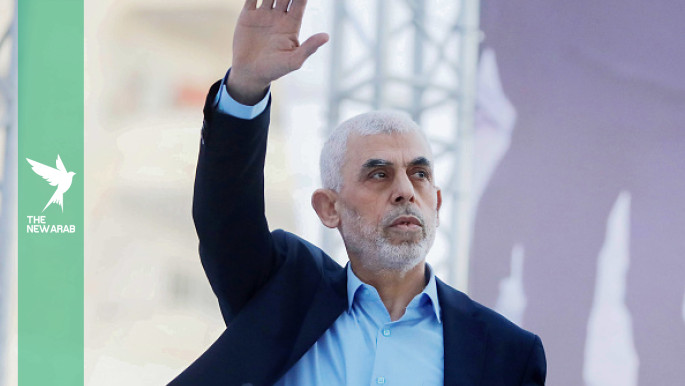
Israel had planned to kill Sinwar before 7 October but did not follow through with it [Getty]
Testimonies from senior Israeli army officers in recent months have revealed that Israel had been preparing to assassinate Hamas leaders Yahya Sinwar and Mohammed Deif long before launching its devastating war on Gaza.
Plans to kill the two leaders were formulated as early as 2022 but never implemented, according to officers cited in internal investigations into Israel’s failures during the 7 October 2023 Hamas-led attacks.
The testimonies were described by the Israeli outlet Yedioth Ahronoth as “among the most sensitive issues of the two years preceding the war”.
Assassination plans were repeatedly pushed by senior officials, but the political leadership had refused to approve any operations during periods of relative calm, the officers alleged.
Israeli media reports also suggested the operation was originally set to be launched against the backdrop of mass anti-government protests over the judicial overhaul.
One testimony said that Israel had intended not only to assassinate Sinwar and Deif but also two to three additional senior Hamas figures, before moving to bomb military sites belonging to the group.
The plan reportedly envisioned a staged escalation that would begin with targeted killings, followed by strikes on intelligence-identified locations, then a ground incursion aimed at “cleaning up” rocket-launching areas.
Further testimonies indicate that the blueprint for inflicting major damage on Hamas and toppling its leadership enjoyed strong backing from many senior officials, including Prime Minister Benjamin Netanyahu.
Yet both the operations and intelligence divisions blocked limited and broad operations throughout the 18 months leading up to 7 October.
Another account reported by Israeli media claims that the army’s Southern Command had urged the assassination of Hamas leaders as early as May 2022, after an attack in the town of Elad in which four Israelis were killed by Palestinians from the occupied West Bank.
Shin Bet reportedly supported the proposal, but it was rejected due to Israel’s long-standing political doctrine of keeping Hamas “contained” in Gaza through periodic escalations rather than decisive action.
Another testimony described a renewed opportunity to strike Hamas leadership during Passover 2023, when the group responded to Israeli provocations with rocket fire.
The plan stalled after then-southern commander Eliezer Toledano met the Chief of Staff Lieutenant General Herzi Halevi, who insisted such assassinations should only proceed when there was a greater chance of locating Deif and Sinwar.
It was also decided that any assassinations should take place during a period of heightened tension so that Israel could justify the resulting escalation.
Israeli media further reported that in early 2023, the Israeli security establishment had shifted its focus toward Lebanon and Iran rather than Gaza, further delaying any action.
Senior Israeli officials acknowledged that it was unclear what was decided behind closed doors and why Israel had continued to allow Hamas to rule in Gaza while shelving military plans against the group.
They cited conflicting assessments, political disputes, and misleading information within Israel’s security establishment.
Sinwar was later killed in Rafah in October last year after a tank shell hit a building where he was sheltering after he was injured in an operation. The Israeli military has also claimed that Deif was killed in a strike on Khan Younis on 13 July.