COLUMBIA — If there was a prevailing theme for attendees of South Carolina’s second-ever Nuclear Summit this week, it was one of optimism.
The ink had all but dried on a $2.7 billion deal struck Dec. 8 to transfer control of Santee Cooper’s unfinished nuclear reactors at V.C. Summer — once a multi-billion dollar boondoggle that collapsed in scandal — to private investment group Brookfield. It now awaits final approval by the state-owned utility’s board of directors.
Tech industry giants and South Carolina manufacturers waxed poetic from the floor of Colonial Life Arena about their ambitions for the state’s continued economic prosperity and a revolution in artificial intelligence technology powered by the Westinghouse-designed AP-1000 nuclear reactors soon-to-be installed at the Jenkinsville-based facility.
Beside the stage, the University of South Carolina’s Mollinari Engineering School displayed renderings of a planned Nuclear Innovation Center on its campus to help support the industry. In the wings, South Carolina state Sen. Tom Davis, a Beaufort Republican who helped spearhead the latest proposal through the halls of power in Columbia, could be overheard speaking of redemption for the project, whose initial failures resulted in Westinghouse’s bankruptcy and the indictment of multiple energy industry executives.
The long nightmare, it seemed, was ending.
Santee Cooper ratepayers who’d been on the hook for the uncompleted project’s costs for years would soon see that obligation erased as private owners assumed the facility’s cost. The regulatory environment had turned in the industry’s favor, with President Donald Trump’s White House and other international partners expected to inject billions of dollars into nuclear energy investments in the coming years. (Nuclear Regulatory Commission chairman David Wright, an Irmo native, was in attendance at the Dec. 9 summit and delivered remarks.)
“We’re going to show that there’s a different way today to build nuclear,” Santee Cooper CEO Jimmy Staton told attendees. “We’re not going to necessarily build nuclear on the on the backs of ratepayers. We’re going to build it in conjunction with the federal government and with folks that know how to manage risk in different ways, and are capable of being able to do that.”
Many spoke of a burgeoning “nuclear renaissance” looming in the United States’ future, with South Carolina — once a case study for the perils of nuclear energy development — now being painted as a potential template for America’s nuclear industry to regain a momentum not seen in more than 40 years.

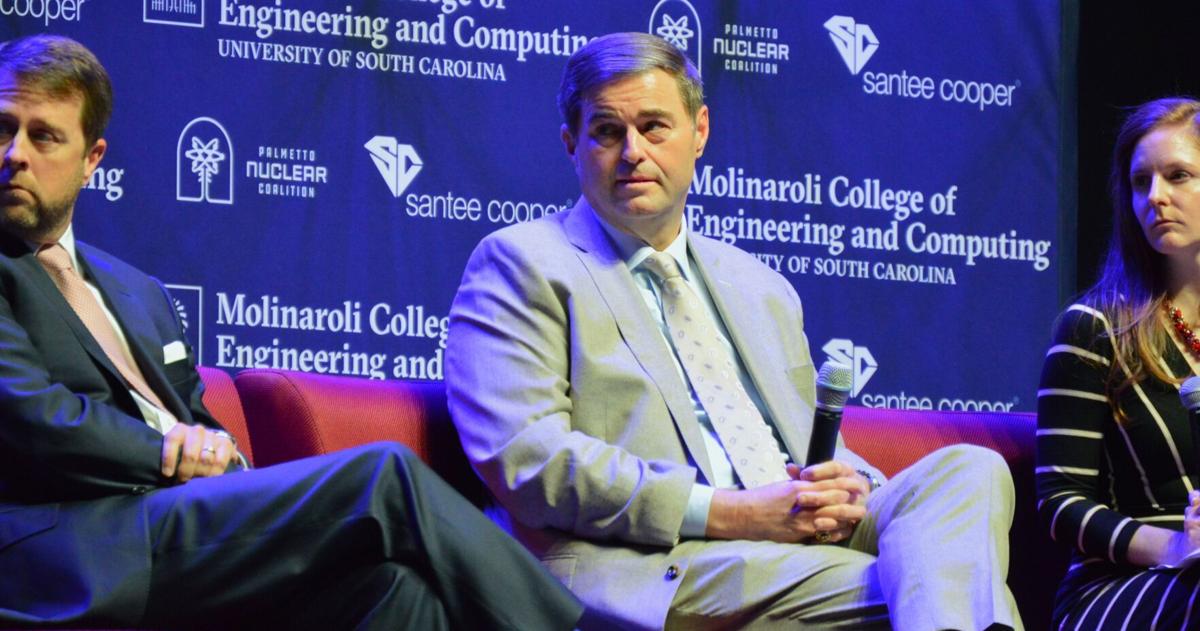
Santee Cooper CEO Jimmy Staton and the chairman of Santee Cooper’s board of directors, Peter McCoy, listen to a fellow panelist during the 2nd annual South Carolina Nuclear Summit in Columbia on Dec. 9, 2025.
Nick Reynolds/Staff
“I work with utility companies around the United States, and I would tell you that all of them are very focused on this project,” John Cogan, a banker with New York City investment firm Centerview Partners, told attendees Dec. 9. “They see Jenkinsville as the rebirth of the nuclear renaissance in the United States, and they see the model that Santee Cooper and Brookfield have created to build this project as the model — the template — that will be used for many more reactors to come.”
The projected benefit to the state would be substantial too, with a report released by Westinghouse during the conference that estimates some 7,300 jobs and $7.3 billion of gross domestic product would be generated for the state during the construction phase of the 2,300 megawatt project, with an additional $1.6 billion and 2,700 jobs supported in the state each year of its 80-year lifetime.
Now that there’s a plan to purchase the facility, they just have to finish building it.
Private investors claim to have the support of both the federal government and foreign partners, like the Japanese, in place as a bulwark to the cost overruns that doomed V.C. Summer 1.0.
There is also significant private interest, with U.S. based tech companies and the federal government now eyeing vast quantities of clean energy as imperative to the nation’s competitiveness in the tech sector and for national security. It’s getting the ball rolling, however, that will be the challenge.
“It’s not hard to build a nuclear power plant, it’s hard to build the first,” Luca Oriani, a Westinghouse executive involved in the development of the AP-1000, said during his Dec. 9 remarks.
Kogan, speaking from the financial side, assured attendees the risk to the public, unlike last time, was minimal.
Because all the financial risk was being assumed by private investors and tech industry giants, there would be “no way, shape or form” Santee Cooper’s customers would face any risk of cost overruns and delays — a sentiment shared with reporters by House Speaker Murrell Smith, R-Sumter, after the conference.
“I think this is the model that we’re going to see implemented across the country to attack this problem,” said Kogan. “And hopefully, if we do eight or 10 of these, and the costs come down, you know, then you can maybe utilities would embark in a more traditional format. But I think this is the winning formula for today.”