
With less than a year to go until the next elections, State Comptroller Matanyahu Englman warned in a speech Tuesday that Israel is unprepared to tackle foreign interference at the ballot box and said such meddling could undermine public confidence in the vote itself.
Englman highlighted what he called an increasing threat of cyberattacks from Iran, amid Tehran’s wide-ranging effort to recruit Israelis for espionage missions inside the country. He called on the government to take swift action to address the problem.
“We must recognize that foreign influences may emerge and affect our democratic process,” said Englman in a speech at Tel Aviv University’s Cyber Week conference. He added that the “purity of Israel’s elections is in danger.”
“During an election year, the threat will intensify and may jeopardize the democratic process — creating chaos on election day, undermining public confidence in the election system, influencing voters and distorting election results, eroding citizens’ trust in the vote count and results, deepening social division, and more,” he warned.
Englman said that his office is currently conducting a review regarding the government’s conduct in the face of foreign influence in the digital realm, and said that “significant deficiencies” have been found.
Get The Times of Israel’s Daily Edition
by email and never miss our top stories
By signing up, you agree to the terms
“Government bodies and the Central Elections Committee must come to their senses and improve their readiness to prevent foreign influence on the elections expected to be held in Israel next year,” he said.

An illustrative photo of a person typing on a keyboard as part of a cyber breach. (Techa Tungateja; iStock by Getty Images)
By law, elections must be held by October 2026, when the current government is due to complete its four-year term. Speaking at the same conference, former prime minister Naftali Bennett vowed to make combating cyberattacks a priority if he returns to office, an effort he called a “Cyber Iron Dome” after Israel’s vaunted missile defense system.
“Imagine that Iran secretly infiltrates Israel with a million cyberattack experts, and they enter all of our systems and wreak havoc in Israel,” Bennett said. “They shut down hospitals, wipe out all of the public’s savings in banks, skew election results.”
If Iran does interfere in elections, it wouldn’t be the first time. In early 2019, ahead of a closely contested election that ended up being the first of several in a row, Iranian hackers allegedly got into the cellphone of Benny Gantz, then the chief rival of Prime Minister Benjamin Netanyahu.
The hackers were not thought to have obtained any classified material from Gantz, a former IDF chief of staff. But the incident happened after the Shin Bet had warned of the danger of foreign interference in elections, after such meddling had been reported in votes in the United States and Europe.

Former prime minister Naftali Bennett speaks during the Israel Information Technology Conference in Ness Ziona, May 5, 2025. (Avshalom Sassoni/Flash90)
Englman’s warning was one of a few notes of caution at the Tel Aviv University conference. Yossi Karadi, head of the National Cyber Directorate, said in his speech that cyberattacks were expected to be a central feature of Israel’s next war.
“We’re quickly getting to the point where the next war will begin and end in the digital realm, without a single tank or without a plane taking off,” he said, dubbing a potential conflict of this sort Israel’s “first cyber war,” according to Channel 12.
Such a scenario could involve, he said, a “digital siege” in which power stations are shut down, communications and transit systems are cut off and, potentially, water systems are compromised.
He said there were 1,200 influence campaigns directed at Israeli citizens and aimed at sowing fear and confusion during the 12-day Israel-Iran war in June, the network reported. He also pointed to a cyberattack on Shamir Medical Center on Yom Kippur, which Israeli authorities have linked to Iran.
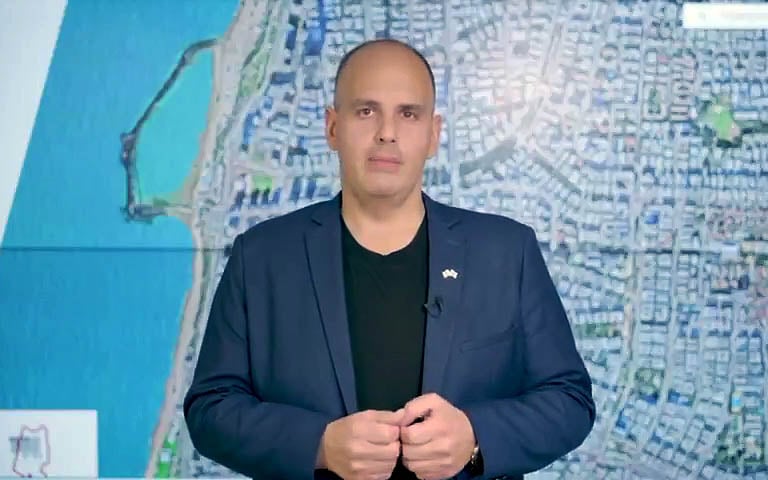
Bat Yam mayor Tzvika Brot cautions residents against maintaining ties with Iranian intelligence agents in a video message released on December 2, 2025. (Screenshot/X)
Since then, Iran appears to have stepped up its recruitment of Israelis as spies. Last week, Bat Yam Mayor Tzvika Brot said Iranian agents have sent texts seeking to draw in millions of Israelis. The Shin Bet is working with local authorities to combat the threat, he said.
“The amazing thing that we’ve seen in recent weeks is that a very shocking number of Israelis… clicked on those links and made contact with the Iranians,” Brot said, adding that “on the fringe, there is a small number of people who are truly Iranian spies, possibly for ideological reasons,” but the “decisive majority” are regular citizens.
In an interview with Channel 12 news last week, Brot claimed that in an esteemed high school in one of the cities that is working with the intelligence agency, a double-digit number of students admitted to having made contact with Iranians online.
You appreciate our journalism

You clearly find our careful reporting valuable, in a time when facts are often distorted and news coverage often lacks context.
Your support is essential to continue our work. We want to continue delivering the professional journalism you value, even as the demands on our newsroom have grown dramatically since October 7.
So today, please consider joining our reader support group, The Times of Israel Community. For as little as $6 a month you’ll become our partners while enjoying The Times of Israel AD-FREE, as well as accessing exclusive content available only to Times of Israel Community members.
Thank you,
David Horovitz, Founding Editor of The Times of Israel
Already a member? Sign in to stop seeing this