WASHINGTON — Defense Secretary Pete Hegseth told congressional leaders Tuesday that he was still weighing whether to release the full video of an attack on an alleged drug boat that killed two survivors, even as he faced intensifying demands from Congress for disclosure.
Hegseth provided a classified briefing for congressional leaders alongside Secretary of State Marco Rubio and other top national security officials. Senate Democratic leader Chuck Schumer said that when he asked the Defense secretary whether he would allow every member of Congress to view the video of the attack from September, Hegseth’s response was: “We have to study it.”
But lawmakers are demanding a full accounting from the Department of Defense on the strikes that killed two people who were clinging to the wreckage of an initial strike. Legal experts say that action may have violated the laws governing the use of deadly military force. The situation has awakened the Republican-controlled Congress to its oversight role after months of frustration about the trickle of information from the Pentagon.
Schumer described the briefing as “very unsatisfying” and added that “every member of Congress — so many members of Congress, Democrats and Republicans — had a right to see it, wanted to see it, and should see it.”
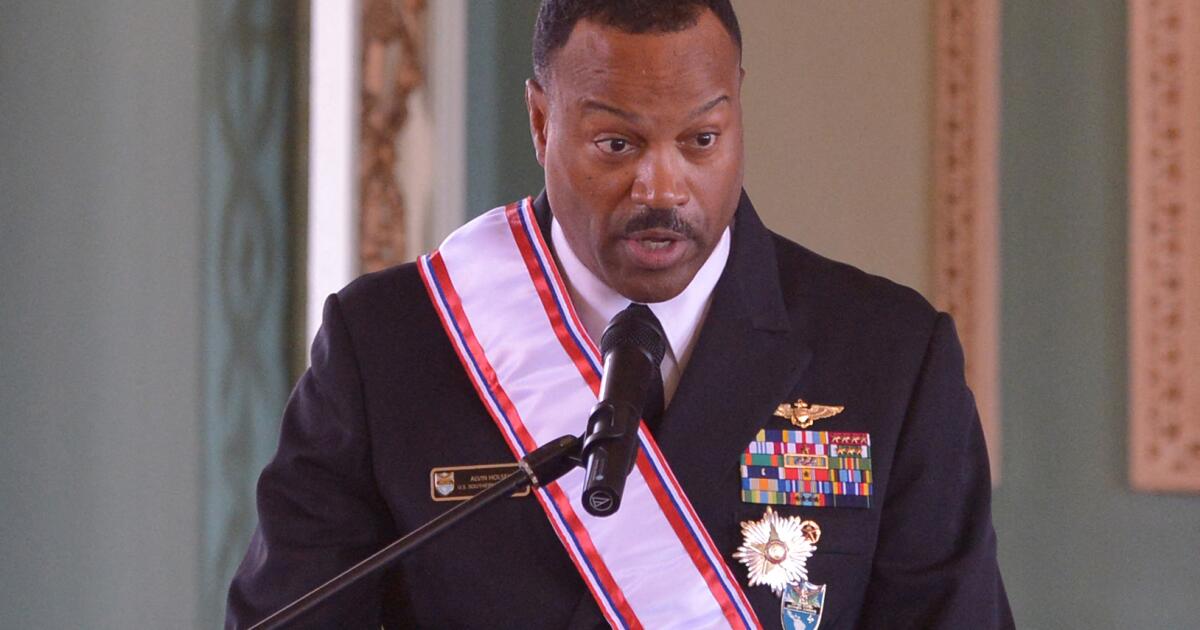
Separately Tuesday, the U.S. Navy admiral who is retiring early from command of the campaign to destroy vessels allegedly carrying drugs near Venezuela spoke to key lawmakers overseeing the U.S. military. The classified video call between Adm. Alvin Holsey, who will be retiring from U.S. Southern Command in the coming days, and the GOP chair and ranking Democrat of the Senate Armed Services Committee represented another determined step by lawmakers to get answers about the operation.
Sen. Roger Wicker of Mississippi, the Republican chair of the Senate Armed Services Committee, declined to discuss the specifics of the call but described Holsey as a “great public servant.” He also said that the Pentagon is weighing whether releasing the video would disclose classified information.
In its annual defense authorization bill, which was crafted by both Republicans and Democrats, Congress is demanding that the Pentagon turn over unedited video of the strikes, as well as the orders authorizing the attacks. The legislation threatens to withhold a quarter of Hegseth’s travel budget if he refuses.
“There is a growing demand that everyone get a right in the Senate to see it,” said Sen. Jack Reed, the top Democrat on the Senate Armed Services Committee.
He added that Holsey answered the senators’ questions and they “got a little more clarity” but also said that “there are still many questions to be answered.” Reed later added that Holsey did not give a reason for his retirement other than saying it was a personal decision.
Congress presses for more information
What lawmakers learn from Holsey could shed new light on the purpose and parameters of President Trump’s campaign, which has struck 22 boats and killed at least 87 people since it started in September. Trump has also been making threats against Venezuelan President Nicolás Maduro, sending a fleet of warships near the South American country, including the largest U.S. aircraft carrier.
Holsey became the leader of U.S. Southern Command just over one year ago, but in October Hegseth announced that Holsey would be retiring early from his post. As commander of U.S. forces in the region, Holsey oversaw a command structure that has in recent years been mostly focused on building stability and cooperation across much of Latin America.
Trump’s drug boat campaign, however, has added a new, deadly dynamic to its mission. Rather than trying to interdict drug vessels, as forces like the U.S. Coast Guard have traditionally done, the Trump administration asserts that the drugs and drug-smugglers are posing a direct threat to American lives. Officials say they are applying the same rules as the global war on terror to kill drug smugglers.
Republicans have mostly stood behind the overall campaign, but Democrats say that the logic underpinning it is deeply problematic.
“They are using expensive, exquisite American military capabilities to kill people who are the equivalent of corner dealers and not making progress interdicting the trafficking by the cartels,” said Sen. Chris Coons, a Delaware Democrat.
Lawmakers are also questioning what intelligence the military is using to determine whether the boats’ cargo is headed for the U.S. As they have looked closer at the Sept. 2 strike, lawmakers learned that the destroyed boat was heading south at the time of the attack and that military intelligence showed it was headed toward another vessel that was bound for Suriname.
Still, it remains to be seen whether the Republican-controlled Congress will push back on the Trump administration’s campaign.
“I want a full set of data to draw my conclusions from,” said Sen. Thom Tillis, a North Carolina Republican who had demanded accountability after it was revealed that two survivors had been killed.
Trump this week justified the strike by claiming that the two suspected drug smugglers were trying to right part of the boat after it had capsized in the initial attack. However, Adm. Frank “Mitch” Bradley, the special operations commander who ordered the second strike, told lawmakers in a closed-door briefing last week that he ordered the second strike to ensure that the cocaine in the boat could not be picked up later by cartel members.
War powers resolution vote
A group of senators — three Democrats and one Republican — is also preparing to force a vote on legislation as soon as next week that would halt Trump’s ability to use military force against Venezuela directly without congressional approval.
Sen. Tim Kaine, a Virginia Democrat who is sponsoring the legislation, said that after reading the classified legal opinion from the Department of Justice that underpins boat strikes, he had “deep skepticism about the legality of any of these operations.”
The senators have already tried unsuccessfully to pass a similar resolution, but almost all Republicans voted against it. However, the senators say there is renewed interest from GOP lawmakers amid the Trump administration’s increasing threats against Venezuela, as well as scrutiny on the strike that killed survivors.
Sen. Rand Paul, the Kentucky Republican who is also sponsoring the legislation, called for a public hearing from Holsey. He argued that the laws governing when it is legal to fire on shipwrecked troops also protect American soldiers who are caught in the same situation.
“These follow on strikes of people who are wounded in the ocean is really against our code of military justice,” he said. “They are illegal.”
Groves and Mascaro write for the Associated Press. AP reporter Ben Finley contributed to this report.